I had a call from the BBC this morning inviting me on to the Radio Scotland Morning Call phone-in with Louise White. The subject was the study blogged by Forest here, by someone at Heriot Watt University here in Edinburgh. It claimed that passive smoke exposure 'in particular in more than two places of exposure was significantly associated with risks of stroke, angina, heart attack, abnormal heart rhythms ... impacted on sleep problems, self-recognition, making decisions, self-confidence, under strain constantly, depressed and happiness in never smokers' (this from the abstract).
Ouch. And to wind up, 'elimination of indoor passive smoking from different sources should still be a focus in future health programs'.
This is surely a case of torturing the figures till their pips squeak. None of the issues in question, including depression and lack of self-esteem, can be attributed to causes as vague as secondary smoke exposure (especially if you experience it in two friends homes in the space of what, a day? a week?)
I wasn't called on to the show until very nearly the end of the discussion, just before 9.30 a.m.. Professor Linda Bauld was on and a medic arguing for further restrictions, and Dr Stuart Waiton from Taking Liberties against it. Stuart pointed out that the new research that comes out all the time always tends to suggest that people's liberties should be further restricted for their own good. Professor Bauld didn't think that legislation would be the answer, but she did want to use what I can only describe as pester power. (It's not enough to open the window or even to go out of the door, you have to go right outside, close the door, etc. I am only surprised that third-hand smoke wasn't mentioned). The medic acknowledged that he would not want to use extra powers to interfere if he thought people were smoking at home in front of kids, but somehow did want something to be done. Callers had varying viewpoints, I think most felt that further powers would not be enforceable (by which I think was meant teachers, health visitors and social workers being able to take action of sorts if they suspect kids are exposed to passive smoke).
My objections to all these restrictions are that the other factors in these conditions they talk of are all vague, nothing is being measured, everything is approximate, nothing is ruled out, and we are expected to accept more or less as a matter of faith that tobacco smoke has the same effect as bad air and damp housing.When I did finally get on air I responded to the point made about this 'new research' recommending more restrictions, by commenting on the neverending flow of anti-smoking studies and by pointing to my favourite page on the Cancer Research UK website. It's the one that says that they fund studies that support existing tobacco policy. (Or to be blunt, they are unlikely to fund studies that don't find a significant risk to health from secondary smoke, or any other excuse to tighten restrictions further.)
Then I had the producer on the line thanking me for my time. By the time I remembered to put up the volume again a minute or so later, they had moved on to a discussion about doggie-bags. Seriously I hope that the national broadcasting station in an independent Scotland will offer something a little more heavyweight!
My views were offered as a non-smoker. I did dabble in smoking a little bit in the early days following the smoking ban. But I didn't miss it when I wasn't smoking.
I was also invited on to the show as a campaigner. Campaigning is not one of my strengths, I am more of a desktop warrior, and it's superficial and non-engaging. Other priorities have taken over (work, mostly) and the group on which this blog bases its name has not really functioned effectively for over two years. I now see the whole issue as one caused by too much centralisation of power generally, and certainly not one that can be resolved by people like me taking on tobacco control directly.
Showing posts with label Linda Bauld. Show all posts
Showing posts with label Linda Bauld. Show all posts
Monday, 24 March 2014


Thursday, 6 February 2014
Health, safety, toxicology and hypotheses
Hat tip Junican, see comments. In reply to Linda Bauld.
You can't go far wrong if, whenever you see the word 'may' in science, you dismiss the supposition. Science does not do supposition or superstition. It does hypothesis. Scientific investigations MUST depend upon an initial hypothesis. It would be extremely silly to assume that the hypothesis is true, and act upon it, without confirmation of its truth.
The propositions of Public Health are, at the moment, concerning ecigs, ambivalent, and this is a serious matter. There ought to be no such ambivalence.
The mechanical safety of the machine is not a 'health' matter. It is a 'safety' matter, just as electric kettles are a 'safety' matter. The liquids are also not a 'health' matter. They are a 'toxicology' matter. That is, the danger of trace elements in ecig liquid is a matter for scientists in toxicology to decide, and not the Public Health advocates.
Wednesday, 1 August 2012
From Linda Bauld: the case for plain packaging (UK Smoking Cessation Conference address)
Here's Linda Bauld's spiel.
She sticks fairly closely to the slide show, reproduced below the audio clip.
I thought I would present it here as we are near the end of the consultation period on this (12 August). To me (cynic that I am) it sounds as if she is saying the following:
1. There is no empirical evidence about plain packaging because it is not in place anywhere yet.
2. We have been asked by the government to compile evidence and we have done so using reports of varying quality that somehow combine to make a very strong case.
3. It is quite untrue that our academic report is biased. It is all peer reviewed. We chose all the studies and the government chose us to do the work because of our monopoly of wisdom and experience in this particular area.
4. Branded packs are more attractive than plain ones and this suggests that people will be less inclined to choose plain packs even when they can't choose branded ones. Plain packs are associated with older, less attractive and less popular people in society and the young won't want to be associated with that kind of person (this is what it says in the research!)
5. Young people that our colleagues gave plain cigarettes to were too embarrassed to get them out when out with their smoking friends, and more likely to think about quitting. This is ample evidence that they will actually go on to quit when the law is enacted and their friends are all carrying plain packs around.
6. There is no evidence that the policy will result in further extension of illicit tobacco sales (forgot about point 1, where it says there is no evidence about any aspect of the policy, because it has not been implemented anywhere yet).
For more about peer reviewing see here. It does not prove worth. This whole area of research is led by policy requirements, and peer review is alleged here to be part of this process.
She sticks fairly closely to the slide show, reproduced below the audio clip.
I thought I would present it here as we are near the end of the consultation period on this (12 August). To me (cynic that I am) it sounds as if she is saying the following:
1. There is no empirical evidence about plain packaging because it is not in place anywhere yet.
2. We have been asked by the government to compile evidence and we have done so using reports of varying quality that somehow combine to make a very strong case.
3. It is quite untrue that our academic report is biased. It is all peer reviewed. We chose all the studies and the government chose us to do the work because of our monopoly of wisdom and experience in this particular area.
4. Branded packs are more attractive than plain ones and this suggests that people will be less inclined to choose plain packs even when they can't choose branded ones. Plain packs are associated with older, less attractive and less popular people in society and the young won't want to be associated with that kind of person (this is what it says in the research!)
5. Young people that our colleagues gave plain cigarettes to were too embarrassed to get them out when out with their smoking friends, and more likely to think about quitting. This is ample evidence that they will actually go on to quit when the law is enacted and their friends are all carrying plain packs around.
6. There is no evidence that the policy will result in further extension of illicit tobacco sales (forgot about point 1, where it says there is no evidence about any aspect of the policy, because it has not been implemented anywhere yet).
For more about peer reviewing see here. It does not prove worth. This whole area of research is led by policy requirements, and peer review is alleged here to be part of this process.
Saturday, 7 July 2012
Fact checking charity cautiously debunk's Penny's 26 per cent claims
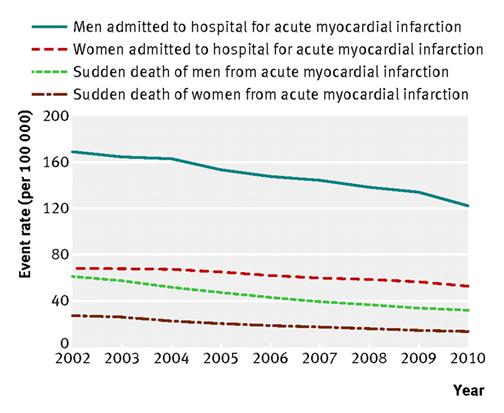
Among the more outrageous things that was claimed in this week's fanfare commemorating five years since the smoking ban was implemented in England was Laurie Penny's claim in the Independent that heart attack admissions had dropped 'as much as' 26 per cent since the ban started. Even Linda Bauld could only come up with a figure of 2.3 per cent for heart reductions in England (a figure too small to show that it has a single cause): 26 per cent was a figure that demands explanation.
The report by independent fact checking organisation Full Fact even provides an illustration:
This should show without any doubt that there is no appreciable difference in heart attack rates in relation to the smoking ban. The reporter declares herself at a loss to understand where Penny's figures have come from (a request from Full Fact had no reply at the time of writing). She then discusses various other heart attack reports, all of them small ('five US cites', etc.) giving results with smoking ban declines of up to 50 per cent, and mentions Linda Bauld's study linked above from the University of Bath. (No evidence is given that larger-scale studies convincingly undermine the smaller ones, by including cities where no drop heart attacks was recorded following the introduction of a smoking ban.)
The conclusion is stated with moderation:
Still, look on the bright side. Yet another body has acknowledged that the 'heart attack miracle' is an unsustainable fiction.
The report by independent fact checking organisation Full Fact even provides an illustration:
 |
| Source |
This should show without any doubt that there is no appreciable difference in heart attack rates in relation to the smoking ban. The reporter declares herself at a loss to understand where Penny's figures have come from (a request from Full Fact had no reply at the time of writing). She then discusses various other heart attack reports, all of them small ('five US cites', etc.) giving results with smoking ban declines of up to 50 per cent, and mentions Linda Bauld's study linked above from the University of Bath. (No evidence is given that larger-scale studies convincingly undermine the smaller ones, by including cities where no drop heart attacks was recorded following the introduction of a smoking ban.)
The conclusion is stated with moderation:
It is very hard to assess the accuracy of Ms Penny’s claim without first knowing her source. The research we have found from the NHS Information Centre shows at most a 22 per cent decline, although this only refers to fatalities. Among all incidents of heart attacks the reduction was a more modest 13 per cent. [emphasis added]Ms Penny's claim is so far from the available evidence that it is hard to escape the conclusion that she has not researched the material properly. This article does properly conclude: 'however it is noticeable that trends don't seem to have changed much since 2002', but then we read:
This suggests that there may be wider social and environmental factors that have also contributed to the fall, and singling out the impact of the smoking ban is a difficult process.Suggests? how about 'shows categorically', Full Fact?
Still, look on the bright side. Yet another body has acknowledged that the 'heart attack miracle' is an unsustainable fiction.
Tuesday, 17 April 2012
Plain packaging moves across the world
In Australia the case opens in court as the tobacco companies defend their intellectual property against the plain packaging laws. The Australian government is confident of victory, arguing that it will not gain directly by confiscating tobacco brand markings.
The legal arguments are beyond me but this link shows that opposition to the plain packaging proposals is shared with many bodies such as the US Chamber of Commerce. The Express has also opposed the policy. This link from Brand Republic gives a number of views including one from its own industry – not heard enough:
Here the government consultation on plain packaging has opened: coordinated by the Department of Health to cover all the legislative assemblies as well as England. (It's worth responding: the EC had to publish responses to its Consultation on revising the Tobacco Products 2001 Directive. The public didn't like its proposals and this showed up in the consultation responses. It also showed that the tobacco company was not alone in opposing an extension to tobacco control. The more embarrassment they get the better.)
Simon Clark says in his blog that Andrew Lansley promised an independent review* of the evidence on plain packaging. I haven't read this review yet, but since it is co-authored by a team including Gerard Hastings, Linda Bauld and Crawfood Moodie (refer to front page of the report for their affiliations), it cannot be described as independent. As Simon says, 'there is not a single marketing, communications or branding expert on the panel'. Perhaps they would have been considered vested interests?
*yes he really did! Jesus, they surpass themselves. 'The Department of Health has ... commissioned an independent academic review of the existing evidence on the effects of plain packaging'. Said independent review is authored by a team of ten people, affiliated with the University of Nottingham, the Cancer Research UK Centre for Tobacco Control Research at the Institute of Social Marketing at Stirling University, and the UK Centre for Tobacco Control Studies. I've said this before: Cancer Research includes in its funding conditions for tobacco-related research the provision that research 'support current UK policy priorities', including plain packaging. How the {censored} does he get off with calling this an independent academic review?
h/tip Simon Clark for the link
The Commonwealth argues that even if big tobacco could prove the government was acquiring their property rights the manufacturers still wouldn't win in court.
That's because the purpose of the plain packaging legislation - namely to improve public health - is within the scope of the Commonwealth's legislative power under the constitution's commerce, trade and external affairs powers.This sounds like a blank cheque book: claim health grounds and you have a legal basis for any action. Even if the result were certain to be as the government claim, would this over-ride the legitimate requirements of traders to be able to legally brand their goods?
The legal arguments are beyond me but this link shows that opposition to the plain packaging proposals is shared with many bodies such as the US Chamber of Commerce. The Express has also opposed the policy. This link from Brand Republic gives a number of views including one from its own industry – not heard enough:
"Just focusing on the connection between branding and smoking behaviour may be a distorted way of looking at the way of branding.
"Branding on pack is about differentiating product and competition on the basis of quality, reputation and price but if all the packs look the same you move very quickly towards a generic commoditised market place and that is typified by price competition.
"It means there is a loss of incentive for companies to invest in quality and reputations because they have no way to communicate that to consumers. While I’m sure the familiar brands will continue, if you were to launch a new product into the market it can only be a price fighting product and if that is a means of reducing prices to consumers then actually it may result in more people smoking rather than less because it becomes a very price sensitive market.
Simon Clark says in his blog that Andrew Lansley promised an independent review* of the evidence on plain packaging. I haven't read this review yet, but since it is co-authored by a team including Gerard Hastings, Linda Bauld and Crawfood Moodie (refer to front page of the report for their affiliations), it cannot be described as independent. As Simon says, 'there is not a single marketing, communications or branding expert on the panel'. Perhaps they would have been considered vested interests?
*yes he really did! Jesus, they surpass themselves. 'The Department of Health has ... commissioned an independent academic review of the existing evidence on the effects of plain packaging'. Said independent review is authored by a team of ten people, affiliated with the University of Nottingham, the Cancer Research UK Centre for Tobacco Control Research at the Institute of Social Marketing at Stirling University, and the UK Centre for Tobacco Control Studies. I've said this before: Cancer Research includes in its funding conditions for tobacco-related research the provision that research 'support current UK policy priorities', including plain packaging. How the {censored} does he get off with calling this an independent academic review?
h/tip Simon Clark for the link
Tuesday, 11 October 2011
Professors Jill Pell and Linda Bauld to speak at smoking cessation event, Edinburgh
Might as well call it a trade fair, but it's a smoking cessation conference. Jill Pell and Linda Bauld are both tobacco control advocates, as is the Minister for Public Health Michael Matheson who is also addressing the conference.
More on Jill Pell and her groundbreaking research on asthma and heart attack admissions can be found here. Not for the first time, Pell's conclusions on the health impacts of the smoking ban have been found to clash with the evidence of somebody else's data.
Linda Bauld who this year left Bath University for Stirling, is best known for her contributions to the Evidence Review of the English smoking ban, and for speaking of harassment following the disagreement with Philip Morris.
Both academics, and the Health Minister, should be wary of involving themselves too closely with smoking cessation interests. This particular conference doesn't seem to be sponsored by Pfizer or similar, though. It's hard to know what exciting things will happen there, apart from talks by Pell, Bauld and Mr Matheson – perhaps not much as it's free to get in! (check here).
(If you can't make the conference you can still train as a stop smoking support worker. Academically accredited with Glasgow Caledonian University.)
More on Jill Pell and her groundbreaking research on asthma and heart attack admissions can be found here. Not for the first time, Pell's conclusions on the health impacts of the smoking ban have been found to clash with the evidence of somebody else's data.
Linda Bauld who this year left Bath University for Stirling, is best known for her contributions to the Evidence Review of the English smoking ban, and for speaking of harassment following the disagreement with Philip Morris.
Both academics, and the Health Minister, should be wary of involving themselves too closely with smoking cessation interests. This particular conference doesn't seem to be sponsored by Pfizer or similar, though. It's hard to know what exciting things will happen there, apart from talks by Pell, Bauld and Mr Matheson – perhaps not much as it's free to get in! (check here).
(If you can't make the conference you can still train as a stop smoking support worker. Academically accredited with Glasgow Caledonian University.)
Saturday, 10 September 2011
Liquor license group challenges Health Director Wymyslow, Ohio
The Buckeye Liquor Permit Holders' Association issued this press release yesterday. They state that a new Executive Summary Report published by the Ohio Department of Health misrepresents the main study, 'Analysis of the Impact of Ohio's Smokefree Workplace Act', by failing to refer to vital data presented in the report. It was not reported that fewer than 1 per cent of smokers increased their patronage of bars after the smoking ban came in. The fact that venues in the lowest tax bracket were excluded from the study was also left out of the summary report. The group also points to the claim in Ohio Health Department's report that heart attacks dropped drastically (by 26 per cent) following the smoking ban, referring to Michael Siegel, smoking ban advocate of 25 years' standing, who shows that there were more heart attacks after the smoking ban than before it.
The group also questions the appointment of employees of the Public Health and Health Promotion departments of the administration to write an economic study, when their career interests are at stake in the outcome. The omission of information in the Executive Summary concerning bars specifically is achieved by collating information for the entire hospitality sector, which conceals damage to bars. Leaving out establishments in the low tax bracket enhances the focus on bars and restaurants in areas less affected by the ban (in districts with fewer smokers). (Both these issues are covered in an enlightening 2008 paper by Michael Marlow entitled 'Honestly, who else would fund such research?')
Opponents of Ohio Bans have today gone even further and called for the resignation of the Health Director Dr Theodore Wymyslow, on the grounds that the Executive Summary Report gives misleading and essentially fraudulent information to the press – both broadcast and print media. This report has been released one month before a debate on the constitutionality of the smoking ban is heard in the Ohio Supreme Court and the Ohio group holds that this is a deliberate attempt to influence the outcome of this debate.
The methodology of the Ohio report rings bells. Professor Linda Bauld, a professor in Socio-management recently appointed to Stirling University, published a significant report on the economics of the smoking ban in March: The Impact of Smokefree Legislation in England: Evidence Review. It is curious that the public accepts as impartial and authoritative economic reports about smoking bans that are written by researchers in public health departments, who in general lack insight into the economics of the hospitality industry and are swayed by the requirements of their paymasters.
We should take a leaf from Michael Marlow's paper and remember the 'rhetoric of assent' referred to in Michael Marlow's paper: 'that is an initial readiness to suppose that the other guy or gal is also fairminded and trustworthy and deserves to be heard out'. Unfortunately the influence of the Framework Convention on Tobacco Control makes this very difficult, as the FCTC works to resist 'tobacco industry interference' (interpreted as widely as they can) in public policy (Article 5.3). It is hard not to dismiss the insights of the other camp when they are so determined to dismiss any take on the issue that doesn't emanate from public health.
I look forward to an update on Ohio.
The group also questions the appointment of employees of the Public Health and Health Promotion departments of the administration to write an economic study, when their career interests are at stake in the outcome. The omission of information in the Executive Summary concerning bars specifically is achieved by collating information for the entire hospitality sector, which conceals damage to bars. Leaving out establishments in the low tax bracket enhances the focus on bars and restaurants in areas less affected by the ban (in districts with fewer smokers). (Both these issues are covered in an enlightening 2008 paper by Michael Marlow entitled 'Honestly, who else would fund such research?')
Opponents of Ohio Bans have today gone even further and called for the resignation of the Health Director Dr Theodore Wymyslow, on the grounds that the Executive Summary Report gives misleading and essentially fraudulent information to the press – both broadcast and print media. This report has been released one month before a debate on the constitutionality of the smoking ban is heard in the Ohio Supreme Court and the Ohio group holds that this is a deliberate attempt to influence the outcome of this debate.
The methodology of the Ohio report rings bells. Professor Linda Bauld, a professor in Socio-management recently appointed to Stirling University, published a significant report on the economics of the smoking ban in March: The Impact of Smokefree Legislation in England: Evidence Review. It is curious that the public accepts as impartial and authoritative economic reports about smoking bans that are written by researchers in public health departments, who in general lack insight into the economics of the hospitality industry and are swayed by the requirements of their paymasters.
We should take a leaf from Michael Marlow's paper and remember the 'rhetoric of assent' referred to in Michael Marlow's paper: 'that is an initial readiness to suppose that the other guy or gal is also fairminded and trustworthy and deserves to be heard out'. Unfortunately the influence of the Framework Convention on Tobacco Control makes this very difficult, as the FCTC works to resist 'tobacco industry interference' (interpreted as widely as they can) in public policy (Article 5.3). It is hard not to dismiss the insights of the other camp when they are so determined to dismiss any take on the issue that doesn't emanate from public health.
I look forward to an update on Ohio.
Saturday, 3 September 2011
Stirling University versus Philip Morris: more links
Yesterday there were yet more stories in the Independent on the tussle between tobacco and the powers that be.
Tobacco giants tell Whitehall to hand over its secret minutes: discusses tobacco companies' search for evidence supporting anti-tobacco legislation. Considering that much recent legislation is manifestly unreasonable, requiring the government to show justification for it seems fair.
If data cannot be safely made public, FOI shouldn't apply: this one is written by Maurice Frankel, director of the UK Campaign for Freedom of Information. He reckons that disclosure will make the information available to tobacco companies, and this will imperil similar projects in the future. There must be a wider public interest at stake, however, than protecting data from scrutiny by outside observers. (Does Professor Hastings really believe that his insights and work will significantly improve Philip Morris' success in the youth market?) There may be issues on which it is better not to reveal data, but if this represents a dangerous release of data I would suggest FOI isn't a very robust concept.
Reports from the Scottish press include the Scotsman (including a statement from the Information Commission) and the Record, which gives an embarrassingly emotive account of the issues (perhaps Professor Hastings should seek employment with Philip Morris as he seems to have all the insights they need?). We learn that there are 13,500 deaths a year from smoking (no reduction on 2004), and that the academics are quite right to withhold the information.
Finally from Frank Davis' blog, a response to the initial 'Exclusive' on Thursday from Stephen Connor on this issue, which reported how Professor Linda Bauld of Stirling University, also involved in the study, has received abusive communications at home. Can't find much to disagree with here.
Finally: hold the front page! more revelations from Simon Clark at Forest.
Tobacco giants tell Whitehall to hand over its secret minutes: discusses tobacco companies' search for evidence supporting anti-tobacco legislation. Considering that much recent legislation is manifestly unreasonable, requiring the government to show justification for it seems fair.
If data cannot be safely made public, FOI shouldn't apply: this one is written by Maurice Frankel, director of the UK Campaign for Freedom of Information. He reckons that disclosure will make the information available to tobacco companies, and this will imperil similar projects in the future. There must be a wider public interest at stake, however, than protecting data from scrutiny by outside observers. (Does Professor Hastings really believe that his insights and work will significantly improve Philip Morris' success in the youth market?) There may be issues on which it is better not to reveal data, but if this represents a dangerous release of data I would suggest FOI isn't a very robust concept.
Reports from the Scottish press include the Scotsman (including a statement from the Information Commission) and the Record, which gives an embarrassingly emotive account of the issues (perhaps Professor Hastings should seek employment with Philip Morris as he seems to have all the insights they need?). We learn that there are 13,500 deaths a year from smoking (no reduction on 2004), and that the academics are quite right to withhold the information.
Finally from Frank Davis' blog, a response to the initial 'Exclusive' on Thursday from Stephen Connor on this issue, which reported how Professor Linda Bauld of Stirling University, also involved in the study, has received abusive communications at home. Can't find much to disagree with here.
Finally: hold the front page! more revelations from Simon Clark at Forest.
Thursday, 1 September 2011
Stirling University 0, Philip Morris 1
Today the Independent newspaper reveals that Philip Morris has made a FOI request of Stirling University's Institute of Social Marketing involving data for research on the smoking habits of young people.
The leader ('The uses and abuses of freedom') is at least slightly measured, and concludes:
Significantly, the studies are funded by the public, and their findings are expected to (at the very least) inform public policy. Gerard Hastings' pleas that the children interviewed during these studies did not expect their data to fall into the hands of tobacco companies suggest that he hasn't fully appreciated what public funding implies. As somebody comments under the article, he should not have given assurances to subjects that would run counter to his obligations under FOI.
Significantly BMJ editor Richard Smith has also agreed that Philip Morris should see the data collected at Stirling. I agree that Philip Morris should have access too, not least because the Institute of Social Marketing and Cancer Research UK are behind the studies. Their agenda is specifically anti-tobacco, and it is hard to imagine that their research can be other than policy-led. This gives Philip Morris a legitimate interest.
Edit: The Scotsman quotes the office of the Scottish Information Commissioner:
In fact it is old news: the request has already been approved by the Scottish Information Commissioner in a decision dated June 2011 that criticised the University's conduct in the affair.
The tone of the Independent on this whole issue is almost hysterical. No less than three articles by science editor Steve Connor appear in today's edition:
(a loaded way to describe a Freedom of Information request);
(in which tobacco and climate change are treated as identical issues); and
Good that you can rely on the press to be even-handed, especially when it calls itself the Independent? I have no objection to dirty tricks being reported, but the report implies that because tobacco companies have been caught in the past being less than economical with the truth their opponents in tobacco control studies have always been and will always be beyond reproach.
As well as these three pieces we have another by Jean King at Cancer Research (which contributed to funding for the study at issue) : 'This industry should be kept away from young people.' Tobacco is just one thing that many people agree is not a product for young people's consumption. Is this a reason for a major newspaper not to ensure that both sides are properly interviewed in a report about a dispute?
The leader ('The uses and abuses of freedom') is at least slightly measured, and concludes:
Scientific research, which has a value in its own right, but potentially also a commercial and social value, could be seen as the university's exclusive property. If the university and the research, however, have taxpayer funding, should the findings not be more widely available? In the end, the Information Commissioner might have to weigh the arguments – and that might be no bad thing.This brings us back to the fact that the decision appears to have been made already. I would have expected the writer of a leader to know this: have there been further developments since then? The University was given until 15 August to comply, and it isn't clear what has happened since then.
Significantly, the studies are funded by the public, and their findings are expected to (at the very least) inform public policy. Gerard Hastings' pleas that the children interviewed during these studies did not expect their data to fall into the hands of tobacco companies suggest that he hasn't fully appreciated what public funding implies. As somebody comments under the article, he should not have given assurances to subjects that would run counter to his obligations under FOI.
Significantly BMJ editor Richard Smith has also agreed that Philip Morris should see the data collected at Stirling. I agree that Philip Morris should have access too, not least because the Institute of Social Marketing and Cancer Research UK are behind the studies. Their agenda is specifically anti-tobacco, and it is hard to imagine that their research can be other than policy-led. This gives Philip Morris a legitimate interest.
Edit: The Scotsman quotes the office of the Scottish Information Commissioner:
In a statement, the office of Scotland's Information Commissioner, Kevin Dunion, said: "The commissioner has not ordered the university to release the information. He has found that the request was not vexatious, and ordered the university to make a substantive response to Philip Morris International.
"A substantive response could include release of the information in part or whole, or a refusal to release information with an explanation of why, under the provisions of the FOI Act, the university believes this to be the correct course of action.
Friday, 24 June 2011
Revisiting Liberal Vision ...
And why not – some big names from Tobacco Control have done so ... (see comments)
Tuesday, 15 March 2011
New professor annoys publicans
A professor of socio-management newly appointed by Stirling University has annoyed some publicans by stating that the smoking ban has had no clear adverse effect on the hospitality industry. The measured tones of Mark Daniels at the Publican describe this conclusion as 'rude', while the Pub Curmudgeon does a bit of digging on the new professor showing a clear career interest in smoking restrictions. (This includes vice chairmanship of Cancer Research UK's Tobacco Advisory Group: you need to be on message if you want any money for your research from them.)
Professor Bauld is clearly on the up in tobacco control. Apart from praising the smoking ban and hiding its deleterious effects on the nation's social economy, she has produced this magnificent document. It sets out by describing the Framework Convention on Tobacco Control. On page 7 she tells the world that it needs a 100% smoke-free environment, that it must reject any form of air filtration or ventilation, that guidance will be provided on punishing those who infringe no-smoking laws and that implementing the FCTC's requirements is not resource dependent. Any country can do it, no matter how poor. Tell that to the Japanese.
Welcome to Scotland, Linda. I'm glad that your talents are becoming more widely recognized.
Professor Bauld is clearly on the up in tobacco control. Apart from praising the smoking ban and hiding its deleterious effects on the nation's social economy, she has produced this magnificent document. It sets out by describing the Framework Convention on Tobacco Control. On page 7 she tells the world that it needs a 100% smoke-free environment, that it must reject any form of air filtration or ventilation, that guidance will be provided on punishing those who infringe no-smoking laws and that implementing the FCTC's requirements is not resource dependent. Any country can do it, no matter how poor. Tell that to the Japanese.
Welcome to Scotland, Linda. I'm glad that your talents are becoming more widely recognized.
Monday, 6 December 2010
Nicotine based smoking cessation treatments available to Scottish children
This is not a new story: nicotine replacement therapies have been approved for people as young as 12 since 2005. General Practitioners in Scotland were sent updates on good practice in 2007, in order to remind doctors that, following research, NRT was considered safe for 12–18-year-olds and pregnant women as well as other adults.
I came across this story when the Herald reported it in 2007. I wrote it up here (the link to the Herald story is at the foot of the page), and it is clear that the comments (mostly very critical of prescribing NRT to young people) have been edited out.
Two of the people mentioned in the Herald piece, Linda Bauld and John Britton are both leading figures in tobacco control, involved with the UK Centre for Tobacco Control Studies. Their interest in tobacco control as a growing concept is clear, even though they don't have direct personal commercial interest in nicotine products.
Recommending nicotine for young people doesn't seem sound to me but not being a medic I'm not in a position to make detailed comment. However, I don't like the fact that comments have been censored from the Herald article (the words '0 comments' imply that no comments were ever made, which is patently false).
I came across this story when the Herald reported it in 2007. I wrote it up here (the link to the Herald story is at the foot of the page), and it is clear that the comments (mostly very critical of prescribing NRT to young people) have been edited out.
Two of the people mentioned in the Herald piece, Linda Bauld and John Britton are both leading figures in tobacco control, involved with the UK Centre for Tobacco Control Studies. Their interest in tobacco control as a growing concept is clear, even though they don't have direct personal commercial interest in nicotine products.
Recommending nicotine for young people doesn't seem sound to me but not being a medic I'm not in a position to make detailed comment. However, I don't like the fact that comments have been censored from the Herald article (the words '0 comments' imply that no comments were ever made, which is patently false).
Subscribe to:
Posts (Atom)