Showing posts with label NRT doesn't work. Show all posts

Wednesday, 1 January 2014

Vaper challenges Australian charity on its opposition to e-cigs

I make no apology for including this in the blog although I know that some readers may wince at the bad press that e-cig enthusiasts might give smoking. The point here is not about whether smoking or e-cigs are bad for you, however, it is to show what is obvious to vapers – namely that proposals to ban e-cigs illustrates more effectively than any other measure that tobacco control is about anything but health.

Vapers might give tobacco and smoking a bad press, but in general I have found little sign that they agree with the banning of tobacco or institutionalised stigmatisation of smokers – of course there are many bad apples in the barrel who like to mouth off in online comments, but let's look at this rationally. They have found an alternative to smoking that works for them, and then find that the health authorities wish to ban their preferred solution to the smoking issue. They find that the health authorities don't want them to help themselves but to accept help from official channels that is worse than useless and guaranteed to keep many would-be quitters smoking.

This makes a grim picture: not of health authorities that work for the good of health, but of health authorities that work to an agenda that is not altogether clear, but one suspects is contaminated by authoritarianism and perhaps commercial considerations. Who knows, but anyway it's contaminated by irrelevant factors. There is a discussion here about it between Rose (a vaper) and Terry of the Cancer Council of Western Australia. Rose has written an angry letter to the CCWA and now writes, more calmly, to counter Terry's response.

The main points: (1) Terry, writing on behalf of a cancer charity, does not mention cancer in relation to e-cigs, yet his organisation calls for an e-cig ban. Why does he want to ban a product that has not been linked to cancer? This goes beyond the remit of his charity. (2) In common with other authorities wishing to restrict e-cigs, Terry refers to e-cigs as smoking cessation tools, whereas they are in fact an alternative to smoking – recreational products, not medicinal or therapeutic ones. The law that Terry wants to use to ban e-cigs is called the Therapeutic Goods Act, and it does not cover recreational products. (3) Contrary to Terry's assertions about the ineffectiveness of e-cigs 'as smoking cessations tools', Rose points out the enormous popularity of e-cigs and internet presence in the form of user discussion groups. They are truly an alternative to smoking popularised by users rather than by those claiming to act in their interests. (4) Terry recommends conventional smoking cessation medications, as further proof that he is not paying attention to people's preference and experience about what works for them. (5) To Terry's concern about the long-term effects of e-cigs, Rose offers herself as a medical guinea pig, in the meantime pointing out the documented differences between conventional tobacco and e-cigs in terms of carcinogens and other toxins.

Rose compares the CCWA's head-in-the-sand approach to e-cigs as follows:
an organisation such as a Cancer Council failing to notice the current storming of the tobacco market by e-cigarettes, is like the Australian Bureau of Meteorology failing to notice the formation of a Category 5 cyclone just off the coast of Queensland.
I think the observation is apt. (I hope that e-cigs will also help to destroy what remains of tobacco control – at least its worst excesses, and there are very many of these.) She also says:
Those of us who use these products generally experience a profound gnosis that the era of smoking tobacco is coming to an end. Ecigs are to smoking what the motor car was to the horse and buggy.
You may or may not agree with this. But it is a prediction of a trend, not an avowed intent to destroy the tobacco industry. Elsewhere Rose states:
Tobacco control is one thing. Placing prohibitive taxes on smokers, defacing their packaging with theatrical disease pictures, and concurrently preventing them from accessing a safer alternative does nothing but serve the lust for vengeance of anti-smoking zealots, and drive more and more smokers to the black market. The recent KPMG report shows that illegal tobacco sales have risen from 1.4% share of the overall market to 10.4% in a single year.
The argument has moved away from the tedious issue of whether passive smoking causes cancer or not to what the hell is tobacco control up to, actively trying to prevent people from looking for their own preferred alternatives to smoking. They say 'the best thing you can do for your health is to stop smoking', but when people take this advice they are hampered and told they're doing it wrong. This is a sound and well researched argument – well done, Rose!

Wednesday, 27 March 2013

The costs of tobacco control action in Scotland

The tobacco control strategy for Scotland has now been published. A smokefree generation by 2034. Current levels of expenditure to be maintained: drop in the ocean of course but still around £22 million a year. 

Click to enlarge. Figures on tobacco control and smoking cessation expenditure obtained from FOI request from the Scottish Government, December 2012
Last week ASH Scotland posted an article entitled 'What has taking action on smoking and health ever achieved?' The post included a graph, and John Watson of ASH Scotland was kind enough to give me the source, which is Figure 4 in here. Their graph shows a decline in smoking following an apparent peak at around 1972, coincidentally (?) the year before the Scottish Committee of Action on Smoking and Health was born.

I have to admit to some surprise at this peak in the early 1970s. I had always understood smoking to have peaked in the previous decade. However the bigger picture can be seen in Figure 3, which goes back to 1948. There is hardly a blip at that point in the early 1970s although this seems to have been when both male and female smoking rates started to fall.

News of the detail of the strategy was just getting out on Monday morning, when I was invited to talk about the comprehensive smoking ban to be rolled out to all hospital grounds by 2015 (presumably without the need for any legislation but I haven't studied it in detail). Regardless of the number of hospitals that have had to reverse their policy of zero tolerance on smoking and reinstal smoking shelters, off Scotland goes to compound everyone else's mistakes with her own.

The link to the interview is here: for the first 40 minutes of the programme, although there are several interjections from other topics. Kaye Adams is no friend of smoking in general but she gave me a fair hearing on this one and even recalled that I am a nonsmoker. (I think it goes offline seven days after the broadcast, which was Monday 25th).

The BBC story on hospital smoking gave the normal line that smoking kills 13,000 in Scotland every year. I pointed out that this figure was unchanged since before the smoking ban came in and that expenditure on smoking cessation and tobacco control had risen from £1m in 1999 to over £20 million today, with very little impact on prevalance.

There is nothing really to say about the Scottish strategy. They want smoke-free hospitals, prisons, foster-homes and in general to push the notion that tobacco is the only thing worth opposing because tobacco manufacturers are all very bad people who want to make everyone sick, and that really is all that life is about. Happy reading.

Saturday, 19 January 2013

Television advertising of electronic cigarettes

This evening cigarette advertising on television begins again: electronic cigarettes, that is.

In this interview, Sheila Duffy, CEO of ASH Scotland and Michael Ryan, director of E-lites, the brand of electronic cigarette that is being advertised, go head to head. I don't envy Duffy, who is caught between a rock and hard place, and her position is hard to rationalise. Her loyalty is to tobacco control, which has a mission to reduce the smoking rate. Although e-cigarettes allow smokers to use nicotine without smoking, avoiding some of the alleged health effects of smoking, she is cautious about celebrating the advertising of e-cigarettes because using them mimics the act of smoking.

She also comments on the fact that e-cigarettes contain nicotine: however the ASH Scotland position on smoking cessation is: ASH Scotland believes all proven treatments which help smokers to quit should be freely available on the NHS in Scotland. One major treatment is nicotine replacement therapy, which the NHS supplies in Scotland as elsewhere, yet Duffy does not appear to object to the use of nicotine in NRT. Does she believe e-cigarettes should be free on the NHS?

Duffy is caught between the need to appear to respect people's choices and her dislike of what they choose. Countless people worldwide have stopped smoking – good – but done it using e-cigarettes. Perhaps not so good. She cannot come out and condemn e-cigarettes because they do provide an alternative for smokers and are supported by enthusiasts everywhere who have helped them to give up smoking. Her suspicion of e-cigarettes remains.

Michael Ryan, defending the advertisement of e-cigarettes, argues cogently against Sheila Duffy, rejecting out of hand that people will smoke because they see someone using an e-cigarette. He uses public health concerns about smoking to promote e-cigarettes, an entirely logical choice of marketing strategy in modern Scotland – it is a shame he has to repeat the '4000 carcinogens' story used by tobacco control to describe the content of tobacco smoke. No carcinogen found in tobacco smoke is unique to tobacco smoke and I believe the number of toxins in tobacco smoke that can be harmful to humans (if ingested in sufficient quantity) is fewer than ten.

I am not sold on the idea that mass smoking cessation would have a miraculous effect on public health, even if it could be enforced. What is true however is that millions of people have taken up e-cigarette use, either permanently as a means of quitting or for relief in environments that are hostile to smoking. E-cigarettes seem to be a growing market.

Unfortunately for Sheila Duffy, her methods of promoting smoking cessation have failed: twelve years of escalating smoking cessation and tobacco control expenditure have done nothing to hasten smoking cessation, which has actually slowed down.
Figures on tobacco control and smoking cessation expenditure obtained from FOI request from the Scottish Government, December 2012
Number of smokers taken from Scottish Household Survey reports
It is hard to see what tobacco control has to lose from the advent of e-cigarettes if their goal is truly to give smokers an alternative – their record in bringing down the smoking rate is abysmal. It is hard to escape the conclusion that their goal an endless number of attempts to stop smoking, rather than actual successes.
Helping smokers to quit is a highly cost effective public health measure. ASH Scotland believes all proven treatments which help smokers to quit should be freely available on the NHS in Scotland.

Tuesday, 15 January 2013

Fifteen-fold rise in tobacco control spending since 1999 but decline in smoking rate slows right down

On Friday 14 December Sheila Duffy of ASH Scotland speculated in an opinion piece on the possibility of a smoke-free future – one where smokers make up less than five per cent of the population.
Aiming for an adult smoking rate of five per cent or less in roughly a generation is an ambitious but an achievable target. It depends on effectively helping the 69% of adult smokers who say they want to be smoke-free to achieve their ambitions, and preventing children from becoming hooked on tobacco.[1]
She announces a tobacco control strategy to be launched by the Scottish Government in early 2013. It will show the way to reduce the smoking rate within twenty years to levels that might allow them to describe Scotland as ‘smoke-free’.

This effectively involves Scottish Government making policy decisions that will dissuade adults from making the decision to smoke. The graph below shows UK-wide smoking rates over around 60 years from 1948 (the solid lines), with the sharpest declines between the mid 1960s and 1990, most of it before tobacco control was a major government policy issue:


Smoking prevalence and lung cancer incidence, by sex, Great Britain, 1948–2007[2]
Click to enlarge
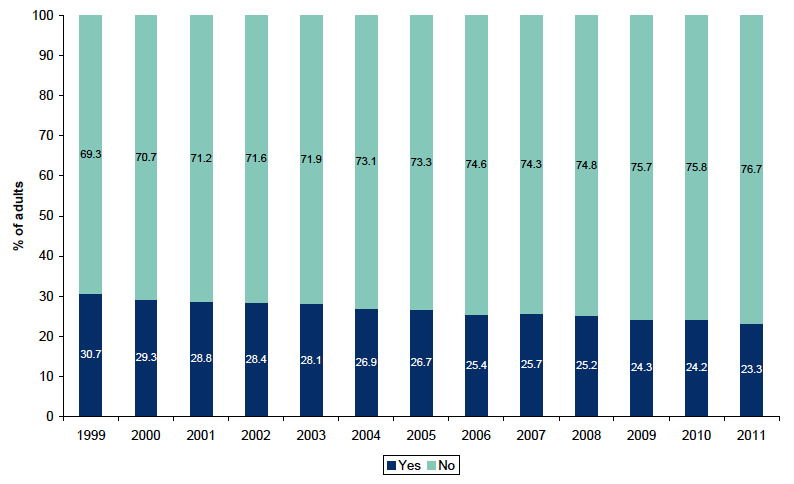
It is immediately evident that the rate of decline has slowed in both genders since the middle of the 2000s. Scottish statistics on the smoking rate since 1999 are shown below:
Whether respondent smokes by year, 1999–2011 data, Adults (2011 base: 12,866)[3]
Click to enlarge
A slight and slowing decline in the smoking rate is clear. In November I submitted a Freedom of Information request to the Scottish Government in order to get a picture of how much money had been spent on tobacco control generally and smoking cessation specifically. The results are shown below:
Figures obtained from FOI request from the Scottish Government, December 2012
Click to enlarge
Viewed against the smoking cessation rate we have this:

Figures on tobacco control and smoking cessation expenditure obtained from FOI request from the Scottish Government, December 2012
Number of smokers taken from Scottish Household Survey reports

We can see that the decline in the smoking rate has slowed in spite of a sharp escalation of tobacco control spending in Scotland (spurting in the middle of the decade in preparation for the smoking ban). We must stress that the total smoking cessation expenditure on this graph is included in the total tobacco control expenditure and not additional to it. However Scottish Government total expenditure on tobacco control has increased by some 1500 per cent – and this figure does not even include expenditure by other bodies such as Cancer Research UK[4] and Big Lottery funding.

Two conclusions: (1) this represents an atrocious waste of public money, particularly in an age of austerity: the prescriptions of tobacco control have resulted in an attack on the hospitality sector and forthcoming restrictions will also inconvenience both smaller and larger shops, when the tobacco display ban is fully enforced. Tobacco control policies have also resulted in higher taxes on tobacco products, all of which favours illegal rather than legal tobacco suppliers.

And (2), if such a huge increase in expenditure has failed to persuade people not to smoke, it is hard to see what new initiatives could possibly make an impact. Certainly Sheila Duffy’s dream of driving the smoking rate down from 25 to 5 per cent of the population in the next twenty years is pure fantasy. She should be recommending an immediate cessation of all tobacco control expenditure.

Saturday, 1 December 2012

Repeat after me: Glas-goals are working

Glasgow's Evening Times applauds Glas-goals, the city's smoking cessation project (a joint initiative of the local NHS health trust and the Evening Times) for its success in driving down smoking rates. Published two days ago, it declares that smoking rates and lung cancer rates are both down (it should have only seven paragraphs in it but at present it has fourteen: someone in the editorial department failed to notice that it has been replicated). An accompanying news report says that the Glas-goals campaign achieved double its expected quit rate.

I don't want to knock anyone's sincere efforts to give up smoking if that is what they want to do. But in the light of previous reports on smoking cessation, it is hard to escape the conclusion that the twelve thousand-plus smokers who have succeeded in quitting their habit are counted as quitters after just four weeks, because that is the common measure. The real test is after the quit programme is over and life has resumed its normal rhythm.

It is clear from the graph to the right of this blog that smoking rates in Scotland have not changed appreciably in the last 12 years. What is less well known is that against this largely unvarying decline in the smoking rate, expenditure on tobacco control as a whole has rocketed from £1.45 million in 1999 to £21.8 million in 2011, according to figures obtained from the Scottish Government in a Freedom of Information request (they even added up the totals for us!) At a bare minimum we can be sure that money distributed through health boards specifically for smoking cessation increased from £1 million in 1999 to £11.08 million in 2011. We also know that lottery money has been spent on tobacco control (the Refresh project) and that Cancer Research UK has funded tobacco control studies in Scotland. So the fifteen-fold increase in government expenditure on tobacco control, supplemented by other funding, has barely made a dint in the smoking rate.

Impressive, no?

P.S. I look forward to observing whether this additional exposure will prompt somebody from the Evening Times to read this story again and realise that they have printed it twice.

Wednesday, 10 October 2012

ASH Scotland heralds Scottish quit rates again

Funny that Sheila Duffy doesn't mention anything about costs.

What she says is this: 
The delivery of 24,529 successful quits in the most deprived areas, measured at one month, means that each of Scotland’s 14 health boards is on course to achieve its Government target. 
She says that the quit target is a four-week period, and that success in meeting a Government target is measured on the number of people attaining it. This is hardly a recipe for encouraging sustained and serious quit attempts.

Back to costs.

The costs applied to official spending on NRT in Scotland are spread through the different health boards, with each health authority getting a top-up for smoking cessation medications. I intend to go through it all to gather the relevant data, but in the meantime the figures for Action on Smoking and Health are laid out here.

Smoking cessation is costed as follows:
NHS services: 1999/2000 £5 million; 2011/2012 £88.2 million. This has been increasing every year since 1999.
Nicotine replacement therapy: 1999/2000 £0.1 million; 2011/2012 £31.4 million. This peaked in the mid 2000s at £40 million.
Whether or not trends followed an identical path in Scotland remains to be seen but the recent Scotsman report recorded a substantial rise in expenditure on NRT (staff costs were not even counted in that report) between 1999 and 2011. A general similarity in trends seems likely. And we saw the result in a recent post here: no change in the smoking rate that would reflect anything like the increased investment in the years since 1999. (Source.) And yet we keep being told how many are giving up (but reading the small print, it usually says 'quit attempts'.)


(Incidentally ASH Scotland is also soft-playing our challenge to the smoking ban, by refraining to make any comment whatever: please see and sign our petition if you haven't already done so!)

Sunday, 7 October 2012

Cost of stop smoking services rises to £2.2 million over 12 years. That's just Lothian

The smoking cessation gravy train rumbles on. The Scotsman reports a growth in annual expenditure on 'free nicotine patches and chewing gum' (a figure that presumably does not include associated personnel costs) between £102,000 and £2,200,000 over twelve years: a phenomenally swift increase. And we can see clearly the impact on smoking rates since 1999 in the graph below:


Figure 10.1, Scottish Government SHS report
(click to enlarge)
Not very impressive really, I think you will agree. Reports are still of 'attempts to quit', and the best (and only) results given in most reports show four-week quit rates. Amazingly the Scottish Government's report dated 25 September also shows 'a 31.5% increase in the number of items prescribed for smoking cessation [let's be precise!]', as if that were some kind of measure of success: in fact it appears that 31.5 per cent more treatments were dispensed in order to achieve the same results that were being achieved eleven years ago, at less than one twentieth of the cost. The smoking ban itself does not appear to have had any clear impact, other than to reverse the decline in smoking rates temporarily.

The latest draft budget for the health division (2013–2014) shows that the allocation for 'tobacco control' (a curious item for a health budget) is £12.3 million, unchanged from last year. Although not a large amount in budgetary terms it looks from this information as if it could be better used elsewhere in the economy – a point brought home particularly in these times of austerity, but use of public money in this way is never excusable.

Friday, 3 August 2012

Scotsman: Bill Jamieson on unflattering research of NRT

The piece is here. The third paragraph is enticing:
Pass me my nicotine patches and the NiQuitin mint drops. I am on Day 23 of what Sheila Duffy, Reichsmarshall of that crack Panzer Division “Action on Smoking and Health” who has forced me to stand outside on countless rain-soaked pavements would doubtless call a Smoking Cessation Programme. I may be quitting fags after 50 years. But I sure ain’t quitting nicotine.
Jamieson goes on: 'Well, there’s only one thing wrong with NRT. It doesn’t work,' and goes on to explain the research done by Patrick Basham and John C. Luik that sets out the position.


ASH Scotland's daily bulletin doesn't get very deep into this analysis, but comments on the article thus: 
His stance against pharmaceutical products developed to help smokers quit is based on a review by Patrick Basham and John C Luik who are both noted for their links with the tobacco industry. 
(This quotation comes complete with links to Tobacco Tactics, which inspiration for Tobacco Control Tactics.) 'Links' with tobacco companies can cover a multitude of sins, but if you are opposed to people in the pharmaceutical camp there is no point whatever in going to them for funding. All research is paid for, to the extent now that it is very hard to believe any of it. I can only say that ASH Scotland's dismissal of Basham and Luik's contribution is easy. All they have to do is refer to the tobacco connection, and the job is done.

Perhaps they didn't like the way Sheila was described in Jamieson's article. But it's always tough at the top.

Wednesday, 9 May 2012

Scottish Government pays incentives to allow expectant mothers to shop at Asda

Free NRT thrown in, although it will probably be claimed that this is optional. The compulsory part is giving up smoking. Public health  minister Michael Matheson claims that this scheme has been 'a success' (a 50 per cent success rate at one month). Launched in Tayside, he now wants it rolled out across Scotland (the news article claims £50 a month is paid out, but other sources give £12.50 a week).

The Taxpayers Alliance's investigations showed over £60,000 had been spent with only a quarter of those attempting to quit succeeding even in the short term. There were allegations that some non-smoking families resented the financial help given to parents who succeeded in quitting under the scheme. According to the National Institute for Clinical Excellence, the long-term prospects for people quitting under this scheme are not necessarily good:
However, a search by the Cochrane Collaboration of all the available evidence looking at whether competitions and incentives help smokers to quit in the medium to long term showed that such incentives do not enhance long term smoking cessation rates, with early success tending to dissipate when the rewards are no longer offered.
Earlier this year a Tobacco Control Study was reported in several papers including the Scotsman showing that nicotine patches, even in conjunction with counselling, do not give quitters an advantage over people stopping without pharmaceutical support.

This has to be a pharmaceutical company's dream: patients getting a financial incentive to participate in a programme that gives them free medication.

It seems that no cost is too great where smoking cessation medications are concerned. Look at the delegate list for this year's UK National Smoking Cessation Conference. So far 261 people have registered for at least one day, at £250 (£375 for two days) with recommended accommodation at £99 per night. At a guess I would hazard that most of it is reclaimable on expenses, plus food. So the cost to the public purse so far (for 261 delegates) has run from anything between just over £62K (for one day with no accommodation), to nearly (£150K for two days with two nights' accommodation. Some people might even need three nights!) And they still have a few weeks to sign up more delegates.

All in a concerted campaign to dissuade people from using a legal product.

Saturday, 24 March 2012

Nicotine patches: change of tune from the UK Centre for Tobacco Control Studies

From this:
The prevalence of smoking is higher among Pakistani and Bangladeshi males than among the general population. Smokers who receive behavioural support and medication quadruple their chances of stopping smoking, but evidence suggests that these populations do not use National Health Service run stop smoking clinics as frequently as would be expected given their high prevalence of smoking. [emphasis added] 
To this:
FREE nicotine patches or intensive counselling via an NHS helpline do nothing to help smokers quit, says a Government- funded study.
This latter study is led by Tim Coleman, and the earlier study was co-authored by Rachna A. Begh, both of the UK Centre for Tobacco Control Studies. Three years elapsed between the two pieces.

What are the policy implications? The concluding paragraph of Tim Coleman's study is non-committal:
In England, where support for smoking cessation is available to all smokers either free or at relatively low cost, adding additional proactive telephone counselling or an offer of free nicotine replacement therapy to usual quitline care did not affect smoking cessation rates. On the basis of this study, providing these through a quitline is not recommended.
and:

What is already known on this topic

  • Quitlines can support large numbers of smokers in achieving smoking cessation.

  • The most effective and cost effective methods of support through quitlines need to be determined.

What this study adds

  • Among callers who sought help to stop smoking through the English quitline, offering free nicotine replacement therapy was no more effective than standard support by the quitline.

  • Cessation rates were not improved by offering additional telephone contacts with advisors providing proactive counselling.

  • Offering free nicotine replacement therapy or proactive support were no more effective than standard reactive quitline support
It is tempting to ask what nonsense we have been fed for the last few years about NHS being four times more likely to quit. Freedom2Choose has raised this question more than once in the past (also here).  Three years ago the mantra 'four times more likely to quit with NHS help' was received wisdom.

The Department of Health page making this claim is now archived.  However, new Department of Health guidance, dated 2011/2012, lists Nicotine Replacement Therapy with an A evidence rating ('the recommendation is supported by good (strong) evidence').  Make of this what you will. (The same document gives Champix an A evidence rating, and states there is 'no clear evidence' of a link between taking Champix and increased depression or suicidal thoughts.)

This is an extremely messy picture. The notion that NRT doesn't work is backed by other evidence besides Tim Coleman's study, but it is not supported by the Department of Health guidance linked above. Nor is it reflected in the Scottish 'Give it up for baby' campaigns, which routinely supply free patches, and pay expectant mothers to make use of the quitting service. The  body promoting 'Give it up for baby' is, rather sinisterly, named NMSC (National Social Marketing Centre), with the slogan 'leading behaviour change'. Instead of evidence-based persuasion, we have psychological manipulation of people's behaviour to suit the whims of policy makers and planners. Behaviour change could well take priority over the supporting evidence, with planners claiming that 'the ends justify the means'.  (Incidentally Tim Coleman has also recently 'discovered' that patches don't help pregnant women stop smoking either.)

Prediction: the UK Centre for Tobacco Control Studies will call for 'more research' to solve the problem of quitting; the Department of Health and National Social Marketing Centre will continue to promote the use of nicotine patches.

Friday, 2 March 2012

Nicotine replacement could be made stronger for expectant mothers

Nicotine replacement therapy is not only distributed free on prescription in Scotland, but in areas that have taken up the 'give it up for baby' programme pregnant women are paid to use it.

A report from the University of Nottingham now 'discovers' that NRT doesn't work for pregnant women, concluding that changes in the mother's metabolism resulting from pregnancy suggest that patches with a stronger dose of nicotine could be the answer. Now they will need to find an optimum level of nicotine that is strong enough to 'work' but not strong enough to harm the foetus.

Tim Coleman, author of the study, is a leading figure in UK Centre for Tobacco Control Studies, with acknowledged personal interests in the development of smoking cessation drugs. True to form he has identified a research opportunity in the unreliability of the nicotine replacement cessation regime. That's his living I suppose but these days it's not hard to think of many better ways to use resources.

Wednesday, 18 January 2012

Scottish Government's 2012 smoking campaign

You've read this story before, there is never a better time to stop smoking, and you are more likely to quit if you call the government stop smoking helpline.

Not even  recent mainstream reports of nicotine replacement as a failed treatment stops the Scottish Government in its tracks.

Also in the Evening Times, which also reports on the deferred tobacco display ban, which the Scottish Government now believes will be in place by 2015. It includes the provocative line:
The Scottish Government also needs to notify the European Union (EU) of the revised regulations – including one specifying how much of the area where cigarettes are stored can be seen when a sale is made.
Needs to notify the European Union? Are we really under that kind of obligation to the EU? 

Tuesday, 10 January 2012

Nicotine replacement has no proven benefit in quitting, say all the papers

Here is an example. And another, from north of the border.

Stories like this used to be commonplace. Sometimes, like this one, they were brought out to herald national no-smoking day. As ever their aim was to convince people that the best way to stop smoking was to rely on a nicotine crutch and under no circumstances to depend on your own will power.

Freedom 2 Choose (the UK group) has long campaigned for recognition that the claim 'four times more likely to quit with the NHS' was based on as much hot air as the claim that the Scottish smoking ban resulted in a 17 per cent drop in heart attacks (press release from 2009 can be read here). The Scottish group, Freedom to Choose group (Scotland) held its own demonstration at the 2010 (Glasgow) conference of the United Kingdom National Smoking Cessation Conference: the annual trade fair of smoking cessation professionals (the 2012 conference has yet to be announced).

The announcement that smoking cessation medications don't work any better than will power has had a muted reception from anti-smoking professionals. John Britton, of the UK Centre for Tobacco Control Studies, says it is 'not a surprising revelation' (is he about to resign, then?) He seems to feel that the availability of NRT gives people the necessary inspiration to quit, even though it doesn't actually make them any better at doing it. Deborah Arnott of Action on Smoking and Health seems to have her head in the sand:
Deborah Arnott, chief executive of the Action on Smoking and Health (Ash) charity said there was good evidence that the provision of medication and counselling to help smokers quit, as provided by the Stop Smoking Services in the UK, was effective and cost-effective. "Ash agrees, however, that it is essential that such support is provided as part of a comprehensive tobacco control strategy, which includes mass media campaigns to encourage smokers to quit."
Arguing along the same lines, research leader Gregory Connolly (Center for Global Tobacco Control, Harvard School of Public Health) adds:
"We have to think about, when we go into the real world, what are the other factors out there that are contributing to the relapse that the drug is not [addressing]," he said. "Clearly we know that social interventions such as price, clean indoor air policies and very strong public education campaigns do have a long-term effect and we can show that through population research." [emphasis added]
What do we know about clean air policies and strong public education campaigns? That they have led directly to stagnation in the long-term decline in smoking. The driver to smoking cessation is volition. Wanting to give up is key. Mass media campaigns don't help when their intent is to frighten people into quitting or otherwise ostracise or demoralise them.

The only effective starting point is wanting to quit. And being aware that some of the people and institutions who tell you how difficult it is want to make money, or prove their worth to society, by helping you.

Saturday, 20 August 2011

Driving smoking down yet further in Scotland

First a graphic illustration (from Cancer Research UK):

Figure 6.2: Prevalence of cigarette smoking by age, Great Britain, 1974-2005

And an interview with Michael Matheson (Scottish Health Minister) (available 6 more days from today). Sheila Duffy also participates. The Minister is questioned about the failure of the Scottish Government to meet its smoking targets. Both the Minister and Sheila Duffy point out in the interview the dramatic fall in smoking rates that has occurred since 1999. The graph (UK-wide) shows that there has actually been very little change in smoking rates since 2005.

Unusually for a BBC Scotland interview presenter Colin Kelly (sitting in for Kaye Adamson on Call Kaye) challenged the Minister and a couple of callers on their approach to smoking. Colin's fear is that if the Minister pushes too hard there will be a backlash against the smoking ban, which he likes. He is concerned about  individual liberty – to an extent – as well as costs. At 24.50 minutes into the clip he asks the Minister whether the only people who now smoke are in deprived pockets of Scotland who require help in many different areas of their lives – Matheson replies that they have a 'range of measures in place to try and help people who do wish to give up smoking'! The only problem he recognises in smokers is that they smoke.

The next stages of Scottish smoking cessation strategy seems to aim at the smokers in Scotland's most deprived communities. If Matheson is anything to go by, they won't get much of his personal attention because he already knows that all their health problems are smoking-related.

A recent initiative to persuade people not to smoke got off to a quiet start in Arbroath last weekend, where just 30 people signed up. The Courier reports the failure rates of smoking cessation programmes in the area, and state that NHS Tayside had the lowest success rate at 33 per cent (not mentioning that this figure was likely to have been a success rate at four weeks – very far from being a confirmed success story).  Professionals know that cold turkey is a very common quit method. Professional intervention seems quite over-rated, especially by those that provide it. Even if the reporters on the Courier are not reporting the full story it's good that they point out some of the failures of the smoking cessation service.

More here: again this relates to the UK, but is relevant. Of the whole NHS smoking cessation activity Chris Holmes points out that the 'real' smoking cessation rate has been about 6 per cent over the last few years. He says this:

Ladies and gentlemen, this programme was started by the Blair government in 2001.  It has been running for a decade, and boasting roundabout 50% success rates all along, with hundreds of thousands of smokers being duped into taking part with scandalous misinformation about actual outcomes, and yet the number of smokers in the UK today is: “similar to previous years”!
It's hard to resist the conclusion that the smoking rate has flattened out, and that no amount of NHS service delivery will make any difference in the future.

Edit, 21 August: You can access a permanent link to the Matheson discussion here.

Tuesday, 16 August 2011

Swiss Federal Health Office: nicotine addiction is a disease

The Swiss Federal Health Office has determined that basic insurance should cover the cost of treating of nicotine addiction, which is to be treated officially as a disease – 'under certain conditions', yet to be decided. The story is here.

Pfizer has successfully put the case that Champix, among other smoking cessation medications, should be on a list of medications funded under basic insurance. (Not only does this drug have an extensive history of adverse effects – it has also allegedly attempted to conceal these effects from the general public.)

Health care free at the point of delivery is a miracle that our ancestors might only have dreamt of but like any other dream it has a downside. Defining what is 'essential', basic, becomes a matter of political lobbying according to the priorities of the day and is no longer a matter of common sense.

Treating something that is not a disease as if it were a disease and getting the treatment paid for whether by the health department or an insurance company is removing control of the situation from the individual with the affliction. It is also giving easy money to the person supplying the treatment. They don't have to sell it to the public – they have to sell it to the authorities.

Ironically even those who support the reimbursement of smoking cessation costs by insurance schemes are aware of the shortcomings of the medication:
CIPRET says Champix can double the chances of heavy smokers giving up in three months. But Gianfranco Domenighetti, professor of health economics at Lugano University, warns that the controversial medication needs to be well tolerated. “According to a Canadian study, this medicine increases cardiovascular risk by 73 per cent,” he said. Tolerance and effectiveness issues have also been raised for other treatments such as nicotine substitutes or Zyban, an antidepressant used against addiction. But most of all, according to de Haller, “their effectiveness is not 100 per cent guaranteed”. [...]
Some voices, notably in parliament, have suggested that anti-smoking drugs should only be reimbursed if the treatment is successful. De Haller is sceptical about “making people pay in relation to the therapy’s success, when the effectiveness is not 100 per cent guaranteed”.
'Not a hundred per cent guaranteed' is euphemism in style. We learned just the other day that when people  get shopping vouchers to take smoking cessation medication in Scotland they achieve a rate of only 50 per cent at four weeks. The rate drops further in the following weeks.

Health risks and hit-and-miss success rates acknowledged, the court ruling requires that smoking cessation medications can be paid by insurance schemes in the right conditions. The qualifier itself indicates that this medication is not 'basic'. Even if limited in application, the ruling will still provide drug companies with a guaranteed market for a drug that treats a state of mind.

I wonder what Simon Chapman would make of it all?

Monday, 13 June 2011

Dutch cut back on smoking cessation

I have learned over the last few years to become very cautious on the issue of universal health benefits – getting all medication free at point of need. Being congenitally hypothyroid I got everything I needed (for that condition) free even before the Scottish Government made everything free. The point is that I believe everyone should have the right to life-saving drugs – the problem is that when the state provides health care, it also decides what is essential, what you need. That is why it can criminalise somebody for treating themselves with cannabis for multiple sclerosis yet think nothing of prescribing Champix, or ritalin for kids, or countless other pharmaceutical remedies that someone else has decided society 'needs' so much that it should get it without the individual paying for it. The beneficiaries of this arrangement are easily identified and less easily satisfied with their stupendous market share in medicines.

In the Dutch case, they are definitely doing what they should be doing in Scotland, and axing subsidised smoking cessation. Anyone who wants to give up smoking needs a lot of will power.Many people can do it without drugs if they want to do it at all. This is not denying anyone treatment for leprosy, malaria, AIDS, tuberculosis, or any other life-threatening condition. It's withdrawal of health budget money from behavioural change, which is acknowledged by practitioners not to be effective.

The United Kingdom National Smoking Cessation Conference started today, with 603 delegates learning all the tricks of the trade. For example, they plan to teach 'disadvantaged carers' (single parents?) how to exercise TA (temporary abstinence) using NRT (nicotine replacement therapy) so as not to hurt their kids – anti-smokers' peculiar idea of harm reduction (take a pharmaceutically prepared substitute). I have my own feelings about these campaigns to stop people smoking at home. But that aside, the money spent on smoking cessation would be better spent on almost any other aid, not only for disadvantaged carers of children but also of carers of people with dementia, many of whom who are likely to be elderly themselves instead of all these resources invested in stopping people from smoking.

I don't know how far the Dutch cuts go, but insofar as they stop supporting this appalling market in NRT and related medications, I'm with them.

Tuesday, 17 May 2011

Policy by public opinion poll according to ASH Scotland

The lull in anti-smoking legislation will soon be over, and Sheila Duffy will soon stop reminding the incoming government of its obligations to children and get down to some serious work. Her latest effort claims:
Our polling shows that the public are aware that there are risks to children’s health from exposure to tobacco smoke with a huge 88% saying that they think second hand smoke increases the risk to a child’s health ...
The agenda has clearly moved to children (adults are no longer exposed in the workplace), meaning we can expect restrictions on smoking in homes and cars. The reasoning is superbly executed ... most people think smoke endangers children, therefore policy must be 'x'. (Are most people right? We should be told, but not only by Sheila Duffy.) More:
This is not necessarily about getting smokers who look after children to quit. Rather it is about informing people about the harms caused by tobacco smoke and showing parents and carers that the best way of protecting their children from the harm caused by second hand smoke is to not smoke around them.
So they are not even bothered about getting adults to quit any more. They are after 'harm reduction', which means nicotine replacement therapy in ASH Scotland's language. This means that they may have absorbed the wisdom imparted by the likes of Tim Coleman that NRT doesn't work for most people once they have left the clinic. That is, it doesn't work as a quit smoking tool, but it can still be used to relieve temporary discomfort.

Ms Duffy then goes on to recommend a 'social marketing campaign' covering the dangers of passive smoke exposure to children. What happened to public information campaigns? The term 'social marketing' is itself instructive, as marketing is a form of deliberate persuasion. The messenger is quite uncritical of the message: it has been taken for granted as fact, removed from the realm of objectivity, and given to the marketers to deliver to the public.

ASH Scotland has yet to start pushing for third-hand smoke awareness, but it's only a matter of time. Third-hand smoke is discussed clearly by Chris Snowdon here; he quotes author Winickoff from a private email regarding his study on third-hand smoke:
Basically, the study found that IF you believe that thirdhand smoke is harmful to infants and children, then you were much more likely to have a home smoking ban.
Not much science there either really, is there? More logic, really, and certainly doesn't address the issue whether third-hand smoke is a danger to children, or an issue that would make it advisable to wear a face mask when changing bed linen. The line of argument is identical to Sheila Duffy's. If enough people believe it's dangerous, there is no need to prove it any more.