I had a call from the BBC this morning inviting me on to the Radio Scotland Morning Call phone-in with Louise White. The subject was the study blogged by Forest here, by someone at Heriot Watt University here in Edinburgh. It claimed that passive smoke exposure 'in particular in more than two places of exposure was significantly associated with risks of stroke, angina, heart attack, abnormal heart rhythms ... impacted on sleep problems, self-recognition, making decisions, self-confidence, under strain constantly, depressed and happiness in never smokers' (this from the abstract).
Ouch. And to wind up, 'elimination of indoor passive smoking from different sources should still be a focus in future health programs'.
This is surely a case of torturing the figures till their pips squeak. None of the issues in question, including depression and lack of self-esteem, can be attributed to causes as vague as secondary smoke exposure (especially if you experience it in two friends homes in the space of what, a day? a week?)
I wasn't called on to the show until very nearly the end of the discussion, just before 9.30 a.m.. Professor Linda Bauld was on and a medic arguing for further restrictions, and Dr Stuart Waiton from Taking Liberties against it. Stuart pointed out that the new research that comes out all the time always tends to suggest that people's liberties should be further restricted for their own good. Professor Bauld didn't think that legislation would be the answer, but she did want to use what I can only describe as pester power. (It's not enough to open the window or even to go out of the door, you have to go right outside, close the door, etc. I am only surprised that third-hand smoke wasn't mentioned). The medic acknowledged that he would not want to use extra powers to interfere if he thought people were smoking at home in front of kids, but somehow did want something to be done. Callers had varying viewpoints, I think most felt that further powers would not be enforceable (by which I think was meant teachers, health visitors and social workers being able to take action of sorts if they suspect kids are exposed to passive smoke).
My objections to all these restrictions are that the other factors in these conditions they talk of are all vague, nothing is being measured, everything is approximate, nothing is ruled out, and we are expected to accept more or less as a matter of faith that tobacco smoke has the same effect as bad air and damp housing.When I did finally get on air I responded to the point made about this 'new research' recommending more restrictions, by commenting on the neverending flow of anti-smoking studies and by pointing to my favourite page on the Cancer Research UK website. It's the one that says that they fund studies that support existing tobacco policy. (Or to be blunt, they are unlikely to fund studies that don't find a significant risk to health from secondary smoke, or any other excuse to tighten restrictions further.)
Then I had the producer on the line thanking me for my time. By the time I remembered to put up the volume again a minute or so later, they had moved on to a discussion about doggie-bags. Seriously I hope that the national broadcasting station in an independent Scotland will offer something a little more heavyweight!
My views were offered as a non-smoker. I did dabble in smoking a little bit in the early days following the smoking ban. But I didn't miss it when I wasn't smoking.
I was also invited on to the show as a campaigner. Campaigning is not one of my strengths, I am more of a desktop warrior, and it's superficial and non-engaging. Other priorities have taken over (work, mostly) and the group on which this blog bases its name has not really functioned effectively for over two years. I now see the whole issue as one caused by too much centralisation of power generally, and certainly not one that can be resolved by people like me taking on tobacco control directly.
Showing posts with label passive smoke exposure. Show all posts
Showing posts with label passive smoke exposure. Show all posts
Monday, 24 March 2014


Tuesday, 14 May 2013
Where but California ... staying in a hotel that provides smoking rooms can seriously damage your health
A new study warns non-smokers off using hotels that provide smoking rooms. Go for hotels that don't provide smoking rooms, because otherwise your health will be at risk.
Thanks to the BMJ blog for this live-saving information.
The smoke gets into non-smoking rooms (self-closing fire doors notwithstanding) and of course hallways. They even tested the non-smoking guests.Non-smokers should give hotels that allow smoking in certain rooms a wide berth, say the authors, and instead choose completely smoke free hotels.The researchers analysed the surfaces and air quality of rooms for evidence of tobacco smoke pollution (nicotine and 3EP), known as third hand smoke, in a random sample of budget to mid-range hotels in San Diego, California.
Thanks to the BMJ blog for this live-saving information.
Tuesday, 23 October 2012
Passive smoking scare gets sillier and sillier (ask the EPA)
We are told again today that secondary smoke in confined places can impair breathing within twenty minutes. “The observed short-term effects of secondhand smoke tell us that even a short exposure is indeed harmful for normal airways.”
How do they know? By sending 'healthy' volunteers into such spaces.
Well, the Environmental Protection Agency has already declared secondary smoke to be a danger to health. But it has also declared all particulates under a certain size (PM2.5) to be dangerous to the same degree:
So what is the difference between secondary smoke and PM2.5 from any other source, in the eyes of EPA? None, it would seem.
Why yet another study telling us what we already know, that scientists have decreed that PM2.5 and secondary smoke are a danger to our health that we must never be subjected to, and against which regulations already exist. Especially since the research involves exposing subjects to these substances like the EPA does here.
Why don't they show us how effective air cleaning would be in such a situation? Now that would be worth doing. We might learn something that we don't already know.
How do they know? By sending 'healthy' volunteers into such spaces.
During this time, researchers measured participants’ total respiratory impedance, resistance, and reactance with the use of an impulse oscillometry, a noninvasive way of measuring the physical properties of respiratory movement during quiet breathing. Results showed that short-term exposure to concentrated secondhand smoke significantly and immediately impacted participants’ airways, invoking such physiologic changes as increased airway impedance and resistance. Participants showed no clinical signs or feelings of discomfort during the test.What did their test add to current knowledge?
Well, the Environmental Protection Agency has already declared secondary smoke to be a danger to health. But it has also declared all particulates under a certain size (PM2.5) to be dangerous to the same degree:
- There is no safe level of exposure to PM2.5;
- Inhaling PM2.5 can kill within hours of exposure; and that
- PM2.5 can also cause cancer…
So what is the difference between secondary smoke and PM2.5 from any other source, in the eyes of EPA? None, it would seem. Why yet another study telling us what we already know, that scientists have decreed that PM2.5 and secondary smoke are a danger to our health that we must never be subjected to, and against which regulations already exist. Especially since the research involves exposing subjects to these substances like the EPA does here.
Why don't they show us how effective air cleaning would be in such a situation? Now that would be worth doing. We might learn something that we don't already know.
Tuesday, 28 August 2012
Smoking ban miracle in Germany
Readers of this story recognise the holes in it. Researchers found a city where heart attack admissions have dropped following the introduction of a smoking ban, and quickly decided that it would help in building the case for a smoking ban, regardless of any other factors, such as the comprehensiveness of the ban and whether or not it did actually result in a reduction of so-called passive smoke exposure (rather than simply ensuring that people were exposed at home rather than in recreational venues).
The story says that the drop in heart attacks in Bremen was a 25 per cent drop and compares it to the drop of 2.4 per cent that the Department of Health found in England. A ten-fold disparity (as well as the huge disparities in population) in the figures must surely tell them something! but the figures of various heart attack drops are rattled off as if they proved, rather than cast a heavy shadow over the theory that smoking bans stop heart attack admissions.
A more accurate measure would have involved a larger population, across the whole of Germany. Why pick Bremen anyway – simply because the figures could be made to show a large drop? Small populations are more likely to produce startling variances for a wide variety of reasons.
An example of a study seeking to cover a wider population base is here. No statistically significant drops in heart attacks were found when studies were conducted over wider population bases using publicly available data on admissions, and employing appropriate controls.
The story says that the drop in heart attacks in Bremen was a 25 per cent drop and compares it to the drop of 2.4 per cent that the Department of Health found in England. A ten-fold disparity (as well as the huge disparities in population) in the figures must surely tell them something! but the figures of various heart attack drops are rattled off as if they proved, rather than cast a heavy shadow over the theory that smoking bans stop heart attack admissions.
A more accurate measure would have involved a larger population, across the whole of Germany. Why pick Bremen anyway – simply because the figures could be made to show a large drop? Small populations are more likely to produce startling variances for a wide variety of reasons.
An example of a study seeking to cover a wider population base is here. No statistically significant drops in heart attacks were found when studies were conducted over wider population bases using publicly available data on admissions, and employing appropriate controls.
Monday, 30 July 2012
Persuading families not to smoke at home: a how-to guide from the UK National Smoking Cessation Conference
From Laura Jones at the University of Nottingham comes this review of research on initiatives to discourage people from smoking in the home, presented in an audio clip and slide show.
The abstract page contains (as standard) a declaration of no interest, even though it was funded from the UK Centre for Tobacco Control, some of whose staff have clear interests in the nicotine replacement therapy market.
Personally I found the soundtrack quite difficult to listen to, especially when Dr Jones says that inadequate rules about where smoking is allowed in the household (that is, rules that don't amount to a complete ban) might as well not be in place at all. I find it difficult to accept that level of what is politely called 'intervention' where I live (in fact I need not worry on that score as I neither smoke nor have children).
I can see tobacco control experts being content with an absence of legislation in this area: all the more reason to undertake further research into the most effective ways to persuade people not to expose their children to 'second-hand' smoke. But at what point (to paraphrase the title of Chris Snowdon's blog) will the velvet glove become the iron fist?
And will the children whose health is of such concern today find themselves at the receiving end of an iron fist in the future?
The abstract page contains (as standard) a declaration of no interest, even though it was funded from the UK Centre for Tobacco Control, some of whose staff have clear interests in the nicotine replacement therapy market.
Personally I found the soundtrack quite difficult to listen to, especially when Dr Jones says that inadequate rules about where smoking is allowed in the household (that is, rules that don't amount to a complete ban) might as well not be in place at all. I find it difficult to accept that level of what is politely called 'intervention' where I live (in fact I need not worry on that score as I neither smoke nor have children).
I can see tobacco control experts being content with an absence of legislation in this area: all the more reason to undertake further research into the most effective ways to persuade people not to expose their children to 'second-hand' smoke. But at what point (to paraphrase the title of Chris Snowdon's blog) will the velvet glove become the iron fist?
And will the children whose health is of such concern today find themselves at the receiving end of an iron fist in the future?
Tuesday, 22 May 2012
Arizona lung conditions, secondary smoke exposure and guesswork
A study from the University of Arizona relates parental smoking with respiratory conditions carried over into adulthood.
Using data from the 1970s to the 1990s the studies purport to show that parental smoking makes the crucial difference between getting ill and not getting ill. Or something like that. As if there were no other factors to be considered.
Local air quality information is here. It's a recognized issue, and note that the issue of smoking is not even mentioned in this local guidance. The critical thing is:
 |
| Source |
Using data from the 1970s to the 1990s the studies purport to show that parental smoking makes the crucial difference between getting ill and not getting ill. Or something like that. As if there were no other factors to be considered.
Local air quality information is here. It's a recognized issue, and note that the issue of smoking is not even mentioned in this local guidance. The critical thing is:
Sometimes the amount of ozone or particulate pollution can violate federal standards.Sometimes. Pollutant levels vary, from day to day and from region to region. It is therefore impossible to draw conclusions about the impact of passive smoking exposure. You can establish that one or two parents smoke, but can you then factor in whether visiting friends and relatives smoke, for how many hours a day, how big the house is, or how well ventilated? What were they smoking? All these variables for a single 'pollutant'. Then we get to the outdoor pollutants. Where did the children live? How exposed were they to the pollutants and for how long? How bad was the pollution? No one can make accurate generalisations over such things.
Thursday, 17 May 2012
Less anti-smoking advertising under the Coalition
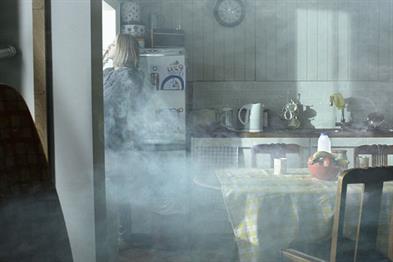 |
| House on fire? Or maybe someone's just burned the toast? No, it's someone smoking at the door, facing outdoors. From Brand Republic |
In this piece, Brand Republic speculates about the future of anti-smoking advertising in the current review and overhaul of government's central communications.
Anti-smoking ads were backed with a £26.7 million budget in 2008/09, which dropped to £14.6 million in 2009/10 and just £1.1 million in 2010/11.I dread to think what they're spending these savings on, but a reduction in this particular budget is welcome news.
Monday, 23 April 2012
No tobacco-related deaths in Scotland, says FOI
H/tips to Bill Gibson for making the FOI request, and Pat Nurse for reporting it.
The question, how many tobacco-related deaths and deaths attributable to passive smoking have been recorded in Scotland.
The answer: none. Or to use (Head of Tobacco Control Division) Mary Cuthbert's words:
The question, how many tobacco-related deaths and deaths attributable to passive smoking have been recorded in Scotland.
The answer: none. Or to use (Head of Tobacco Control Division) Mary Cuthbert's words:
"We hold no information about actual deaths due to passive smoking. It is not possible to give precise figures on deaths resulting from tobacco use."I'll give you an interesting correlation. Tobacco is the only industry that has a global health authority demanding that it should be kept out of talks on health: all governments are under unrelenting pressure to keep the industry away from policy affecting its product. It is also the one commonly held responsible for all ailments affecting central organs and functions of the human body – the heart, the lungs and the respiratory system are destroyed by 'tobacco-related diseases'. Legislation has been brought in throughout the world to protect bystanders from the effects of tobacco smoke. And yet the government cannot say with any certainty how many people it kills, or how many people are killed by exposure to secondary smoke.
Sunday, 1 April 2012
The assault on parents continues
Yesterday another advertisement appeared on the television on secondary smoke exposure in the home. The BBC also interviewed the Chief Medical Officer beside a parent whose son's asthma recovery was put down to her success in giving up smoking.
The CMO declares that 80 per cent of smoke is invisible (yes, nitrogen, carbon dioxide and water vapour are invisible). She also scoffs at the idea that other pollutants are a significant problem, claiming that the UK meets European standards and that tobacco smoke adds 'dramatically' to pollution levels.
There has never been a satisfactory answer to why governments have waited six years after the smoking ban in public places to remind us how vulnerable children are and to mount sustained campaigns regarding smoking in the home. Rather than an authentic health campaign, this resembles more an attempt to extend the bounds of what kinds of intervention are politically acceptable, starting with 'public' and progressing to domestic.
Dave Atherton has written an open letter to Dame Sally Davies (CMO) and Professor Terence Stephenson, Head of Royal College of Paediatrics and Child Health. This spells out more of the fallacies behind the current campaign.
The CMO declares that 80 per cent of smoke is invisible (yes, nitrogen, carbon dioxide and water vapour are invisible). She also scoffs at the idea that other pollutants are a significant problem, claiming that the UK meets European standards and that tobacco smoke adds 'dramatically' to pollution levels.

There has never been a satisfactory answer to why governments have waited six years after the smoking ban in public places to remind us how vulnerable children are and to mount sustained campaigns regarding smoking in the home. Rather than an authentic health campaign, this resembles more an attempt to extend the bounds of what kinds of intervention are politically acceptable, starting with 'public' and progressing to domestic.
Dave Atherton has written an open letter to Dame Sally Davies (CMO) and Professor Terence Stephenson, Head of Royal College of Paediatrics and Child Health. This spells out more of the fallacies behind the current campaign.
Monday, 19 December 2011
Secondary smoke issues at home in Middlesbrough and the Delaware county courts
Here is the background to this story. We are entering the territory of home smoking bans – except they will not be bans applied by central government, but restrictions written into the small print of tenancies. Action on Smoking and Health is keen to encourage people who (imagine that they) experience discomfort from their neighbours' smoke to investigate the terms of their leases for 'nuisance clauses'.
Using smoke-free laws as a clear basis for protecting the health and well-being of one section of the population at the expense of another is what we have come to expect from zealots of this order. They recommend 'reasonable' informal negotiation with smoking neighbours as a kick-off and graduate quickly to the point where complainants are advised to record their symptoms. This is deeply alarmist stuff, clearly intending to induce anxiety about the perceived harm from secondary smoke coming through ventilation shafts, wire ducts and who knows what else. Scepticism about the level of harm from smoke inhaled by householders is expressed clearly by anti-smoking scholar Simon Chapman:
Using smoke-free laws as a clear basis for protecting the health and well-being of one section of the population at the expense of another is what we have come to expect from zealots of this order. They recommend 'reasonable' informal negotiation with smoking neighbours as a kick-off and graduate quickly to the point where complainants are advised to record their symptoms. This is deeply alarmist stuff, clearly intending to induce anxiety about the perceived harm from secondary smoke coming through ventilation shafts, wire ducts and who knows what else. Scepticism about the level of harm from smoke inhaled by householders is expressed clearly by anti-smoking scholar Simon Chapman:
Tobacco smoke also contains ultra-fine particles. Other sources of ultra-fine particles (UFPs) include "laser printers, fax machines, photocopiers, the peeling of citrus fruits, cooking, penetration of contaminated outdoor air, chimney cracks and vacuum cleaners."[8] Wallace and Ott's data on concentrations of UFPs in restaurants and cars found "cooking on gas or electric stoves and electric toaster ovens was a major source of UFP, with peak personal exposures often exceeding 100,000 particles/cm3 .... Other common sources of high UFP exposures [in restaurants] were cigarettes, a vented gas clothes dryer, an air popcorn popper, candles, an electric mixer, a toaster, a hair dryer, a curling iron, and a steam iron."[9]
It is important that research documents residuals from tobacco smoke. But it is equally important that consumers and policy makers are not led to believe that the chemical compounds thus located are somehow unique to tobacco smoke. Unless in the extremely unlikely event that residents burn copious quantities of solanaceous vegetables (aubergine, tomato) which contain small amounts of nicotine, tobacco is going to be the only source of nicotine in homes. But it will not by any means be the only source of many of the ingredients of "third hand smoke" that the unwitting or the fumophobic may believe are attributable only to smoking. The omission of this information in such reports risks harming the credibility of tobacco control. [emphasis added]
Middlesbrough then: here is the story of John Baker at Freedom-2-Choose. His local council left asbestos in his housing association apartment block decades ago and have now come back to clear up the mess. This will necessitate John moving upstairs, into a guest flat. The woman who informed him of this arrangement also advised him that there would be no smoking in the guest flat. At the time of writing he did not know if this restriction was written into any lease or just something the housing association representative felt like saying. But even if it was an empty threat, the climate is now such that it was a believable one.
Now to the Delaware courtroom, where the chips are on the table. Businesses affected by the smoking ban are fighting a lawsuit saying that the claims concerning the dangers of secondary smoke have no credibility. They have obtained under cross examination evidence of conflicts of interest: a witness promoting the smoking ban admitted receiving financial assistance from Johnson and Johnson, who manufacture smoking cessation aids. They have also presented evidence of a substantial drop in takings following the smoking bans. A result is expected in the next few days.
It is good that while Action on Smoking and Health and its Scottish cousin stride ahead with plans to stop everyone smoking at home, the basic premise that secondary smoke kills is far from being universally accepted. We have not yet established that people are harmed by smoke even emitted in the same room before seeking ordnances banning people from smoking in their own homes.
Saturday, 19 November 2011
Thinking of the children?
How can anyone possibly believe that these people care about children: the BMA and all who think like them? I posted this today:
We were prevented from smoking in bars because - to quote the authorities - there is NO SAFE LEVEL of secondary smoke. We were actually *prevented* from doing it, even in private clubs between consenting adults - not just discouraged or shown the dangers, but told YOU WILL NOT DO IT BECAUSE IT IS COMPLETELY lethal and UNACCEPTABLE to expose even consenting adults to it.
Then after a few years we are told that exposure in cars was 23 times more lethal and we should stop doing it in cars. Five years later - *twenty-three times more lethal in a car* - and we know how children have no choice. This is not concern about children ... if they were so concerned about children a ban in cars would have come years ago. This is just using children as a propaganda tool in the next stage of restrictions on smokers. Twenty-three times more lethal than a level of danger so great that we were forbidden by law from taking the risk. (Note that they have quietly reduced this 23 to 11, but not before the public was fed a grossly inflated version.)
I think Robert Dow has it right on the button.
A car is smaller than a bar, but there would usually be no more than two people smoking in the car, and most people would not smoke continuously in a car if they smoke at all. In a bar the upper number of smokers depends entirely on the size of the room, and also ventilation factors also vary so enormously that nobody could take this as a scientific measure. This is typical of the so-called science on secondary smoke. It is based not on measured amounts of anything, but guesswork and generalisations.(I've just heard Amanda Sandford tell George Galloway on Talksport that she doesn't think the time is right for an outright ban in motor cars (bless the BMA, for letting Action on Smoking and Health be seen as moderate on a smoking issue). Even though passive smoke exposure is eleven times greater than in a smoky bar and children don't get a say, there should be no ban, just a debate.)
Wednesday, 21 September 2011
Air pollution and the public health agenda
You will have seen discussion boards where somebody points out that exhaust emissions are worse for you than passive smoking, and someone else says 'ah, but we need cars'! as if this were a good enough reason to ban something that we supposedly don't need, without any proof that it's damaging.
When I was growing up in the 1970s word had reached us in East Yorkshire that Glasgow had a poor health record. We were told that much of this was because of poverty, substandard housing and a damp climate. No one in those days told us that drinking and smoking was the cause or gave us that pearl of twenty-first century wisdom – that smoking causes health inequalities.
But in the corridors of power there is evidence of change going back twenty more years. (H/tip to Rose for the link.) Published in 2002, this link reports attempts to disguise the impact of air pollution on the London smog of 1952:
The medical establishment has appealed to corporations to take note that poor employee health is costing money. Hell, someone has to support them, and why not have a crack at those who support smokers, drinkers and the obese by offering them a livelihood?
Sometimes this smacks less of altruism than of a deliberate attempt to disenfranchise people. Usually, in fact. Any health problem can be resolved by addressing personal issues (smoking, drinking ...). People are not expected to protest about the extent of air pollution (or any other health issue) because health politics is no longer the domain of those most affected by health inequalities. Their duty is to look after themselves so that their employers can make more money from them.
When I was growing up in the 1970s word had reached us in East Yorkshire that Glasgow had a poor health record. We were told that much of this was because of poverty, substandard housing and a damp climate. No one in those days told us that drinking and smoking was the cause or gave us that pearl of twenty-first century wisdom – that smoking causes health inequalities.
But in the corridors of power there is evidence of change going back twenty more years. (H/tip to Rose for the link.) Published in 2002, this link reports attempts to disguise the impact of air pollution on the London smog of 1952:
Delegates attending an international conference in London today to commemorate the 50th anniversary of the Great London Smog of 1952, which caused an estimated 12,000 deaths, will hear how governments from the late 50s onwards deliberately downplayed the huge threat to public health caused by air pollution, and sought to shift the blame firmly onto cigarette smoking instead.
In 1953, Dr Guy Scadding, speaking on the television programme Matters of Medicine, had expressed a belief that air pollution was as much a factor in whether someone developed lung cancer as smoking, citing the significantly higher number of deaths from the disease among those living in polluted cities, as opposed to the countryside, and assuming that rates of smoking were likely to be similar in both populations.
A few years later, in 1957, the Medical Research Council was planning to issue a statement saying although smoking was a significant cause of lung cancer, up to 30% of cases might be caused by air pollution. But the Cabinet committee on cancer of the lung, fearful of another political embarrassment which could be caused by stressing the air pollution connection, asked the MRC to reconsider its statement. On 31 May 1957 a modified version was published, which asserted that although it was likely that atmospheric pollution did play a role in lung cancer, it was 'a relatively minor one in comparison with cigarette smoking'.The clear conclusion?
'What was happening in this committee was a shift away from a concept of health and wellbeing related to an individual¹s environment, occupation, class or work, towards one focused strongly on that individual's responsibility for his or her health, which smoking came to symbolise. After the 1962 report, it was smoking and the type of public health which it epitomised which was to become the central public health issue. Smoking was something which the individual could do something about; air pollution was not,' explains Professor Berridge.Public health, as far back as 1957, was to become judgemental. The medical establishment was already prepared to take an attitude on the issue, and suppress data that would inconvenience the public health message: 'take responsibility'. (Was this an early revolt against universal health provision free at the point of need?)
The medical establishment has appealed to corporations to take note that poor employee health is costing money. Hell, someone has to support them, and why not have a crack at those who support smokers, drinkers and the obese by offering them a livelihood?
Sometimes this smacks less of altruism than of a deliberate attempt to disenfranchise people. Usually, in fact. Any health problem can be resolved by addressing personal issues (smoking, drinking ...). People are not expected to protest about the extent of air pollution (or any other health issue) because health politics is no longer the domain of those most affected by health inequalities. Their duty is to look after themselves so that their employers can make more money from them.
Wednesday, 7 September 2011
Foster parents smoking in Essex
The Evening Standard reports that a couple's attempt to foster children has been foiled following the husband's revelation that he had smoked two cigars within an 18-month period.
The report states that the parents were told specifically that prospective parents must not have smoked for a year prior to fostering, and the two cigars rendered the couple ineligible to be foster carers. This information is not given in the Essex Adoption Service Policy Statement (2008):
Essex County is quoted: "We are not able to comment on individual cases but deciding not to pursue an application is not a decision that is taken lightly."
This decision, based on two cigars, seems to have been made very lightly indeed.
The report states that the parents were told specifically that prospective parents must not have smoked for a year prior to fostering, and the two cigars rendered the couple ineligible to be foster carers. This information is not given in the Essex Adoption Service Policy Statement (2008):
It has been shown that children’s health is adversely affected by passive smoking. The adoption service will not exclude smokers as prospective adopters, but is very unlikely to place babies under the age of 2, or place any children who have asthma or respiratory conditions, with people who smoke.(So passive smoking is very risky to children's health, but in most cases we won't let that stand in our way. We'll just make you feel bad about smoking.) Nor is it given in the relevant guidelines on becoming a foster carer (2010):
If you smoke, you will not be allowed to care for a child under the age of five or a child who has any kind of respiratory problem.Nothing is stated in either document about not having smoked for at least a year prior to adoption or fostering.
Essex County is quoted: "We are not able to comment on individual cases but deciding not to pursue an application is not a decision that is taken lightly."
This decision, based on two cigars, seems to have been made very lightly indeed.
Tuesday, 30 August 2011
Passive smoke 'danger' exposes Scottish Government to legal action
A prisoner has effectively called the bluff of the Scottish Government by suing it for passive smoke exposure – paving the way for many more cases against the government if the prisoner wins.
Reading through the worst claims about secondary smoke, one can see why a prisoner (still exposed to secondary smoke because of exemptions built into the 2005 law) might be worried. The fact that not a single fatality has been identified should offer some reassurance, but a prisoner who lives in dread of smoking-related conditions (which all affect vital body organs) might still seek compensation – why not? (Madame Labate's case might give a reason why not – see most recent link above).
Which way will the Scottish courts fall on this one? Admit no harm, or expose the Scottish public to a bill for compensation?
Will this be a push towards banning smoking in prisons – effectively removing the smoking ban exemption in prisons (as ASH Scotland aims to do)?
Will this be a political decision or one based on the evidence?
Reading through the worst claims about secondary smoke, one can see why a prisoner (still exposed to secondary smoke because of exemptions built into the 2005 law) might be worried. The fact that not a single fatality has been identified should offer some reassurance, but a prisoner who lives in dread of smoking-related conditions (which all affect vital body organs) might still seek compensation – why not? (Madame Labate's case might give a reason why not – see most recent link above).
Which way will the Scottish courts fall on this one? Admit no harm, or expose the Scottish public to a bill for compensation?
Will this be a push towards banning smoking in prisons – effectively removing the smoking ban exemption in prisons (as ASH Scotland aims to do)?
Will this be a political decision or one based on the evidence?
Tuesday, 17 May 2011
Policy by public opinion poll according to ASH Scotland
The lull in anti-smoking legislation will soon be over, and Sheila Duffy will soon stop reminding the incoming government of its obligations to children and get down to some serious work. Her latest effort claims:
Ms Duffy then goes on to recommend a 'social marketing campaign' covering the dangers of passive smoke exposure to children. What happened to public information campaigns? The term 'social marketing' is itself instructive, as marketing is a form of deliberate persuasion. The messenger is quite uncritical of the message: it has been taken for granted as fact, removed from the realm of objectivity, and given to the marketers to deliver to the public.
ASH Scotland has yet to start pushing for third-hand smoke awareness, but it's only a matter of time. Third-hand smoke is discussed clearly by Chris Snowdon here; he quotes author Winickoff from a private email regarding his study on third-hand smoke:
Our polling shows that the public are aware that there are risks to children’s health from exposure to tobacco smoke with a huge 88% saying that they think second hand smoke increases the risk to a child’s health ...The agenda has clearly moved to children (adults are no longer exposed in the workplace), meaning we can expect restrictions on smoking in homes and cars. The reasoning is superbly executed ... most people think smoke endangers children, therefore policy must be 'x'. (Are most people right? We should be told, but not only by Sheila Duffy.) More:
This is not necessarily about getting smokers who look after children to quit. Rather it is about informing people about the harms caused by tobacco smoke and showing parents and carers that the best way of protecting their children from the harm caused by second hand smoke is to not smoke around them.So they are not even bothered about getting adults to quit any more. They are after 'harm reduction', which means nicotine replacement therapy in ASH Scotland's language. This means that they may have absorbed the wisdom imparted by the likes of Tim Coleman that NRT doesn't work for most people once they have left the clinic. That is, it doesn't work as a quit smoking tool, but it can still be used to relieve temporary discomfort.
Ms Duffy then goes on to recommend a 'social marketing campaign' covering the dangers of passive smoke exposure to children. What happened to public information campaigns? The term 'social marketing' is itself instructive, as marketing is a form of deliberate persuasion. The messenger is quite uncritical of the message: it has been taken for granted as fact, removed from the realm of objectivity, and given to the marketers to deliver to the public.
ASH Scotland has yet to start pushing for third-hand smoke awareness, but it's only a matter of time. Third-hand smoke is discussed clearly by Chris Snowdon here; he quotes author Winickoff from a private email regarding his study on third-hand smoke:
Basically, the study found that IF you believe that thirdhand smoke is harmful to infants and children, then you were much more likely to have a home smoking ban.Not much science there either really, is there? More logic, really, and certainly doesn't address the issue whether third-hand smoke is a danger to children, or an issue that would make it advisable to wear a face mask when changing bed linen. The line of argument is identical to Sheila Duffy's. If enough people believe it's dangerous, there is no need to prove it any more.
Saturday, 7 May 2011
WHO demands general smoking ban in Germany
It is harder now for European authorities to claim that smoking bans are universally popular. Germany has failed to enforce its ban, Spain has protested vigorously, and Belgian café proprietors and customers have also protested about a ban due for implementation in food establishments on 1 July, three years earlier than planned. The Netherlands has also thrown off its ban for bars without employees.
Demands not just for a full implementation of the ban in Germany but for the law to be enforced centrally instead of in its federal states have appeared, of all places, in the British Medical Journal. I only have access to the abstract but already the Heidelberg branch of the World Health Organisation gets its say, claiming that the German people are exposed to dangerously high levels of smoke in their restaurants and pubs.
(Clearly he seems to be under a misapprehension that people are forced to allow smoking in pubs and that unwilling customers are forced to go into them.)
People seem happy to tell priests to keep out of politics and stick to religion: not a view I would necessarily agree with – everybody should have a say in politics. I would only agree to limiting religious interference in politics if religion wanted to keep secular interests out of politics. Why don't people realise that health is the new religion? Why do people tolerate health officials who are so steeped in politics that they happily recommend interfering with German legislation in order to achieve their smoke-free agenda?
The study is entitled 'Full smoking ban is needed in Germany as four out of five pubs flout regulations'. What size of budget is needed to report what is common knowledge: that people can smoke in German public houses?
The Netherlands didn't get off scott-free either. Tobacco control has no respect for national boundaries.
Demands not just for a full implementation of the ban in Germany but for the law to be enforced centrally instead of in its federal states have appeared, of all places, in the British Medical Journal. I only have access to the abstract but already the Heidelberg branch of the World Health Organisation gets its say, claiming that the German people are exposed to dangerously high levels of smoke in their restaurants and pubs.
(Clearly he seems to be under a misapprehension that people are forced to allow smoking in pubs and that unwilling customers are forced to go into them.)
People seem happy to tell priests to keep out of politics and stick to religion: not a view I would necessarily agree with – everybody should have a say in politics. I would only agree to limiting religious interference in politics if religion wanted to keep secular interests out of politics. Why don't people realise that health is the new religion? Why do people tolerate health officials who are so steeped in politics that they happily recommend interfering with German legislation in order to achieve their smoke-free agenda?
The study is entitled 'Full smoking ban is needed in Germany as four out of five pubs flout regulations'. What size of budget is needed to report what is common knowledge: that people can smoke in German public houses?
The Netherlands didn't get off scott-free either. Tobacco control has no respect for national boundaries.
Sunday, 30 January 2011
Claims looming for passive smoke exposure in Scottish prisons
The Herald reported this week that a number of prisoners in Scotland exposed to secondary smoke have lodged cases claiming damages. The first is expected in court in the next few months.
The likelihood that a successful case would result in a series of copycat claims must be food for thought for the Scottish Government. But what would it achieve by defending each claim successfully?: of course it would undermine its own case that 'there is no safe level of secondary smoke' ...
What would you do in the Scottish Government's case?
The likelihood that a successful case would result in a series of copycat claims must be food for thought for the Scottish Government. But what would it achieve by defending each claim successfully?: of course it would undermine its own case that 'there is no safe level of secondary smoke' ...
What would you do in the Scottish Government's case?
Subscribe to:
Posts (Atom)