Showing posts with label Paul Waterson. Show all posts

Sunday, 23 September 2012

Petition PE 01451 reported in Scottish Sunday Express

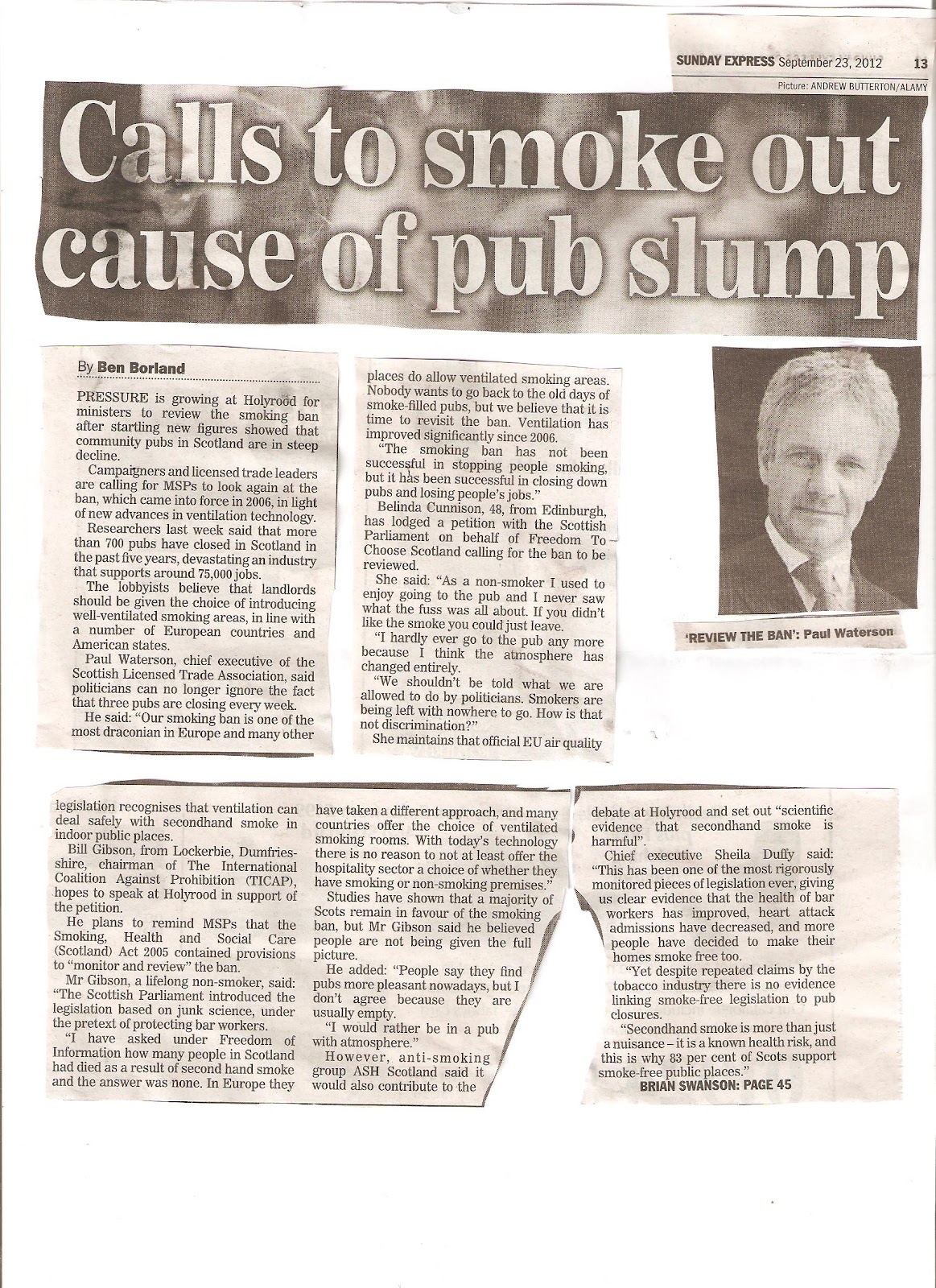
Another good write-up on the petition from Ben Borland in the Scottish Sunday Express
Click to enlarge
Paul Waterson of the Scottish Licensed Trade Association and Sheila Duffy of ASH Scotland are both interviewed. The writer Ben Borland also called me and Bill Gibson at home. Paul Waterson rightly points out that our ban is more severe than those in Europe, and that ventilation technology has moved on apace since 2006 (which it has, but it could no doubt have coped with tobacco smoke even then). He would like to see smoking rooms reintroduced.

Sheila Duffy expects to provide 'scientific evidence that secondary smoke is harmful', which rather seems to miss the point of the petition. The petition refutes the notion that secondary smoke needs to be isolated and banned, rather than treated as just one of many airborne toxins. If all toxins are dealt with by setting air quality standards and applying technology where it is needed, there is no need for additional evidence about the toxicity of smoke. If it is so dangerous it will exceed the air quality standards, and air cleaning/ventilation will be applied.

She also refers to improvements in heart attack rates (supporting the 'junk science of the year' study by Professor Jill Pell announced to the world in 2007 and published in 2008), and disputes that pubs have suffered since the smoking ban was implemented. I was fully expecting a retaliation from Sheila Duffy to the Scotsman piece on the petition published on Friday: that may yet come.

Sunday, 12 June 2011

Too little too late: Duffy answers Waterson

The response, when it came, was barely audible. Sheila Duffy's retaliation to Paul Waterson's suggestion that perhaps we should review the smoking ban came five days later, and somewhat tepidly reiterating the same tired points that we have been hearing for years now.

The smoking ban reduced heart attack admissions by 17 per cent in the year following implementation. Except they didn't, as was blindingly obvious from the moment Jill Pell's study was announced to the world (nine months before the actual study was published).

Asthma attacks in children declined by 18 per cent (the smoking ban did not affect child venues) – this was not true either.

Duffy also remarks on the state of the hospitality sector, remarking that it has not suffered overall. However, certain sections have suffered, namely pubs, clubs and bingo halls. The licensed trade association would not be calling for a review if its members were not suffering.

Duffy finally asks 'who would compromise or roll back on these health gains'? The problem has been that she and her like have lost much credibility over these supposed health gains. Consider ASH Scotland's next project: extending the smoking ban to prisons and mental institutions and intervening to stop people from smoking with children at home. It's the issue of children that exposes the poverty of the secondary smoking claims. It is an article of faith among anti-smoking activists that smoking bans do not increase children's exposure to secondary smoke. But the smoking ban inevitably involved at least the risk to children of considerably more exposure to secondary smoke. Since the strategy was denormalising smoking, the politically acceptable route was to prohibit smoking in public places and then conduct a very thorough 're-education' to persuade parents not to smoke at home. (Coming soon to a town near you.) It might have been more credible simply to have made some very strong statements about secondary smoke to encourage parents to smoke away from home, but left adult venues alone, with perhaps some encouragement to use extraction systems. That would have both reinforced smoking as an adult activity and protected children further from exposure to smoke – but of course would not have 'denormalised' smoking or made smokers an object of public vilification.

As a rebuttal of Paul Waterson's piece, Sheila Duffy's fails: Mr Waterson's is better researched and more reasonable. I would not agree with his recommendation of separate smoking rooms, unless he wants bars hit with rules from licensing boards about when staff may enter specific rooms in pub premises. An indoor air quality standard and extraction systems could do the job, clear the air of  all the stale air as well as the smoke, and open up pubs for business to their core punters again.
Tuesday, 7 June 2011

Licensees are quitting, not smokers, says SLTA

Today Paul Waterson has bid for another look at the smoking ban.  He begins:
Five years ago our pubs were generally full of life, had a great atmosphere and were just about holding their own against vicious price competition from the supermarkets.
A promising start. We knew that the supermarket prices had always been a problem, but it was a problem that broke the surface only when the smoking ban had sent away a good number of traditional pub customers.

Mr Waterson's piece goes on to explain how the smoking ban as enacted in Scotland has failed to catch on in Europe, pointing out that the better the weather, the laxer the enforcement tends to be. In terms of trade, bars are closing at four times the rate that they closed before the smoking ban came in. The losses have amounted, he says, to one-eighth of Scotland's pubs.

Comparing this to the smoking cessation rate in Scotland is an interesting move. Although the ban was not introduced (ostensibly) to prevent people from smoking, it's clear that the alleged damage from secondary smoke won't decline in the long term unless the smoking rate declines as well. And Mr Waterson has good reason to draw attention to the poor long-term success rate of smoking cessation interventions by the NHS. The latest official report (summary here) gives this paragraph:
Quit outcomes based on client follow-up at 12 months after the quit date use data for the 2009 calendar year (12 month outcomes for the full 2010 calendar year are not yet available). Based on data for 2009, the quit rate at 12 months was 7% with 68% of cases 'lost to follow-up'/smoking status unknown by this stage. 
A 7 per cent quit rate at 12 months (that's 7 per cent of the 7.4 per cent of smokers that even tried to give up)  seems rather bleak from where I am sitting. Sheila Duffy does her best to sound optimistic but this is all she can manage:
While giving up smoking can be difficult for some, it is encouraging to see that at least 39% of those who attended stop smoking services in 2010 remained quit a month later. [emphasis added] 
Surely anyone wanting to give up would like a fair idea of their chances after the first few weeks of intensive support. Failure to give any information after four weeks doesn't look promising. A rough ballpark figure suggests that from one year to the next, 93 per cent of the smoking population carries on smoking, plus 92 per cent of the remaining 7 per cent who have tried to quit, plus any youngsters who have taken up the habit and minus any smokers who have died. It gives Paul Waterson good grounds for saying that the impact of the smoking ban has been far greater on licensees and their establishments than it has on the smoking rate.

Mr Waterson speaks of moderate amendments, the old days having gone forever, and so on. Whatever. As long as government dominates the discussion of what should be allowed the trade will need to grow teeth before it will make any impact – if my reading of the current Scottish Government's agenda is accurate. Begging the government to increase drinks prices to ridiculous heights will not help the drinks industry and will not help the licensed trade either. To quote at second hand from here:
The hospitality industry lobbies for more restrictions on supermarket-bought alcohol to boost sales in bars; small brewers push for more punitive tax rates on big brewers... the only winners are the healthists who get support bit by bit for more regulations on everything. It's like a bunch of folks on the scaffolds complaining that the other guy's noose isn't quite tight enough. Y'all might instead direct your attention to the hangman sometime and try helping each other cut those ropes.
Things could get more ridiculous yet, as some health expert (not in Scotland thankfully) has said the drinking age should be raised to 24. Raising any legal purchasing age so far beyond the age of majority would not, I suspect, go down well with young people in this country. But some people will enjoy flying this kind of kite.

The licensed trade and its associates and rivals need to consider their strategy very carefully. But it's good to see that the smoking ban is at last getting some of the attention it deserves.