Showing posts with label Petition PE 01451. Show all posts

Friday, 25 January 2013

PE 01451 closed after very brief hearing, Scottish Parliament

It looks as if I'll need another attempt to upload the video of the Health and Sport Committee meeting on Tuesday this week. In the meantime the link is here. The meeting lasts over three hours. Our petition comes in at about 180.35 minutes in.

Calling it a hearing is something of an exaggeration. One member, Aileen McLeod MSP, introduces a letter with some supplementary evidence presented to her in person by her constituent Bill Gibson, and sent to other committee members subsequently.

Gil Paterson MSP talks of his experience with the automotive industry, comparing workers in a car workshop where he describes a sealed environment and gas masks. He then opines that there will never come a time, regardless of the advances made in air cleaning technology, when the smoking ban can be repealed safely.

Richard Simpson MSP says that the ventilation issue was settled way back in 2001, recommends closing the petition and abruptly leaves the committee room leaving the convenor, Duncan McNeil MSP, to wind up in his absence.

Glancing at the sheet in front of him (no doubt the Spice briefing) regaling tales of improvements in heart attack and asthma admission rates, he concludes that the smoking ban has been of great benefit and, no one dissenting, declares the petition closed.

No scrutiny of the evidence has taken place, nor suggestions made to call expert evidence on smoking and air cleaning technology. Mr McNeil declares that the smoking ban works according to Health and Safety Executive guidelines by removing the source of the pollution rather than providing ventilation, showing that he has chosen not to consider the possibility raised in the petition – namely, that removing smoking gets rid of a single source of indoor air pollution, leaving the remainder, and making very limited difference to any toxicity in the air.
 

Tuesday, 27 November 2012

Seeking assistance from the devil?

This has gone to all members of the Public Petitions Committee, for their information:
Dear [Public Petitions Committee Clerk]

I refer to the Note by the Clerk (http://www.scottish.parliament.uk/S4_PublicPetitionsCommittee/Meeting%20Papers/Papers_20121127.pdf) in respect of my petition, 01451.

You point out that the Scottish Government does not seem prepared to consider reviewing the smoking ban, partly in the light of its adherence to the Framework Convention on Tobacco Control. You may not be familiar with Article 5.3 of this convention, which is set out briefly at http://www.who.int/fctc/guidelines/article_5_3.pdf. As follows: 
"in setting and implementing their public health policies with respect to tobacco control, Parties shall act to protect these policies from commercial and other vested interests of the tobacco industry in accordance with national law”.  
In other words, groups associated with the tobacco industry are considered to be unreliable, constituting an automatic conflict of interest. For background notes describing opposition to smoking ban, however, your note relies almost exclusively upon sources funded by the tobacco industry (the TMA and Forest). You also suggest that TMA and Forest are suitable bodies that the committee could approach for their view of the petition.

I would suggest that the Scottish Government's commitment to the Framework Convention on Tobacco Control would predispose it to distrusting and failing to take seriously any views presented by either the TMA or Forest. Is it possible to seek views that the Scottish Government would be forced to consider seriously on their merits and without prejudice? 

For example, you refer to a report by the University of Glamorgan (this may not be the same one but it is on a similar theme by the same author), in other words by an authority outside the normal range of those consulted by Scottish Government but one relevant to this issue as the paper is published within Building Services Engineering Research & Technology. 

Seeking views in support of the petition only from sources that the Government inherently rejects as untrustworthy is unfair to the petitioners. I would urge you to seek views from sources that are not associated with the tobacco industry as outlined above.
The clerk's note claims in a note to paragraph 19 that they have 'not been able to access' the research from the University of Glamorgan on the efficacy of ventilation, even though we supplied it to the Public Petitions Committee on disc. It seems they will do anything rather than ask us for information! – even admit that the Scottish Parliamentary Information Centre (SPICe) researchers can't find something.

The Public Petitions Committee meets at 10 am, Committee Room 1.

Sunday, 25 November 2012

Petition 01451 update

Scottish Parliament Petition 01451, which closed 22 October, will receive a hearing on Tuesday before the Public Petitions Committee. As on earlier occasions, the petitioners have not been invited to give evidence.

The SPICe (Scottish Parliament Information Centre) Committee has briefed the Public Petitions Committee. I haven't found a reference for it yet but there is a note from the clerk to the committee based on the briefing here (PPC/S4/12/17/3).

The clerk's note makes a number of points. It notes that EU 13779 – the ventilation standard published by the European Commission four years ago that shows how to clean smoke out of buildings – doesn't have the force of law. (Our petition simply points out that removing smoke can be part of a coherent air quality standard.)

It flags up a UK Parliament document by the Parliamentary Office of Science and Technology on indoor airborne pollution pointing out that no government department has specific responsibility for this area. (This document seems to concern itself mostly with cooking fumes and ETS, and cites the famous Pellesque 17 per cent drop in heart attacks that allegedly followed the implementation of the Scottish smoking ban in evidence.)

In a section on passive smoke, it then lists evidence that passive smoke damages health, using all the usual sources.

It lists counter-arguments, sourced mainly from the Tobacco Manufacturers' Association.

In a section on ventilation, it gives arguments against the use of ventilation (basically, against the use of piss-poor ventilation that has already been shown not to work).

It presents arguments in the petition in favour of using air-cleaning systems: Paragraph 19:
Those who support the use of ventilation systems also use the wider argument that identifying and measuring the components of ETS and assessing the exposure of non-smokers to them in real-life situations, present very great difficulties.  TMA (2004, p 8) stated that various substances that make up ETS are generally only present in extremely low concentrations, some below any meaningful measurement.  It contended that some of these are likely to be present in the air anyway, emanating from other sources and inseparable from the ETS contribution.  
It gives a brief history of parliamentary activity on the smoking ban, listing the two previous petitions. It then addresses the Scottish Government's view. The Scottish Government does not intend to review the smoking ban. It considers on the basis of studies carried out in the early stages of implementation that the smoking ban had proven health benefits. It does not want to reverse the tide of denormalising smokers, and it also wishes to adhere to the Framework Convention on Tobacco Control, which recommends public smoking bans.

Finally the petitions clerk suggests that further information could be sought from interested parties, including ASH Scotland, NHS Scotland, Forest, the TMA, or the petition could be referred to the Health and Sport Committee.   

Inherent bias is overwhelming. The Scottish Government's plan for tobacco control will be published early in the New Year, and we get a hint of it here – the Government has announced a plan to make Scotland smoke-free by 2030. (John Watson of ASH Scotland says: 
"We know that 69% of smokers say they want to quit and we know that two-thirds of current smokers started before they were 18.
"If we achieve those goals, we are actually talking about a small number of willing adult smokers continuing to do that. That is their business, and we don't want them to be criminalised or stigmatised for doing that."
Is Watson unique in tobacco control, not to want to denormalise smokers? Or is he lying?)  

As usual, competing interests of the tobacco control lobby are ignored:
In its submission to the then Scottish Executive‘s consultation in 2004, ASH Scotland, presented details of research which led it to conclude that ventilation could not be accepted as a solution to the risks associated with exposure to ETS. 
ASH Scotland received a considerable funding boost in the lead-up to the smoking ban (£1m in 2005/2006 as opposed to £779K in 2004: FOI request result). Are we supposed to believe that this conflict of interest was immaterial? On this basis they decided that because a certain ventilation system was not fool-proof, no other air cleaning system could possibly work!

Petition 01451 calls for a review of the smoking ban in the light of EN 13779, which shows how an indoor air quality standard can accommodate smoking, and in view of advances in air cleaning technology which has to deal with toxins that are far more dangerous than secondary smoke.

The Scottish Government really does not want to consider our petition! Note the mention of the Framework Convention on Tobacco Control and note also that every single reference to arguments in favour of our petition is sourced by tobacco interests – that even those the petitions clerk suggests consulting over the petition are tobacco interests. (Article 5.3 of the FCTC advises against allowing tobacco industry interests to contribute to health policy. This will allow the Scottish Government to reject the evidence of these contributors solely because they are assumed to wish to 'undermine or subvert tobacco control interests'.)  They are setting up straw man arguments by only taking evidence from opponents they distrust as a matter of principle.           

Sunday, 28 October 2012

Minimum pricing shelved

As reported by the new-look Freedom2Choose.info website.

Since there is a legal dispute as to the competence of the Scottish Parliament on minimum pricing that will take years to sort out, the Scottish Licensed Trade Association would do well to focus its efforts in supporting our call for a review of the smoking ban. Paul Waterson and the Association clearly recognise the impact of the smoking ban on the hospitality trade.

Reviewing, and amending, the smoking ban is clearly within the competence of the Scottish Parliament.

Wednesday, 10 October 2012

ASH Scotland heralds Scottish quit rates again

Funny that Sheila Duffy doesn't mention anything about costs.

What she says is this: 
The delivery of 24,529 successful quits in the most deprived areas, measured at one month, means that each of Scotland’s 14 health boards is on course to achieve its Government target. 
She says that the quit target is a four-week period, and that success in meeting a Government target is measured on the number of people attaining it. This is hardly a recipe for encouraging sustained and serious quit attempts.

Back to costs.

The costs applied to official spending on NRT in Scotland are spread through the different health boards, with each health authority getting a top-up for smoking cessation medications. I intend to go through it all to gather the relevant data, but in the meantime the figures for Action on Smoking and Health are laid out here.

Smoking cessation is costed as follows:
NHS services: 1999/2000 £5 million; 2011/2012 £88.2 million. This has been increasing every year since 1999.
Nicotine replacement therapy: 1999/2000 £0.1 million; 2011/2012 £31.4 million. This peaked in the mid 2000s at £40 million.
Whether or not trends followed an identical path in Scotland remains to be seen but the recent Scotsman report recorded a substantial rise in expenditure on NRT (staff costs were not even counted in that report) between 1999 and 2011. A general similarity in trends seems likely. And we saw the result in a recent post here: no change in the smoking rate that would reflect anything like the increased investment in the years since 1999. (Source.) And yet we keep being told how many are giving up (but reading the small print, it usually says 'quit attempts'.)


(Incidentally ASH Scotland is also soft-playing our challenge to the smoking ban, by refraining to make any comment whatever: please see and sign our petition if you haven't already done so!)

Controlling air quality is the route to reforming smoking bans


Controlling air quality is the route to reforming smoking bans first published by ThinkScotland


A DAY DOES NOT PASS when we are not asked to believe that a substance that most people were breathing since the beginning of time – smoke from ordinary plant materials – cannot be dealt with using modern air cleaning technology. For all the literature produced about it, there have been no medical cases where causation of medical conditions has been categorically proven to be due to low levels of exposure to tobacco smoke – a fact that has made many people question the need for any smoking ban, never mind one as comprehensive as the one found in Scotland.
Recently I proposed, on behalf of Freedom to Choose (Scotland)1, Scottish Parliament petition 01451 (Review of smoking ban) in order to challenge the assumptions of the health lobby, whose underlying motivation is to discourage smoking, that smoke is a toxin that no air cleaning technology can now or will ever be able to deal with safely, that there is no safe level of tobacco smoke, and, most definitely, that ventilation doesn't work.
Declaring that never will technology be able to clear the emissions from smoking seems to be the product of a mindset that does not want to enable smokers to be catered for either in the workplace or in recreational venues. The position of Freedom to Choose (Scotland) is that society's interests should be met rather than resisted. A blanket prohibition on smoking makes it harder for people to get together socially, and this affects people more in districts where concentrations of smokers are higher, aggravating inequalities in many ways.
It is generally true that in workplaces there is a principle that exposure to toxins is best avoided if at all possible, however it has also always been recognised that different workplaces involve different sorts of exposures to different levels of risks from different sources that are difficult to avoid without fundamentally challenging the nature of that workplace.
Asking schoolteachers and children to put up with classrooms that had tanning lamps installed and running in the ceilings would be unacceptable, yet we allow restaurants to install patio dining and drinking facilities where their workers are "forced" to expose themselves on a daily basis to the risk of malignant melanoma from solar radiation. Just as with any Class A carcinogen, there is, theoretically, no safe level of exposure to sunlight, yet we do not ban patio dining: we accept that workers can reduce the risk through partial protection provided by clothing, awnings, and sunscreen use.
We tolerate workers being exposed to levels of carbon monoxide and diesel exhaust products in indoor garages that would never be acceptable in a day-care centre: we do not simply ban indoor garages, however we accept the partial protection afforded by modern ventilation and air filtration technology.
Freedom to Choose (Scotland) is urging that the same sort of thought be applied to allowing pubs freedom of choice in deciding their own smoking policies based upon the wishes of their owners, workers, and clientele.
The ambient air, into which tobacco smoke is released, is not clean in the first place, making it well nigh impossible to isolate secondary smoke as the cause of sickness because pollutants contained in smoke are not limited to smoke. So not only is smoke not avoidable, but removing it still leaves air containing viruses, bacteria, spores, pollen, and plain old smells.
If the advocates of smoking bans are interested in clean air, their method of extracting one specific source of so-called ‘toxins’ (tobacco smoke) and leaving us with record-breaking pollutant levels in the general atmosphere lacks all logic. Their purpose is clearly and simply to discourage tobacco use by pinning all kinds of respiratory, heart and lung conditions on to smoking (or secondary smoke), in spite of the exposures to other toxins or adverse environmental conditions in the workplace, on the battlefield, or even in the home.
There are specific, measurable standards of occupational exposure to airborne contaminants, and permissible exposures vary between different jurisdictions. In saying that there is ‘no safe level’, the enemies of tobacco smoke declare that there is no point in measuring tobacco smoke which, because it is so lethal, one cannot be exposed to at all. In fact it is a mix of particles and gases, each constituent of which can be said to have a permissible safe level expressed in parts per million or billion. If people are smoking in a given air space and these permissible levels are not exceeded (for whatever reason: the room is large with a high ceiling, the window is open) there cannot be said to be a danger. When the level of smoking approaches impermissible levels, air-cleaning equipment can be used. Permissible standards are the guide regardless of whether or not a facility allows smoking.
Equipment that cleans air employs various technologies: extraction and filtration, ionising technology, and others: sometimes combined within a single unit. Any equipment that cleans air has to be maintained and serviced to ensure efficient running.
Any venue that wishes to permit smoking needs to ensure that its air-flow can cope with it. The industry should carry an audit of recommended equipment for all sizes of venue and price ranges but with specific air quality requirements in mind. Establishments that wish to allow smoking can then obtain the equipment, and once in place, patrons can be invited to smoke.
The result should be that ambient air, even with the addition of smoking, treated with air cleaning equipment, gives a cleaner result than ambient air in a non-smoking establishment where no treatment of air has taken place.
Of course upholding such standards would be an ongoing concern of the industry, with the assistance of environmental officers. But using local environmental officers to uphold and maintain air quality standards rather than simply hand out tickets to smokers is a far better use of local resources. This is about priorities.
Freedom to Choose (Scotland) believes that smoking bans damage people, increasing their isolation; and damage businesses, when they are helpless to alleviate a problem because of overzealous regulation. Taken to extremes, both isolation and business failure are measurably detrimental to health. With the rapidly increasing air pollution rates and increasing numbers of lung cancers found in non-smokers (Glasgow is one of the most polluted cities in the UK), sending people outside on to the street to smoke is worse than fiddling while Rome burns.
The power of the health lobby is a significant obstacle. We should be able to allow the hospitality industry (together with the appropriate government agency) to set standards for air quality, to give the air-cleaning industry the specifications it needs for improving ambient air, and in doing so create spaces with improved air quality where smoking can take place with the minimum of inconvenience to anyone else.

1 Freedom to Choose (Scotland) includes both smokers and non-smokers and receives no support from any industry.

Wednesday, 3 October 2012

Scottish pub closures blamed on supermarket prices: more expected

Supermarket beer prices are held responsible for pub closures and many more closures are expected.

Nothing if not opportunist I added the following comment to the Express;
I am author of petition 01451 at the Scottish Parliament, 'review the smoking ban' open for signatures until 22 October. The smoking ban was brought in with the promise that non-smokers would fill the pubs if smoke were no longer a problem. Someone didn't do their market research properly, as the pub's traditional customers were used to the differential between supermarket and pub prices but people the pubs were now trying to woo were not used to them. And many smokers no longer cared to pay the differential now that they were shunted outdoors throughout the evening. 
Public pressure to bring in minimum pricing will not benefit pubs in the near term, because the European Union will fight them. Far better to take advantage of modern air standards and air cleaning technology and enable the hospitality trade to cater for smokers again.
It is nothing short of madness to expect that minimum pricing will bring relief to the bar trade in the near future. Europe will fight it.

This is the answer! Please sign and share.

Tuesday, 25 September 2012

Better late than never!

The Scotsman report on PE 014515 appears in the ASH Scotland bulletin today.

The story is complemented with this digest of tobacco control legislation. This includes 'evaluation' of the smoking ban: of course, different from 'post-legislative scrutiny'. 'Evaluation' includes the (Times junk stat of the year 2007) 17 per cent reduction in heart attacks, and a reduction in smoke in bars of 86 per cent.

I am sure most air cleaning systems would achieve better than 86 per cent.

Well, a nod of acknowledgement from ASH Scotland is appreciated. A more detailed attack would also be illuminating.

Monday, 24 September 2012

No comment from ASH Scotland on PE 01451?

After the Scotsman article on Friday detailing our petition I have been waiting all weekend for Sheila Duffy's response. She can usually be relied upon to make a robust rebuttal of anyone who challenges the wisdom of tobacco control in the pages of the Scotsman.

I've had to wait until today for the daily ASH Scotland news bulletin (not posted online yet), only to find that neither Friday's coverage at the Scotsman, nor Sunday's at the Scottish Sunday Express (which was not online, but they cover reports regularly that are not online) even made it to the daily news bulletin!

I wouldn't even mention this had I not found their coverage in the past to be pretty reflective of what's out there in the mainstream press: not all of it favourable to their cause.

Can it be that Sheila and her crew are lost for words?

Sunday, 23 September 2012

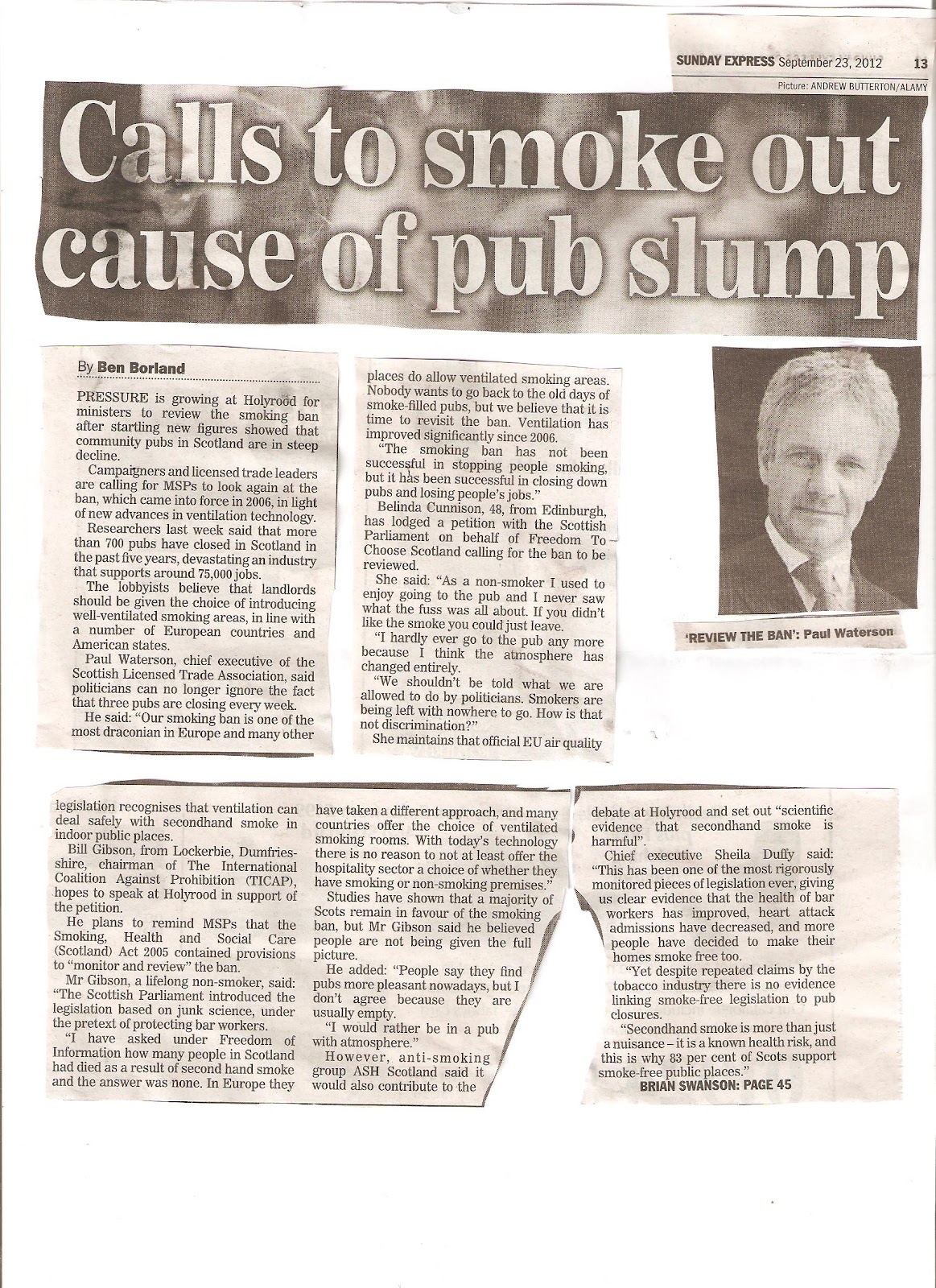
Petition PE 01451 reported in Scottish Sunday Express

Another good write-up on the petition from Ben Borland in the Scottish Sunday Express
Click to enlarge
Paul Waterson of the Scottish Licensed Trade Association and Sheila Duffy of ASH Scotland are both interviewed. The writer Ben Borland also called me and Bill Gibson at home. Paul Waterson rightly points out that our ban is more severe than those in Europe, and that ventilation technology has moved on apace since 2006 (which it has, but it could no doubt have coped with tobacco smoke even then). He would like to see smoking rooms reintroduced.

Sheila Duffy expects to provide 'scientific evidence that secondary smoke is harmful', which rather seems to miss the point of the petition. The petition refutes the notion that secondary smoke needs to be isolated and banned, rather than treated as just one of many airborne toxins. If all toxins are dealt with by setting air quality standards and applying technology where it is needed, there is no need for additional evidence about the toxicity of smoke. If it is so dangerous it will exceed the air quality standards, and air cleaning/ventilation will be applied.

She also refers to improvements in heart attack rates (supporting the 'junk science of the year' study by Professor Jill Pell announced to the world in 2007 and published in 2008), and disputes that pubs have suffered since the smoking ban was implemented. I was fully expecting a retaliation from Sheila Duffy to the Scotsman piece on the petition published on Friday: that may yet come.

Saturday, 22 September 2012

Scotsman reports on petition

Having submitted two previous petitions (both listed in the side bar) on the smoking ban, press attention was something I did not particularly expect. However the Scotsman has given this account, and it is a fair one:
A group called Freedom to Choose Scotland, which has previously lobbied for an end to the ban, says that new European Air Quality standards on indoor areas, published since the smoking ban, backs up its case.
The group says these guidelines do not suggest good practice involves a ban on smoking. It is recognised as a pollutant, along with others, but ventilation requirements are set out to deal with these.
The Petition states: “Ventilation, or clean air technology is a developing science and ventilation includes extraction and other methods of air cleaning,
It adds: “Any effective air cleaning system removes toxins regardless of their source.”
The EC document that first prompted us to submit Petition 01451 is called EN 13779 – Ventilation for non-residential buildings. As the petition says, its section on 'good practice' does not call for a general smoking ban. but concerns the quality of air brought in from outside and the way exhaust air is released. I would be lying if I claimed to understand it all. But the point is that the rules are the same for tobacco smoke as for everything else. Indeed if you look at Table 3 (p. 17) you will see that, while smoking is treated differently from non-smoking, even smoking is described only as a 'moderate' level of pollution.

The article also picks out another important point: removing toxins 'regardless of their source'. Why single out a single source of (relatively mild) pollutants when our whole environment is stuffed with regulation-breaking levels of them? It really doesn't make sense.

It makes no more sense than to say the doctrinaire solution of preventing smoking in public places will always prevail, when we have the collective will and the understanding required to obviate the need for a comprehensive ban.

So a huge thanks to Scott MacNab for the write-up in the Scotsman. It comes shortly after stories in the media about pub closures prompted by a report: 'Local pub, local hub? The future of the Scottish community pub', which you can download from here. The report does not flinch from the impact of the smoking ban on pubs, but its main concern is the duty escalator on beer, which has made it much more expensive for consumers in recent years. It describes Scottish pub closures in stark terms: 703 community closed in Scotland since 2007 (nearly one-fifth of the total). This cannot be doing Scottish social and community life any favours.

More soon.

Petition link here: please keep sharing, the closing date is 22 October!

Wednesday, 19 September 2012

In Switzerland, smoking rooms nearly over the experimental phase


More on the petition ...

In Switzerland, New High-Tech Lounges Put The Cool Back In Smoking
Source
On one side are coffee tables and oak chairs covered with leather. On the other side, there are Egg armchairs by Arne Jacobsen, a black Bakelite telephone and an old flea market record player. It hardly comes as a surprise that in this era of ever more restrictive smoking laws, when people often have to brave the elements just to take a drag, the Bon Génie would be an instant hit among smokers. Besides offering a roof, which is something smokers already appreciate, it also provides an environment with real style. 
It is not, however, the only such place in Switzerland catering to the needs and tastes of smokers. Several other refined smoking rooms have opened in recent years, including the vast Cigar Lounge at the Schweizerhof Hotel in Bern, which is also inspired by the 1950s post-war style, and the more modern Fish Tank at the Lausanne Palace & Spa, which was refurbished two years ago. These successful examples are leading more and more hotels, such as the Beau Rivage Palace in Lausanne, to also consider smoking lounges. 
“Today’s smoking lounges don’t have anything to do with the old smoky rooms for Havana cigar connoisseurs, or worse yet, the smoking areas in airports,” says Antoine Wasserfallen, a professor at the Hotel School in Lausanne. “They are the result of careful research in design and new technologies.”
Wasserfallen foresees that smoking lounges, still in their experimental phase, will evolve in the near future. “People like smoking lounges. But most of them aren’t profitable enough,” he says. “In some cantons, waited table service is banned, so you have to find solutions to make the sales easier, such as installing a serving hatch,” the expert notes.
This smoking room is the initiative of someone who wanted an alternative to seeing smokers booted out into the cold, and believed that technology would deal with the smell of smoke, which some people find objectionable. They struggle to cope with food service being banned in some smoking rooms – but throughout the UK, this whole arrangement would be illegal, because smoke is so, so poisonous that even the most up-to-date technology can't deal with it.

Heaven forbid that anyone should be allowed to use their skills to address a problem (whether perceived or real) like secondary smoke. Tobacco control and all its friends in government have decreed that their way is the only way and it's not up for discussion. Non-negotiable. You cannot now, or ever, devise a system that will stop smoke from killing people. They have declared it to be impossible, now and for all time. (Flat earthers!)

Someone from the mainstream media called me today about our new petition 01451 (calling for a review of the smoking ban), which addresses this very issue. We know, and have known for some time, that the European Commission has air quality standards and techniques for ventilation, and tobacco smoke is dealt with here. It is absolutely pointless for the authorities to hide any longer behind the mantras, 'there is no safe level of secondary smoke', and 'ventilation doesn't work'.

It is up to those in office to devise systems that will work. Set standards, and if the standards are met there is no problem. If the standards are not met, that is what technology is for. And the technology will clean all the muck. Not just the muck from tobacco smoke, but all the other airborne pollution.

Is it really too much to ask, when humankind has learned to kill by remote control weaponry, to allow the use of technology to enable people to sit and have a drink together?

Saturday, 15 September 2012

No new evidence? New petition launched

Four years ago the European Commission published an indoor air quality standard entitled:


The document refers to smoking several times. One example:
The level of air quality required, and the method of classification applied shall be specified. Whether smoking is allowed or not is an important input. The necessary air flow rates to achieve the specified requirements shall be calculated. If nothing is declared, the rates of outdoor air per person for Indoor Air Quality category IDA 2 can be used as a default.
The European Commission, the details of whose forthcoming (and rather savage) revised tobacco directive have been leaked to the press, have published evidence that tobacco smoke can be dealt with in the same way as any other toxin. In essence this is (1) establishing a safe air quality standard; (2) advising how to remove the toxins in cases where the air quality standard is breached.

Somehow in spite of having published this guidance on air quality, the European Commission has adopted an authoritarian stance recommending smoking bans in all indoor workplaces everywhere in Europe, as if there were no other solution available to a mild toxicity problem.
PE 01451, Review of smoking ban

The smoking ban in Scotland is based on this extreme position, and the new petition PE 01451 asks the Scottish Parliament to request the Scottish Government to take seriously the existence of a European standard that should enable smoking rooms to operate.

A FOI request established that the Scottish Government had no record of this standard as of last summer, even though it was published in 2008. It is therefore new evidence, which the Parliament did not have access to when the legislation went through in 2005. All they had (or all they paid attention to) was the mantras 'there is no safe level of secondary smoke' and 'ventilation doesn't work'.