From Laura Jones at the University of Nottingham comes this review of research on initiatives to discourage people from smoking in the home, presented in an audio clip and slide show.
The abstract page contains (as standard) a declaration of no interest, even though it was funded from the UK Centre for Tobacco Control, some of whose staff have clear interests in the nicotine replacement therapy market.
Personally I found the soundtrack quite difficult to listen to, especially when Dr Jones says that inadequate rules about where smoking is allowed in the household (that is, rules that don't amount to a complete ban) might as well not be in place at all. I find it difficult to accept that level of what is politely called 'intervention' where I live (in fact I need not worry on that score as I neither smoke nor have children).
I can see tobacco control experts being content with an absence of legislation in this area: all the more reason to undertake further research into the most effective ways to persuade people not to expose their children to 'second-hand' smoke. But at what point (to paraphrase the title of Chris Snowdon's blog) will the velvet glove become the iron fist?
And will the children whose health is of such concern today find themselves at the receiving end of an iron fist in the future?
Monday, 30 July 2012


Wednesday, 25 July 2012
Plain packaging may not work, but that's not the point
Can't say I have ever been a fan of Ian Paisley (whichever), but the logic in this piece is risible.
Of course it's the point. The author admits that the policy may not have its desired effect (indeed may have an adverse health outcome) once passed into law. But her message is that this doesn't matter: what matters is being politically on-message and knocking tobacco companies because 'reputable person' knows how bad smoking is.
But Nuala, really, what is the point of an anti-tobacco policy that assists the sale of illegal and even less safe cigarettes? What kind of a health outcome is that?
She argues that a campaign based on threats to jobs could be unethical because if all jobs mattered people could get paid to dangle babies over cliff tops for fun. Somehow laws are made to prevent such unethical forms of employment:
Nuala's conclusion?
Having just declared that a growth in illicit sales doesn't really matter, this line of argument is hard to swallow. Nuala clearly has gripes with the influence of Paisley when she mentions the burning of Irish flags (she may have a point there), but you don't need to support Paisley to realise that this is totalitarian nonsense of the first order.
Maybe plain packaging on fags isn't going to stop them being bought. Maybe it will make smuggling easier if all branding is removed. I don't know. But that's not the point.
But Nuala, really, what is the point of an anti-tobacco policy that assists the sale of illegal and even less safe cigarettes? What kind of a health outcome is that?
She argues that a campaign based on threats to jobs could be unethical because if all jobs mattered people could get paid to dangle babies over cliff tops for fun. Somehow laws are made to prevent such unethical forms of employment:
But that's why we have laws, isn't it? To impose a consensus about what's acceptable and what's not, on the general public.That's not my understanding of a law: this is as much as to say that the government is there to tell us what to think, and tell us what our values should be. Impose a consensus? Can anyone advise where she learned that? Is it recognisable legal theory?
Nuala's conclusion?
Smoking belongs in the past. God help people who are addicted, it's hard to give up. But that doesn't mean we should keep making the things and profiting from another generation's misery.
Saturday, 21 July 2012
Australian budget forecasts no drop in tobacco revenue
Just when you thought that Australian tobacco revenue might be expected to fall in the wake of plain packaging legislation that the government expects to introduce at the end of this year, no downward change is projected in budget forecasts. Indeed, an increase in revenue is predicted. From Martin Cullip, writing for Hands Off our Packs.
Thursday, 19 July 2012
Plain packaging of shops: banned from calling themselves tobacconists
When the tobacco display ban was first suggested I feared immediately that it would result in more illicit trade. I felt it was important that shops should retain the ability to inform customers that they did in fact sell tobacco: since advertising was banned, this would not necessarily be easy. But I thought the authorities would want people to recognise lawful outlets for tobacco if only for the sake of getting the revenue. I didn't really expect authorities to go to the length of banning the word tobacconist from the signage of shops.
This is why:
The proprietor's work in establishing and building this trading name and the business has been set at no value by an Act of Parliament that has denied him the right to use it. No doubt they will claim, as plain packaging advocates in Australia claim, that compensation is irrelevant since the government does not gain by depriving businesses of their trading name.
Well actually it does gain: by forcing businesses to change their names, it appropriates more power at the expense of traders. It would be nice to see a challenge to these powers to see if they are legal – while remembering that everything that Hitler did was legal.
The plan is to stop people from associating tobacco with lawful trade and legitimate shops. It it hard to see anything other than a concerted attempt to push the whole business underground and pretend that this will result in improved health.
They can make laws against tobacco but not against people taking risks with their health – especially in times of extreme uncertainty such as we are living in at present. They may succeed in outlawing tobacco but the health outcomes will not change for the better.
This is why:
The Smoke-Free Environments Act prohibits the display of tobacco products, or advertising that a business sells tobacco products.A business must change its name to satisfy this legislation, and this article features a business that has been calling itself a tobacconist for 50 years, since its establishment in 1962.
The proprietor's work in establishing and building this trading name and the business has been set at no value by an Act of Parliament that has denied him the right to use it. No doubt they will claim, as plain packaging advocates in Australia claim, that compensation is irrelevant since the government does not gain by depriving businesses of their trading name.
Well actually it does gain: by forcing businesses to change their names, it appropriates more power at the expense of traders. It would be nice to see a challenge to these powers to see if they are legal – while remembering that everything that Hitler did was legal.
The plan is to stop people from associating tobacco with lawful trade and legitimate shops. It it hard to see anything other than a concerted attempt to push the whole business underground and pretend that this will result in improved health.
They can make laws against tobacco but not against people taking risks with their health – especially in times of extreme uncertainty such as we are living in at present. They may succeed in outlawing tobacco but the health outcomes will not change for the better.
Does the World Health Organization want to kill tobacco growing in Africa?
Antonio Abrunhosa thinks so. He is the CEO of this organisation (International Tobacco Growers' Association) and you can see him in action here:
The Lagos writer of this piece, Torin Orugun, takes issue with the idea that WHO is out to destroy the tobacco industry. He cannot find any direct evidence that tobacco control expects tobacco not to be grown in Africa.
The motions on these topics are lengthy and involved and I haven't looked through them either to find evidence that WHO wants to kill off the tobacco industry in Africa. However the writer has accepted the view that tobacco kills, and that Articles 17 and 18, which concern the development of alternatives to tobacco growing, take into account the impossibility of rushing this process. He quotes a local Framework Convention Alliance member who accuses the ITGA of being a tobacco front group (the ITGA, representing several million farmers across the globe, has three staff including its chief executive. If it is funded by the tobacco industry it is not funded well), which wants to undermine the credibility of the World Health Organisation's Framework Convention on Tobacco Control, using the farmers as a vehicle.
The case of the ITGA is that the people working on developing alternatives to tobacco in developing countries do not know about tobacco, and far from wanting to understand the experience of tobacco farmers, they actually exclude them from their discussions. Even government representatives from departments other than health are not really welcome. The delegations then hear criticisms of the contributions of the tobacco industry, including its participation in debt bondage and child labour (see link to Articles 17 and 18 above). This is disingenuous as it is a feature of poverty and characterises other industries as well. This website on child labour mentions tobacco only as one of many forms of child labour: there is no guarantee any form of agriculture replacing tobacco would be able to eradicate it. See also video at the foot of this piece.
Orogun mentions the mechanism by which all parties to the Convention must work by consensus before motions are adopted, denies that there is any plan to ditch tobacco farming and quotes people who criticise ITGA for their lack of positive comment on the positive health impact of the Framework Convention on Tobacco Control. He seems to conclude that representation within the World Health Organisation is fair and effective, and that it is beyond reproach on the basis of its stated aims.
Much as I agree that it is not healthy for a single industry to control agriculture in any country, as tobacco is held to do in Malawi, it is also bad that an international body that is accountable only to its members (delegates who have limited personal experience in tobacco cultivation) should control policy in member countries of the FCTC in a way that denies participatory rights to those involved in the tobacco industry. If tobacco is too dominant, this is not a problem that should be resolved by people outside the country with a clear agenda to reduce tobacco consumption. The conflict of interest is overwhelming. The balance of a country's economic and social needs should be tackled from within.
5 minutes 30 seconds in, report of an Argentinian tobacco project that has led the way locally in eliminating child labour. Source
The Lagos writer of this piece, Torin Orugun, takes issue with the idea that WHO is out to destroy the tobacco industry. He cannot find any direct evidence that tobacco control expects tobacco not to be grown in Africa.
The motions on these topics are lengthy and involved and I haven't looked through them either to find evidence that WHO wants to kill off the tobacco industry in Africa. However the writer has accepted the view that tobacco kills, and that Articles 17 and 18, which concern the development of alternatives to tobacco growing, take into account the impossibility of rushing this process. He quotes a local Framework Convention Alliance member who accuses the ITGA of being a tobacco front group (the ITGA, representing several million farmers across the globe, has three staff including its chief executive. If it is funded by the tobacco industry it is not funded well), which wants to undermine the credibility of the World Health Organisation's Framework Convention on Tobacco Control, using the farmers as a vehicle.
The case of the ITGA is that the people working on developing alternatives to tobacco in developing countries do not know about tobacco, and far from wanting to understand the experience of tobacco farmers, they actually exclude them from their discussions. Even government representatives from departments other than health are not really welcome. The delegations then hear criticisms of the contributions of the tobacco industry, including its participation in debt bondage and child labour (see link to Articles 17 and 18 above). This is disingenuous as it is a feature of poverty and characterises other industries as well. This website on child labour mentions tobacco only as one of many forms of child labour: there is no guarantee any form of agriculture replacing tobacco would be able to eradicate it. See also video at the foot of this piece.
Orogun mentions the mechanism by which all parties to the Convention must work by consensus before motions are adopted, denies that there is any plan to ditch tobacco farming and quotes people who criticise ITGA for their lack of positive comment on the positive health impact of the Framework Convention on Tobacco Control. He seems to conclude that representation within the World Health Organisation is fair and effective, and that it is beyond reproach on the basis of its stated aims.
Much as I agree that it is not healthy for a single industry to control agriculture in any country, as tobacco is held to do in Malawi, it is also bad that an international body that is accountable only to its members (delegates who have limited personal experience in tobacco cultivation) should control policy in member countries of the FCTC in a way that denies participatory rights to those involved in the tobacco industry. If tobacco is too dominant, this is not a problem that should be resolved by people outside the country with a clear agenda to reduce tobacco consumption. The conflict of interest is overwhelming. The balance of a country's economic and social needs should be tackled from within.
5 minutes 30 seconds in, report of an Argentinian tobacco project that has led the way locally in eliminating child labour. Source
Wednesday, 18 July 2012
Nicotine vaccine ready for clinical trial in two years
Up to you, but I wouldn't take anything that blocked my brain's capacity to respond to an external stimulus or generally to enjoy things. Wasn't that the idea behind Champix?
This video talks of genetically modifying the liver. No thanks.
The vaccine is currently being tested on mice, rats and primates before clinical trials will take place in around two years' time. More here.
This video talks of genetically modifying the liver. No thanks.
The vaccine is currently being tested on mice, rats and primates before clinical trials will take place in around two years' time. More here.
Fedcaf crusade against the smoking ban: diary, pictures and press coverage
 |
| Source |
Google translates this if you're on Google Chrome.
It is obviously much too early to draw definitive conclusions and assessing results. But there are some findings that we now can say with certainty:
1. From our visits to the outlets in various cities shows conclusively that the loss of turnover confirms itself around -30% . The government recently published figures as there would be in the hospitality industry growth of 4% have been hit clearly not in the subdivision of houses, as we previously reported!2. There is a great fighting spirit in the pub-owners, for the simple reason that it has a survival battle.3. More than 2/3 of the non-smoking bar customers are against the smoking ban in bars.4. Many cafe owners are not well informed about everything about the smoking ban. Also, most have never received any letter from the government.What they know is from the press.More of this is needed!
Plain packaging at the Olympics
This appears to have been a 'false flag', and apparently the police will on duty at the Olympics will not, after all, have to empty their crisp packs into clear plastic bags. As reported today in the Telegraph, the order was given by the chiefs of Thames Valley police to forces on the Olympic sites outside London, on the understanding that this would help to satisfy the sponsors that no one who wasn't sponsoring the Olympics was entitled to any 'trickle-down' free publicity. Imagine someone watching the Games on television in Budapest imagining that Thames Valley police were promoting Walkers' crisps or Ginstead pasties on their lunch breaks? unthinkable.
It turns out that Thames Valley police chiefs were being over-zealous. But isn't it a sign of the times when a crisp packet is viewed as advertising? This is a definition employed by anti-smokers in relation to tobacco and cigarette packets, even though actual advertising was banned over a decade ago.
Brand packaging is brand packaging: it isn't advertising, and I would have hoped that any company forced to forgo its branding for the Olympic Games would sue the sponsors. The idea that small traders should be expected to bury their instincts to capitalise on extra visitors to London in order to avoid committing the new crime of 'ambush marketing' is further evidence yet that the Games were never meant to be a boost to Londoners. Read more here.
It turns out that Thames Valley police chiefs were being over-zealous. But isn't it a sign of the times when a crisp packet is viewed as advertising? This is a definition employed by anti-smokers in relation to tobacco and cigarette packets, even though actual advertising was banned over a decade ago.
Brand packaging is brand packaging: it isn't advertising, and I would have hoped that any company forced to forgo its branding for the Olympic Games would sue the sponsors. The idea that small traders should be expected to bury their instincts to capitalise on extra visitors to London in order to avoid committing the new crime of 'ambush marketing' is further evidence yet that the Games were never meant to be a boost to Londoners. Read more here.
Tuesday, 17 July 2012
Now it's the Guardian's turn
And the tactic employed this time is all in the headline: 'Tobacco packets attract children. Now argue against making them plain.'
This is the kind of argument that is presented as so profound and showing such insight as to disempower opponents completely. There is no evidence showing that children are actually enticed to buy tobacco as a result of finding packs attractive – indeed many children interviewed in the course of 'research' on this topic are barely tall enough to see over the shop counter.
Actually it is the usual moral blackmail: 'I represent children's interests, and the world will despise you if you argue against me.' A commenter says:
This is the kind of argument that is presented as so profound and showing such insight as to disempower opponents completely. There is no evidence showing that children are actually enticed to buy tobacco as a result of finding packs attractive – indeed many children interviewed in the course of 'research' on this topic are barely tall enough to see over the shop counter.
Actually it is the usual moral blackmail: 'I represent children's interests, and the world will despise you if you argue against me.' A commenter says:
... and cue the remainder of hysteria as already spoken, but please feel free to insert this specious argument into any possible article and/or argument from now on into the future.
Because no-one, no matter what the argument, can ever going to turn around and say "you know what – sod the sodding children".It seems claiming the interests of the children puts you on the moral high ground even if your claim is absolute nonsense. How about saying: 'actually, we do want our children to learn not to want things just because they see them on the shop shelves; we do want them to learn that all that glisters is not gold', and even, 'we would rather they were able to buy tobacco legally in shops than have to turn to possible counterfeits in the streets, without being stigmatised. When they are old enough, of course.'
Monday, 16 July 2012
Observer continues plain packaging media attack
The Observer reports that the American Legislative Exchange Council (ALEC) opposes plain packaging, and plans a global campaign against it.
Many readers of the article took this as a piece exposing how powerful capital interests (they fund the Tea Party, for goodness' sake!) influence UK policy. My take on it was that this was a piece trying to evoke the sense that if ALEC disagrees with it, then it must be an ideologically sound policy, on the grounds that my enemy's enemy is my friend.
I have not investigated ALEC. The detail of their purposes doesn't concern me, and is not relevant in any case to the advisability of the plain packaging policy. What is relevant is that they are US-based but wish to campaign beyond the US:
Brand packaging exists to protect the commercial operator from threats in the marketplace, like cheap imitations; and also to protect the consumer from the effects of such copying. Removing it, especially for a product that is already strong in the black market, popular especially among the economically deprived and considered to be hazardous, is surely asking for trouble. I don't see why you have to be a 'right-wing libertarian nut-case' to find this idea sensible.
The Observer's piece, linking this organisation in a quotation from Greenpeace to 'climate change denialists', is a blatant attempt to cast its view of the current issue as wrong, because all the other idiot causes it espouses are wrong (also chucking in words like 'billionaire', 'baron', 'oil'). It's hardly a subtle approach that investigates the controversy properly. The less affluent opponents of the policy don't get a mention (people like newsagents).
Observer goes to the bottom of the class, for reporting very unobservantly.
Many readers of the article took this as a piece exposing how powerful capital interests (they fund the Tea Party, for goodness' sake!) influence UK policy. My take on it was that this was a piece trying to evoke the sense that if ALEC disagrees with it, then it must be an ideologically sound policy, on the grounds that my enemy's enemy is my friend.
I have not investigated ALEC. The detail of their purposes doesn't concern me, and is not relevant in any case to the advisability of the plain packaging policy. What is relevant is that they are US-based but wish to campaign beyond the US:
The organisation's attempts to influence the debate outside its native US has angered health campaigners. "Alec's free-market rhetoric may work in the US but it won't wash here in the UK," said Deborah Arnott, chief executive of Action on Smoking and Health (Ash). "The tobacco industry and its lobbyists have money to burn, and they might as well just set fire to it as their campaign against plain packs is going nowhere. Their legal case is weak and the evidence in support of plain packaging is strong."Money to burn? I wonder what keeps her movement afloat when the nation's hospitals are physically falling apart? And what makes Arnott think that this is not an international issue? Why should anyone limit their campaigns to a single country when the World Health Organisation advocates this policy globally and the companies affected also operate internationally?
Brand packaging exists to protect the commercial operator from threats in the marketplace, like cheap imitations; and also to protect the consumer from the effects of such copying. Removing it, especially for a product that is already strong in the black market, popular especially among the economically deprived and considered to be hazardous, is surely asking for trouble. I don't see why you have to be a 'right-wing libertarian nut-case' to find this idea sensible.
The Observer's piece, linking this organisation in a quotation from Greenpeace to 'climate change denialists', is a blatant attempt to cast its view of the current issue as wrong, because all the other idiot causes it espouses are wrong (also chucking in words like 'billionaire', 'baron', 'oil'). It's hardly a subtle approach that investigates the controversy properly. The less affluent opponents of the policy don't get a mention (people like newsagents).
Observer goes to the bottom of the class, for reporting very unobservantly.
Saturday, 14 July 2012
How long can the Scotsman keep this up?
Plea from British Heart Foundation spokesman to sign petition in favour of packaging – Thursday
Plea from young scientist to sign petition in favour of plain packaging – Friday
Plea from Labour MEP David Martin to sign petition in favour of plain packaging – Friday
Go to Hands Off Our Packs instead!
By the way, the runner up in the race to plain packaging won't be the UK after all.
Plea from young scientist to sign petition in favour of plain packaging – Friday
Plea from Labour MEP David Martin to sign petition in favour of plain packaging – Friday
Go to Hands Off Our Packs instead!
By the way, the runner up in the race to plain packaging won't be the UK after all.
Thursday, 12 July 2012
ASH Scotland: polite disagreement over plain packaging
Admittedly the Scotsman's reasoning was a little flawed in this report, which begins:
ASH Scotland has taken initiatives in fighting illicit tobacco in the past, such as organising this conference in 2010, in which SCDEA participated. (It seems necessary in terms of their PR to be seen to care about the impact of illicit tobacco in the light of their policies; but it also seems a little disingenuous since they don't want people to use the genuine article either. They won't tell people to support their local shop, or to buy genuine tobacco rather than fund criminals in the black market.)
Sheila Duffy offers a resoundingly ineffective argument to counter the assumption that plain packaging will increase smuggling:
POLICE fear smuggling counterfeit cigarettes could become easier if the Scottish Government introduces plain packaging as a way of tackling smoking.and continues:
However, they stopped short of saying it will trigger an increase, saying there is no hard evidence to support that. [emphasis added, here and above]It is not credible to suppose that if conditions for smugglers are made easier, they will not increase their activities. This is wayward report writing, and Sheila Duffy is right (to some extent) to be critical of it. If all the police say is that plain packaging will not put smugglers off, the headline of a report on the police view should not say that plain packaging is a 'smugglers' charter'. The report goes on:
It follows a poll of England and Wales officers which found that almost nine out of ten believed the change would lead to a rise in smuggling and counterfeit packets.
“It is likely that the production of counterfeit cigarettes will probably be made easier by less attention to packaging, and by that logic those already involved will probably seek to continue,” the SCDEA said.As if anyone imagined that the introduction of plain packaging would persuade anyone to stop smugglers' involvement in the trade. This seems a very cautious assessment from the Scottish Crime and Drug Enforcement Agency.
ASH Scotland has taken initiatives in fighting illicit tobacco in the past, such as organising this conference in 2010, in which SCDEA participated. (It seems necessary in terms of their PR to be seen to care about the impact of illicit tobacco in the light of their policies; but it also seems a little disingenuous since they don't want people to use the genuine article either. They won't tell people to support their local shop, or to buy genuine tobacco rather than fund criminals in the black market.)
Sheila Duffy offers a resoundingly ineffective argument to counter the assumption that plain packaging will increase smuggling:
That this represents a “smuggler’s charter”, as your headline suggests, is also a well-worn yet unfounded response by the tobacco industry. Enforcement officers use hidden markings that are hard to copy to check whether packs are illicit.After threatening tobacco smugglers with hidden markings that can be detected only by equipment that is used by enforcement officers, she then goes on to discuss penalties for smuggling and promoting her organisation's policies more generally. She has said actually nothing to suggest that the 'hidden markings' on brand packaging will stop smugglers from taking advantage of the removal of brand packaging.
Tuesday, 10 July 2012
Holding pharmaceuticals responsible
A vaccine against smoking is on the way. It could be years before the public get access to it because of safety plans – just as well really, as the idea of vaccinating someone against the pleasure experienced by a smoker is a serious misuse of medical science in my book.
It might be less serious if there were not an active campaign to denormalise smoking. At least then we would be more clear that people were attempting to quit for their own reasons rather than as a result of official bullying. On the other hand, if there were no campaign of denormalisation, there would be less money thrown at anti-smoking research and this hare-brained idea might never have taken root.
The problem is that manufacturers of drugs can do absolutely no wrong. No doubt motivated by the loftiest of ideals, the whole train gets diverted on to a branch line dedicated to the pursuit of profit, rather than the saving of life. GlaxoSmithKlein has this week been found guilty of 'off-label marketing' (encouraging the use of drugs in cases they were not designed to treat), and also:
GSK (which manufactures smoking cessation drug Zyban) has had to pay $3 billion dollars in settlement.
GSK will pay this from petty cash. I wouldn't take that anti-smoking jag if I were a smoker, nor would I be happy to see it recommended for use in children.
It might be less serious if there were not an active campaign to denormalise smoking. At least then we would be more clear that people were attempting to quit for their own reasons rather than as a result of official bullying. On the other hand, if there were no campaign of denormalisation, there would be less money thrown at anti-smoking research and this hare-brained idea might never have taken root.
The problem is that manufacturers of drugs can do absolutely no wrong. No doubt motivated by the loftiest of ideals, the whole train gets diverted on to a branch line dedicated to the pursuit of profit, rather than the saving of life. GlaxoSmithKlein has this week been found guilty of 'off-label marketing' (encouraging the use of drugs in cases they were not designed to treat), and also:
The company also conceded charges that it held back data and made unsupported safety claims over its diabetes drug Avandia.This is fraudulent: dangerous activity, calculated deception of its customers in the medical profession that might have endangered lives. It is known that prescribed drug use causes thousands of fatalities every year. Some of these deaths are a result of bad combinations of drugs, and it is unknown how many deaths result from drugs with a hidden adverse safety record.
GSK (which manufactures smoking cessation drug Zyban) has had to pay $3 billion dollars in settlement.
GSK said in a statement it would pay the fines through existing cash resources.Not really a struggle then? A slap on the wrist and a few staff kicked out? Other parts of the world do things differently: China, for instance, where a senior executive of a pharmaceutical company was sentenced to life imprisonment, commuted from the death sentence. This reflects the seriousness of the crime both by a commensurate penalty, and its target – the top executive, not someone on the company's payroll.
GSK will pay this from petty cash. I wouldn't take that anti-smoking jag if I were a smoker, nor would I be happy to see it recommended for use in children.
Unite petition against plain packaging
The petition is here.
The story:
Please support the petition and don't forget to answer the consultation: now open until 10 August.
The story:
The FDT [food, drink and tobacco] National Committee has serious concerns that these measures are ill-thought through and not evidence based, and in some parts of our sector, particularly tobacco and alcohol, could simply make it much easier for criminals to sell (unregulated and untaxed) counterfeit and smuggled goods and thus have flow-on affects such as a significant impact on jobs in our sector.All good points, to which we can add that counterfeit tobacco has additional safety implications for consumers.
Please support the petition and don't forget to answer the consultation: now open until 10 August.
Sunday, 8 July 2012
Stripped!
An unusual retribution was taken by Hell's Angels in a Belgium pub on a smoking inspector who was stripped naked and left in a forest to find his own way to the police. Local police have condemned this 'aggression and intimidation'.
It was probably never in the purview of smoking ban supporters that they would be identified with the oppressor and the jack-boot. They even see themselves as modern 'liberators', hence their dialogue is littered with the word 'free' ('smokefree', 'free from the tyranny of tobacco', etc.). But in the end, at present they have the backing of the authorities, the police and courts.
The police are correct in characterising the attack on the officer as intimidating and aggressive. It is not their role to consider the intimidation experienced by smokers attempting to associate in a lawful manner, when their chosen milieu is banned by the state. The police recognise the humanity of the officer, but do not comment on the humanity of the communities on the receiving end of the smoking ban, who find themselves criminals if they smoke together in a public place.
Stripping is topical in the middle of 2012 in the light of alarming developments in the US. The Transportation Security Administration (popularly TSA) has been using increasingly invasive techniques to carry out searches at US airports, which are a popular mode of internal travel in the US, including strip searches. This has even been extended beyond airports: as one commentator observes: 'is there a more sinister component to allowing the cops to take your clothes off after you get caught jaywalking'?
Both this writer, Erin Gloria Ryan, and Naomi Wolf in the Guardian, comment on the use of sexual humiliation as a tool of oppression. Quite how the 'Land of the Free' has morphed into a state where 'humiliation and degrading' treatment is routinely dealt out to petty offenders and suspects is a topic in itself, but it is beyond argument that Homeland Security is increasingly aggressive and happily works to undermine the self respect and dignity of the American public.
I spotted a story a few weeks ago about a passenger retaliating in some way against a TSA officer and being accused of 'sexual assault'. I can't find it now, but if I've remembered it correctly it echoes the treatment handed out to the smoking inspector in Belgium, above, and the authority's reaction. Our poor wee agent has been abused: leave him alone!!
It was probably never in the purview of smoking ban supporters that they would be identified with the oppressor and the jack-boot. They even see themselves as modern 'liberators', hence their dialogue is littered with the word 'free' ('smokefree', 'free from the tyranny of tobacco', etc.). But in the end, at present they have the backing of the authorities, the police and courts.
The police are correct in characterising the attack on the officer as intimidating and aggressive. It is not their role to consider the intimidation experienced by smokers attempting to associate in a lawful manner, when their chosen milieu is banned by the state. The police recognise the humanity of the officer, but do not comment on the humanity of the communities on the receiving end of the smoking ban, who find themselves criminals if they smoke together in a public place.
Stripping is topical in the middle of 2012 in the light of alarming developments in the US. The Transportation Security Administration (popularly TSA) has been using increasingly invasive techniques to carry out searches at US airports, which are a popular mode of internal travel in the US, including strip searches. This has even been extended beyond airports: as one commentator observes: 'is there a more sinister component to allowing the cops to take your clothes off after you get caught jaywalking'?
Both this writer, Erin Gloria Ryan, and Naomi Wolf in the Guardian, comment on the use of sexual humiliation as a tool of oppression. Quite how the 'Land of the Free' has morphed into a state where 'humiliation and degrading' treatment is routinely dealt out to petty offenders and suspects is a topic in itself, but it is beyond argument that Homeland Security is increasingly aggressive and happily works to undermine the self respect and dignity of the American public.
I spotted a story a few weeks ago about a passenger retaliating in some way against a TSA officer and being accused of 'sexual assault'. I can't find it now, but if I've remembered it correctly it echoes the treatment handed out to the smoking inspector in Belgium, above, and the authority's reaction. Our poor wee agent has been abused: leave him alone!!
Saturday, 7 July 2012
Fact checking charity cautiously debunk's Penny's 26 per cent claims
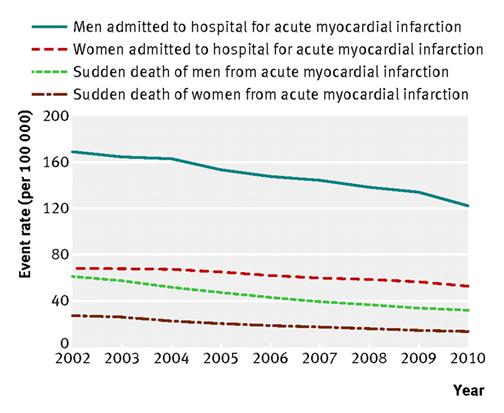
Among the more outrageous things that was claimed in this week's fanfare commemorating five years since the smoking ban was implemented in England was Laurie Penny's claim in the Independent that heart attack admissions had dropped 'as much as' 26 per cent since the ban started. Even Linda Bauld could only come up with a figure of 2.3 per cent for heart reductions in England (a figure too small to show that it has a single cause): 26 per cent was a figure that demands explanation.
The report by independent fact checking organisation Full Fact even provides an illustration:
This should show without any doubt that there is no appreciable difference in heart attack rates in relation to the smoking ban. The reporter declares herself at a loss to understand where Penny's figures have come from (a request from Full Fact had no reply at the time of writing). She then discusses various other heart attack reports, all of them small ('five US cites', etc.) giving results with smoking ban declines of up to 50 per cent, and mentions Linda Bauld's study linked above from the University of Bath. (No evidence is given that larger-scale studies convincingly undermine the smaller ones, by including cities where no drop heart attacks was recorded following the introduction of a smoking ban.)
The conclusion is stated with moderation:
Still, look on the bright side. Yet another body has acknowledged that the 'heart attack miracle' is an unsustainable fiction.
The report by independent fact checking organisation Full Fact even provides an illustration:
 |
| Source |
This should show without any doubt that there is no appreciable difference in heart attack rates in relation to the smoking ban. The reporter declares herself at a loss to understand where Penny's figures have come from (a request from Full Fact had no reply at the time of writing). She then discusses various other heart attack reports, all of them small ('five US cites', etc.) giving results with smoking ban declines of up to 50 per cent, and mentions Linda Bauld's study linked above from the University of Bath. (No evidence is given that larger-scale studies convincingly undermine the smaller ones, by including cities where no drop heart attacks was recorded following the introduction of a smoking ban.)
The conclusion is stated with moderation:
It is very hard to assess the accuracy of Ms Penny’s claim without first knowing her source. The research we have found from the NHS Information Centre shows at most a 22 per cent decline, although this only refers to fatalities. Among all incidents of heart attacks the reduction was a more modest 13 per cent. [emphasis added]Ms Penny's claim is so far from the available evidence that it is hard to escape the conclusion that she has not researched the material properly. This article does properly conclude: 'however it is noticeable that trends don't seem to have changed much since 2002', but then we read:
This suggests that there may be wider social and environmental factors that have also contributed to the fall, and singling out the impact of the smoking ban is a difficult process.Suggests? how about 'shows categorically', Full Fact?
Still, look on the bright side. Yet another body has acknowledged that the 'heart attack miracle' is an unsustainable fiction.
Thursday, 5 July 2012
Hands off our packs, say those that know
Like shopkeepers and the police. And others. Many outside government believe that plain packaging guarantees nothing but increased trafficking of illegal cigarettes: whether traded illegally or actually counterfeit.
Don't forget the public consultation, open till 10 July. A quick preview of the questions can be seen here.
Edit: deadline extended to 10 August.
Don't forget the public consultation, open till 10 July. A quick preview of the questions can be seen here.
Edit: deadline extended to 10 August.
Wednesday, 4 July 2012
Smoking rooms would lead to more restrictions outdoors, says Bish
The Publican's Morning Advertiser reports overwhelming support for a change in the law to allow support for smoking rooms in licensed premises.
Yet Nick Bish, CEO of the Association of Licensed Multiple Retailers warned against 'turning back the clock':
Publicans are forced by the smoking ban to ensure that the no smoking is observed, without compensation and on pain of dire penalties if they get it wrong (as this Irish publican discovered). Bish's members should demand better representation: Bish accepts as given that government is there to restrict smoking areas and will inevitably get its way if there is a fight.
Share prices tell much of the story. The smoking ban has caused huge damage. Perhaps HorecaClaim can help. But the issue needs proper leadership.
Yet Nick Bish, CEO of the Association of Licensed Multiple Retailers warned against 'turning back the clock':
“We need to be careful what we wish for – starting a debate on smoking rooms does not mean it will end there and would inevitably re-open discussions about restrictions in beer gardens, and no-smoking anywhere near the premises. That would turn customers off and the trade away,” he said.I appreciate that Nick Bish has a busy job to do – there are many other issues in the licensed trade than smoking – but he heads an organisation that opposes a plank of legislation that has ruined many in his sector and done pub values no favours at all. The thought that ASH might attempt to force an outdoor ban is interesting, but the whole premise of the ban is meant to be protecting workers from second-hand smoke exposure.
Publicans are forced by the smoking ban to ensure that the no smoking is observed, without compensation and on pain of dire penalties if they get it wrong (as this Irish publican discovered). Bish's members should demand better representation: Bish accepts as given that government is there to restrict smoking areas and will inevitably get its way if there is a fight.
Share prices tell much of the story. The smoking ban has caused huge damage. Perhaps HorecaClaim can help. But the issue needs proper leadership.
Tuesday, 3 July 2012
Flag hoisted on Fedcaf crusade against smoking ban

The tour (not the first undertaken on this boat) is to draw attention to the case against smoking bans in the hospitality sector. Taking part are Frederick Matthei and others from Fedcaf Belgium and HorecaClaim Europe, and Wiel Maessen from Forces and The International Coalition Against Prohibition.

Monday, 2 July 2012
Tobacco control industry: policy-led research newspeak
This one from Michael Siegel's blog. A study purported to investigate whether anti-smoking posters were effective in persuading people not to take up smoking. The findings were negative:
Siegel concludes, 'This is another example of how the anti-smoking movement has recently lost its science base in favor of a pre-ordained agenda'. Recently?
This is not unique. One of my favourite pages is from Cancer Research UK's Tobacco Advisory Group. It details research priorities and I have referred to it many times:
The study clearly states these findings: "The signs did not help recent quitters to stay quit or stop smokers from purchasing cigarettes at the current visit to the store."But the study concludes:
Talk about hiding in plain view. They know the graphic posters don't have the intended effect but are prepared to commission further studies to justify producing and using the posters."A policy requiring tobacco retailers to display graphic health warning signs increased awareness of health risks of smoking and stimulated thoughts about quitting smoking. Additional research aimed at evaluating the effect of tobacco control measures in the retail environment is necessary to provide further rationale for implementing these changes and countering legal challenges from the tobacco industry." [emphasis]
Siegel concludes, 'This is another example of how the anti-smoking movement has recently lost its science base in favor of a pre-ordained agenda'. Recently?
This is not unique. One of my favourite pages is from Cancer Research UK's Tobacco Advisory Group. It details research priorities and I have referred to it many times:
- The Tobacco Advisory Group (TAG) considers Project Grant applications for policy research and policy advocacy activities in tobacco control.TAG particularly funds research and activities that support:
- - Current UK policy priorities, e.g. see the 'Beyond Smoking Kills' report and the Tobacco Control plans of the four UK nations, especially:
- - Plain packaging of tobacco products
- - Greater tax and/or anti-smuggling measures in the UK
- - Monitoring the impact of NHS changes and/or promoting best practice in smoking cessation, mass media campaigns and local tobacco control activities
- - Health inequalities should be addressed in all projects.
Its terms of reference clearly exclude anyone with an open mind on the issue of tobacco control. The direction of policy is established and the researcher is invited to support it or not expect any funding.
California's Tobacco-Related Disease Research Program similarly has a clear policy agenda, as you would expect from its name. If you look at its research priorities (third menu tab), you will find that the priorities are set and your job as researcher is to find reasons to support it. Environmental Exposure needs:
Research that will advance policies to reduce environmental exposure to the toxic effects of tobacco smoke, tobacco smoke residue, cigarette butts, and other tobacco products.Regulatory science:
Research that will expand the scientific basis to inform the regulation of nicotine and tobacco products at the local, state and national levels
Tobacco industry influence:
Research that will advance the ability of communities throughout California to assess and limit the influence of the tobacco industry
and more.
Absent from any of these research needs is any concept that the science should lead the policy. It's all the wrong way round. Annual reports give an idea of the cost of some of these research grants.
As part of its regular 2010 funding cycle, The Scientific Advisory Committee recommended, and TRDRP awarded $12.7 million in 46 new grants at California non-profit research institutions.
As well as the issue of policy determining what is studied and how (rather than an open agenda leading to honest science and well grounded policy) there is an issue of policy being led by wealthy foundations funded from tobacco taxes. The tobacco taxes fund these studies, and this effectively binds researchers into supporting tobacco control, because tobacco control supports them.
All very unsatisfactory and I am grateful to Dr Siegel for reminding me of the issue – but like many I am curious how long it will take him to realise that tobacco control has not recently lost its science base in favour of policy-driven research.
Sunday, 1 July 2012
Counterfeit tobacco no more dangerous, says ASH
Defending plain packaging, Graham Jones MP hosts a piece from Action on Smoking and Health declaring that counterfeit tobacco is no more harmful:
Contraband is black market: illegally traded. It is a legal product on which tax has been evaded. It may also be counterfeit (illegally produced) but need not be.
Tobacco is a regulated product. This means that its ingredients are controlled. Counterfeit tobacco imitates a legal product but its contents are – who knows what?
The Canadian government source that this piece uses does not use the word 'counterfeit'. It discusses contraband tobacco and concludes rather pointlessly that its health effects are the same as those for legal tobacco, which is rather like comparing apples with apples. It stands to reason that legally traded tobacco and illegally traded tobacco will have comparable health effects, because they are essentially the same product.
There is no evidence that the tobacco under discussion is illegal – counterfeit. Even if there were evidence that the tobacco tested by the Canadian government in this particular report were 'only' as dangerous as legitimately traded tobacco, this result would not apply to all tobacco. The whole point of branding is that a particular combination of ingredients and preparation methods earns a trade mark, and can be identified. By definition this feature is absent from counterfeit tobacco.
It is hard not to conclude that ASH has failed to grasp any of the safety concerns about plain packaging, and even that its bosses have failed to grasp the point of branding. Any of Mr Jones's constituents in Haslingden and Hyndburn feel like pointing this out?
The Transcrime report argues that ‘counterfeit tobacco products have been proved to cause even more serious damage to human health’ than legal cigarettes. This is simply not true, indeed research by the Canadian government has concluded that contraband tobacco poses the same risk of harmful health effects as legal cigarettes. All smoked tobacco contains thousands of toxic substances many of which are carcinogenic. All smoked tobacco products are deadly.Without getting into detail it is hard to see how anyone can talk about 'counterfeit tobacco' as if it were a single commodity. The author seems to use the terms counterfeit and contraband interchangeably, and while it is a fair bet that much tobacco ticks both boxes they are not necessarily the same thing.
Contraband is black market: illegally traded. It is a legal product on which tax has been evaded. It may also be counterfeit (illegally produced) but need not be.
Tobacco is a regulated product. This means that its ingredients are controlled. Counterfeit tobacco imitates a legal product but its contents are – who knows what?
The Canadian government source that this piece uses does not use the word 'counterfeit'. It discusses contraband tobacco and concludes rather pointlessly that its health effects are the same as those for legal tobacco, which is rather like comparing apples with apples. It stands to reason that legally traded tobacco and illegally traded tobacco will have comparable health effects, because they are essentially the same product.
There is no evidence that the tobacco under discussion is illegal – counterfeit. Even if there were evidence that the tobacco tested by the Canadian government in this particular report were 'only' as dangerous as legitimately traded tobacco, this result would not apply to all tobacco. The whole point of branding is that a particular combination of ingredients and preparation methods earns a trade mark, and can be identified. By definition this feature is absent from counterfeit tobacco.
It is hard not to conclude that ASH has failed to grasp any of the safety concerns about plain packaging, and even that its bosses have failed to grasp the point of branding. Any of Mr Jones's constituents in Haslingden and Hyndburn feel like pointing this out?
Nicotine vaccine barking up wrong tree, says hypnotherapist
Vaccine-crazed, surely: the idea that one vaccination can stop nicotine cravings. Chris Holmes reports. The idea of vaccinating children against the possibility of enjoying nicotine later in life is frankly abusive: especially given the track records of similar medications based on the idea that you can medically block patients from getting pleasure from nicotine.
(I am not convinced that people don't get pleasure from nicotine, even after their first upsetting experience, and I can't understand from Chris's narration why people smoke when under stress. He says that people smoke for pleasure but that's not the full story. I am a very light smoker – seven or eight a year – and never got that nasty effect on the first attempt)
Vaccinating people according to official recommendations even on medical grounds (disease prevention) is already controversial. Adding vaccinations that will affect behaviour and preferences to the cocktail already administered to children is both medically and ethically hazardous.
(I am not convinced that people don't get pleasure from nicotine, even after their first upsetting experience, and I can't understand from Chris's narration why people smoke when under stress. He says that people smoke for pleasure but that's not the full story. I am a very light smoker – seven or eight a year – and never got that nasty effect on the first attempt)
Vaccinating people according to official recommendations even on medical grounds (disease prevention) is already controversial. Adding vaccinations that will affect behaviour and preferences to the cocktail already administered to children is both medically and ethically hazardous.
Also new: Freedom2Choose official blog
Catch it at birth: the official Freedom2Choose blog, launched on the fifth anniversary of England's smoking ban.

More coming soon!
More coming soon!
Subscribe to:
Posts (Atom)