As reported by the new-look Freedom2Choose.info website.
Since there is a legal dispute as to the competence of the Scottish Parliament on minimum pricing that will take years to sort out, the Scottish Licensed Trade Association would do well to focus its efforts in supporting our call for a review of the smoking ban. Paul Waterson and the Association clearly recognise the impact of the smoking ban on the hospitality trade.
Reviewing, and amending, the smoking ban is clearly within the competence of the Scottish Parliament.
Sunday, 28 October 2012


Tuesday, 23 October 2012
Passive smoking scare gets sillier and sillier (ask the EPA)
We are told again today that secondary smoke in confined places can impair breathing within twenty minutes. “The observed short-term effects of secondhand smoke tell us that even a short exposure is indeed harmful for normal airways.”
How do they know? By sending 'healthy' volunteers into such spaces.
Well, the Environmental Protection Agency has already declared secondary smoke to be a danger to health. But it has also declared all particulates under a certain size (PM2.5) to be dangerous to the same degree:
So what is the difference between secondary smoke and PM2.5 from any other source, in the eyes of EPA? None, it would seem.
Why yet another study telling us what we already know, that scientists have decreed that PM2.5 and secondary smoke are a danger to our health that we must never be subjected to, and against which regulations already exist. Especially since the research involves exposing subjects to these substances like the EPA does here.
Why don't they show us how effective air cleaning would be in such a situation? Now that would be worth doing. We might learn something that we don't already know.
How do they know? By sending 'healthy' volunteers into such spaces.
During this time, researchers measured participants’ total respiratory impedance, resistance, and reactance with the use of an impulse oscillometry, a noninvasive way of measuring the physical properties of respiratory movement during quiet breathing. Results showed that short-term exposure to concentrated secondhand smoke significantly and immediately impacted participants’ airways, invoking such physiologic changes as increased airway impedance and resistance. Participants showed no clinical signs or feelings of discomfort during the test.What did their test add to current knowledge?
Well, the Environmental Protection Agency has already declared secondary smoke to be a danger to health. But it has also declared all particulates under a certain size (PM2.5) to be dangerous to the same degree:
- There is no safe level of exposure to PM2.5;
- Inhaling PM2.5 can kill within hours of exposure; and that
- PM2.5 can also cause cancer…
So what is the difference between secondary smoke and PM2.5 from any other source, in the eyes of EPA? None, it would seem. Why yet another study telling us what we already know, that scientists have decreed that PM2.5 and secondary smoke are a danger to our health that we must never be subjected to, and against which regulations already exist. Especially since the research involves exposing subjects to these substances like the EPA does here.
Why don't they show us how effective air cleaning would be in such a situation? Now that would be worth doing. We might learn something that we don't already know.
Paradoxes of harm reduction
Michael Siegel has attacked robustly and deservedly a paper from the World Health Organization that recommends the banning of e-cigarettes (which it describes pompously as ENDS (electronic nicotine delivery systems, even though some are used without nicotine). The ground for banning them is that they 'resemble' smoking and so hinder the 'denormalisation' of smoking. Believers in tobacco harm reduction, including Michael Siegel, consider that e-cigarettes provide an alternative to smokers that gives them nicotine less hazardously, and that banning e-cigarettes will seriously hamper many people's efforts to stop smoking.
I share this position to the extent that clearly banning cigarettes will make it harder for many people to quit smoking if that is what they want to do. I can't get excited personally about quitting smoking as an objective. I smoke very occasionally, have never smoked heavily and never succeeded in getting addicted (seriously, an anti-smoker told me that I wasn't trying hard enough!). I feel that enough people do give up smoking to demonstrate that it is possible given the willpower and the right circumstances (hence am sceptical about the addiction narrative), but don't share the idea that everyone has to give up.
But for those people who do have this conviction that smokers must give up, it makes absolutely no sense to ban e-cigarettes, simply because of their physical resemblance to the 'real thing'. It leaves medicinal nicotine the only alternative available, and this is a choice that many people simply will not make. There is also abundant evidence of its abysmal success rate.
E-cigarettes are a new kid on the block, and represent unexpected competition in the nicotine market. The power and influence of pharmaceutical companies in supporting tobacco control could be a strong factor in the reluctance of groups like Action on Smoking and Health to embrace Tobacco Harm Reduction.
ASH Scotland appears to be sitting on the fence. But Deborah Arnott sees some of the merits of e-cigarettes, as she explains here. She warns that the end game of tobacco will not be possible unless smokers have a real alternative – and, in my view, she presents e-cigarettes as the only potential subtitute for smoked tobacco that can satisfy smokers. Her tone is: 'Like it or not, smokers will only take what they want'.
Her concerns are that e-cigarettes are not made by the right people. She fears that tobacco companies will buy them up only to stop making them. Those dastardly Chinese make sofas that burn you so they clearly can't be trusted. They have to be regulated to the hilt (and preferably made by someone who won't just phase them out). But they must be available.
It may not occur to Deborah Arnott that she has a conflict of interest to contend with:
I am not sure that aiming to destroy an industry sits well with an aim to reduce the harms from smoking. It is absurdly ambitious, with profound economic implications. Apart from anything else it is stretching a point to call this a charitable objective.
Ending nicotine addiction at all costs is also stupendously ambitious and may also not be beneficial to health (for instance a person may substitute a far more harmful addiction).
The whole crusade, ridiculously, specialises in a very limited area of health interest, and holds tobacco responsible for virtually everything that can go wrong with someone's health.
Unaccountably this anti-tobacco project has become a global monstrosity, with the result that the World Health Organisation creates its first (only?) multilateral global treaty around similar goals. So confused is the World Health Organisation about its myriad goals that it cannot bring itself to bless e-cigarettes, the most successful smoking cessation method to date, because they look so much like smoking cigarettes that they fear that the wrong message will go out to the public.
I share this position to the extent that clearly banning cigarettes will make it harder for many people to quit smoking if that is what they want to do. I can't get excited personally about quitting smoking as an objective. I smoke very occasionally, have never smoked heavily and never succeeded in getting addicted (seriously, an anti-smoker told me that I wasn't trying hard enough!). I feel that enough people do give up smoking to demonstrate that it is possible given the willpower and the right circumstances (hence am sceptical about the addiction narrative), but don't share the idea that everyone has to give up.
But for those people who do have this conviction that smokers must give up, it makes absolutely no sense to ban e-cigarettes, simply because of their physical resemblance to the 'real thing'. It leaves medicinal nicotine the only alternative available, and this is a choice that many people simply will not make. There is also abundant evidence of its abysmal success rate.
E-cigarettes are a new kid on the block, and represent unexpected competition in the nicotine market. The power and influence of pharmaceutical companies in supporting tobacco control could be a strong factor in the reluctance of groups like Action on Smoking and Health to embrace Tobacco Harm Reduction.
ASH Scotland appears to be sitting on the fence. But Deborah Arnott sees some of the merits of e-cigarettes, as she explains here. She warns that the end game of tobacco will not be possible unless smokers have a real alternative – and, in my view, she presents e-cigarettes as the only potential subtitute for smoked tobacco that can satisfy smokers. Her tone is: 'Like it or not, smokers will only take what they want'.
Her concerns are that e-cigarettes are not made by the right people. She fears that tobacco companies will buy them up only to stop making them. Those dastardly Chinese make sofas that burn you so they clearly can't be trusted. They have to be regulated to the hilt (and preferably made by someone who won't just phase them out). But they must be available.
It may not occur to Deborah Arnott that she has a conflict of interest to contend with:
 |
| Source (h/tip Jay) |
I am not sure that aiming to destroy an industry sits well with an aim to reduce the harms from smoking. It is absurdly ambitious, with profound economic implications. Apart from anything else it is stretching a point to call this a charitable objective.
Ending nicotine addiction at all costs is also stupendously ambitious and may also not be beneficial to health (for instance a person may substitute a far more harmful addiction).
The whole crusade, ridiculously, specialises in a very limited area of health interest, and holds tobacco responsible for virtually everything that can go wrong with someone's health.
Unaccountably this anti-tobacco project has become a global monstrosity, with the result that the World Health Organisation creates its first (only?) multilateral global treaty around similar goals. So confused is the World Health Organisation about its myriad goals that it cannot bring itself to bless e-cigarettes, the most successful smoking cessation method to date, because they look so much like smoking cigarettes that they fear that the wrong message will go out to the public.
Sunday, 21 October 2012
EPA human testing and the toxicity of PM2.5
I've just added this site to the sidebar. The video introduces the lawsuit:
As the video says, The Environmental Protection Agency is being sued for exposing human subjects to levels that greatly exceed its own daily exposure limits in a number of experiments, in which the subjects are exposed to – and not just any subjects but those who are particularly at risk. This has come to light since the hospitalisation of one of the subjects led to a FOI request that exposed data concerning many others. Those participating in the tests were not notified that the EPA considered that PM2.5 was something for which (just like secondary smoke) there is 'no safe level of exposure'. 'Particulate matter causes premature death. It doesn’t make you sick. It’s directly causal to you dying sooner than you should', says Lisa Jackson of the EPA (see video).
This whole scenario puts the EPA on a sticky wicket. They are lying about the PM2.5 being toxic, or they are lying to test participants by not revealing the full scale of the risks involve in taking part in the tests. They are also expected to explain the necessity for the tests, since PM2.5 is already regulated.
The condemnation of PM2.5 ('no safe level') is based on particle size, but it seems to stretch credibility to state that just because something is microscopic, it is necessarily more dangerous than something with a larger particles – particle size is only one factor in assessing toxicity. (In the EPA experiments, it is alleged that diesel exhaust was used.) I am not a chemist and cannot assess whether it is an important factor. I can understand finding small particles a particular danger as they are more easily absorbed into the body, but not how the EPA can exclude a reckoning of actual toxicity when reaching the conclusion that there is no safe level of something. It is indeed tempting to conclude that the EPA, in declaring that there is no safe level of exposure to PM2.5, is searching for excuses to regulate. (This discussion covers this assumption over about the first twenty minutes.)
My question is, if there is no safe level of PM2.5, how is there any justification of outdoor smoking bans, if all the background particulates are also so dangerous?
I look forward to more developments on this.
As the video says, The Environmental Protection Agency is being sued for exposing human subjects to levels that greatly exceed its own daily exposure limits in a number of experiments, in which the subjects are exposed to – and not just any subjects but those who are particularly at risk. This has come to light since the hospitalisation of one of the subjects led to a FOI request that exposed data concerning many others. Those participating in the tests were not notified that the EPA considered that PM2.5 was something for which (just like secondary smoke) there is 'no safe level of exposure'. 'Particulate matter causes premature death. It doesn’t make you sick. It’s directly causal to you dying sooner than you should', says Lisa Jackson of the EPA (see video).
This whole scenario puts the EPA on a sticky wicket. They are lying about the PM2.5 being toxic, or they are lying to test participants by not revealing the full scale of the risks involve in taking part in the tests. They are also expected to explain the necessity for the tests, since PM2.5 is already regulated.
The condemnation of PM2.5 ('no safe level') is based on particle size, but it seems to stretch credibility to state that just because something is microscopic, it is necessarily more dangerous than something with a larger particles – particle size is only one factor in assessing toxicity. (In the EPA experiments, it is alleged that diesel exhaust was used.) I am not a chemist and cannot assess whether it is an important factor. I can understand finding small particles a particular danger as they are more easily absorbed into the body, but not how the EPA can exclude a reckoning of actual toxicity when reaching the conclusion that there is no safe level of something. It is indeed tempting to conclude that the EPA, in declaring that there is no safe level of exposure to PM2.5, is searching for excuses to regulate. (This discussion covers this assumption over about the first twenty minutes.)
My question is, if there is no safe level of PM2.5, how is there any justification of outdoor smoking bans, if all the background particulates are also so dangerous?
I look forward to more developments on this.
Wednesday, 17 October 2012
Airside smoking area at Aberdeen airport
Good. And I hope it's illegal. That is, indoors, so that smokers won't be subjected to the airport exhaust emissions that cloud all airports.
Did ASH Scotland see that one coming? Or are they to busy trying to protect Wales?
Did ASH Scotland see that one coming? Or are they to busy trying to protect Wales?
Scotsman declares smoking ban in cars 'a step too far'.
Read here.
The recommendation to ban smoking in cars is made on the basis of research by Aberdeen scientists (as the Evening Express declares proudly), at the Scottish Centre for Indoor Air, which found that:
And although I agree with the Scotsman's leader position on this, their report tells us,
The background to the story popping up last year was an announcement of a study carried out by SCIA (link above), which announced the dangers of smoking in cars, where concentrations of toxins were higher than the 'safe level' of outdoor air exposure recommended by the WHO. This is discussed here in some detail (thanks to Michael J. McFadden for assistance), but this part, concerning the relevance of outdoor exposure levels to measuring secondary smoke in cars, is the most damning:
The Scotsman is to be applauded for not supporting this move. There is no reason to support it.
LATE EDIT
I've just come across an account that contains a direct link to the SCIA study (pdf), with some interesting extracts.
The study also indulges in reinventing the EPA standards:
(Read on also about the SCIA's finding about 23, or 11, times as toxic as a smoky bar claim: 'our data do not support this claim nor the BMA's retraction'.)
The recommendation to ban smoking in cars is made on the basis of research by Aberdeen scientists (as the Evening Express declares proudly), at the Scottish Centre for Indoor Air, which found that:
levels of harmful pollutants were 11 times higher in “smoking” cars when compared with “non-smoking” cars.It seems odd, to say the least, to generalise about smoking cars, as if they all contained equal amounts of smoke, were all of the same size and all subject to the same variable conditions (same number of windows open, vents open to the same degree, and so on).
And although I agree with the Scotsman's leader position on this, their report tells us,
Some experts claim smoking in cars exposes non-smokers to high levels of second-hand smoke which has 23 times more toxins than a busy smoke-filled room. Previous studies have revealed at least three in ten smokers light up in their cars when there are other people present.The same critique can be applied here. There is no standard exposure in a room, which can vary in size, occupancy, air insulation and all other factors pertinent to exposure to contaminants. More significantly this reporting shows no awareness that the British Medical Journal apologised around a year ago for claiming that cars were 23 times more toxic than a bar. They issued an alternative statement: 'the concentration of toxins in a smoke-filled vehicle could be up to 11 times greater [yes, 11 times greater] than that of a smoky bar' (see this link). Quelle coincidence!
The background to the story popping up last year was an announcement of a study carried out by SCIA (link above), which announced the dangers of smoking in cars, where concentrations of toxins were higher than the 'safe level' of outdoor air exposure recommended by the WHO. This is discussed here in some detail (thanks to Michael J. McFadden for assistance), but this part, concerning the relevance of outdoor exposure levels to measuring secondary smoke in cars, is the most damning:
While it is true that according to agencies such as the US EPA that urban, automotive, and industrial air pollution has been shown to be unhealthy or even dangerous when it reaches higher levels for periods of 24 hours or more, it is also true that the EPA doesn’t set standards for FPM 2.5 for shorter periods because there is no sound medical reason to believe that shorter episodes of such exposures actually pose a threat to health. When the SCIA takes readings during car journeys that typically last less than several hours and tries to apply the EPA’s 24 hour standards to those readings, it is explicitly violating the very guidelines of the EPA itself. [These guidelines outlined in the linked post above]The Scottish Indoor Air Centre's aims are somewhat distressingly focussed on SHS levels, declaring that its priority is:
1. Increasing our understanding of exposure to secondhand smoke in homes and cars (particularly with respect to children’s exposure) and its health effects; exploring possible interventions to reduce exposure in these microenvironments. We believe that the provision of real-time exposure data to smokers is likely to be a very effective mechanism of behavioural modification. [Emphasis added]It is fully involved in the National Lottery-funded project Refresh and ASH Scotland in their bid to encourage smoke-free homes. Hence its emphasis on behavioural change.
The Scotsman is to be applauded for not supporting this move. There is no reason to support it.
LATE EDIT
I've just come across an account that contains a direct link to the SCIA study (pdf), with some interesting extracts.
Table 2 presents the descriptive statistics of the mean and maximum PM2.5 found during smoking and non-smoking journeys, while Figure 1 shows the time-weighted average (TWA) PM2.5 for each journey, by participant. PM2.5 concentrations in 3 of the non-smoking journeys exceeded the 25 μg/m3 WHO guidance level for indoor air [16], while this occurred in all smoking journeys for between 11 and 100% of the journey time (53% of the time, on average). [emphasis added]That was one result they didn't shout about. Even with a short car journey the levels of non-smoke contaminants can exceed the EPA 24-hour standard (but this time duration is, according to the standard, is too short to have health implications).
The study also indulges in reinventing the EPA standards:
We have used the WHO PM2.5 guidance level as a comparison as this as the WHO has recently stated that the value can be applied both to indoor and outdoor exposures [16]. The comparison to this guidance should be done with some caution as this health-based value is based on a 24 hour time-weighted average. Clearly the exposures during car journeys we have measured are all much shorter than a 24-h averaging period but given recent work suggesting that there may be no safe level of exposure to SHS [18] we think that the use of the WHO indoor air standards for PM2.5 is a reasonable health-based method of comparison. [emphasis added]Since the guideline explains carefully (para 28) how to calculate whether the EPA standard is valid for periods shorter than 24 hours this seems to be taking a liberty!
(Read on also about the SCIA's finding about 23, or 11, times as toxic as a smoky bar claim: 'our data do not support this claim nor the BMA's retraction'.)
Thursday, 11 October 2012
Technophobia rules in Scottish court as vending machines lose final appeal
The BBC and the Scotsman are among those reporting that Sinclair Collis have lost their case in the appeal court on vending machines in Scotland, with a result that the law scrapping them will be implemented.
What is it with these people! There is a ready made solution to the issue of under-age sales, namely the radio controlled vending machine (see demonstration here). The idea is very simple: you show the bar staff or other supervisor of the machine ID, and the bar staff activates the machine. Activation works for a single sale. No tokens are issued, to be sold on to kids or left lying about. What could possibly go wrong? Ask the Scottish Government:
It is worth noting that the Scottish Government celebrates the use of technology. Well, it says it does, and in certain contexts – such as 'telehealthcare' – it does. Let's hear it:
Let's remember that in taking away vending machines we are robbing kids of the most expensive way to get their hands on tobacco that exists in the marketplace. Any kid that can outsmart a vending machine is not going to be put off by their removal as a potential source, especially when, within a few years, kids will have no memories of them. They'll just go elsewhere for tobacco, which is what most of them were doing all along anyway.
What is it with these people! There is a ready made solution to the issue of under-age sales, namely the radio controlled vending machine (see demonstration here). The idea is very simple: you show the bar staff or other supervisor of the machine ID, and the bar staff activates the machine. Activation works for a single sale. No tokens are issued, to be sold on to kids or left lying about. What could possibly go wrong? Ask the Scottish Government:
The Scottish government argued that vending machines could not involve age checks - unlike sales of alcohol or fireworks. (BBC report, emphasis added)Well, that's fiddlesticks. Note 'could not': once again it suits the Scottish Government for the Scottish public to be worse than incompetent in exercising their responsibilities. Having worked in retail I can say there is no difference between checking ID for tobacco and checking it for alcohol. You just do it. It isn't difficult. The idea that it can't be done is medieval (rather like denying that secondary smoke can't be removed by applying the necessary technology).
It is worth noting that the Scottish Government celebrates the use of technology. Well, it says it does, and in certain contexts – such as 'telehealthcare' – it does. Let's hear it:
“The strategy will say that we will not be looking to deploy one solution for one problem. We will look to promote not just health but wellbeing. We will empower people to make services, [provide] information and [have] the wider community accessible to them and we have to deliver value,” said [the director of the Scottish Centre for Telehealth and Telecare].
Technology is an “enabler”, he explained.But not when the wrong people want to use it, to show that a restrictive piece of legislation is not needed. Then it simply doesn't work.
Let's remember that in taking away vending machines we are robbing kids of the most expensive way to get their hands on tobacco that exists in the marketplace. Any kid that can outsmart a vending machine is not going to be put off by their removal as a potential source, especially when, within a few years, kids will have no memories of them. They'll just go elsewhere for tobacco, which is what most of them were doing all along anyway.
Wednesday, 10 October 2012
ASH Scotland heralds Scottish quit rates again
What she says is this:
The delivery of 24,529 successful quits in the most deprived areas, measured at one month, means that each of Scotland’s 14 health boards is on course to achieve its Government target.She says that the quit target is a four-week period, and that success in meeting a Government target is measured on the number of people attaining it. This is hardly a recipe for encouraging sustained and serious quit attempts.
Back to costs.
The costs applied to official spending on NRT in Scotland are spread through the different health boards, with each health authority getting a top-up for smoking cessation medications. I intend to go through it all to gather the relevant data, but in the meantime the figures for Action on Smoking and Health are laid out here.
Smoking cessation is costed as follows:
NHS services: 1999/2000 £5 million; 2011/2012 £88.2 million. This has been increasing every year since 1999.
Nicotine replacement therapy: 1999/2000 £0.1 million; 2011/2012 £31.4 million. This peaked in the mid 2000s at £40 million.Whether or not trends followed an identical path in Scotland remains to be seen but the recent Scotsman report recorded a substantial rise in expenditure on NRT (staff costs were not even counted in that report) between 1999 and 2011. A general similarity in trends seems likely. And we saw the result in a recent post here: no change in the smoking rate that would reflect anything like the increased investment in the years since 1999. (Source.) And yet we keep being told how many are giving up (but reading the small print, it usually says 'quit attempts'.)

(Incidentally ASH Scotland is also soft-playing our challenge to the smoking ban, by refraining to make any comment whatever: please see and sign our petition if you haven't already done so!)
Controlling air quality is the route to reforming smoking bans
Controlling air quality is the route to reforming smoking bans first published by ThinkScotland
A DAY DOES NOT PASS when we are not asked to believe that a substance that most people were breathing since the beginning of time – smoke from ordinary plant materials – cannot be dealt with using modern air cleaning technology. For all the literature produced about it, there have been no medical cases where causation of medical conditions has been categorically proven to be due to low levels of exposure to tobacco smoke – a fact that has made many people question the need for any smoking ban, never mind one as comprehensive as the one found in Scotland.

Recently I proposed, on behalf of Freedom to Choose (Scotland)1, Scottish Parliament petition 01451 (Review of smoking ban) in order to challenge the assumptions of the health lobby, whose underlying motivation is to discourage smoking, that smoke is a toxin that no air cleaning technology can now or will ever be able to deal with safely, that there is no safe level of tobacco smoke, and, most definitely, that ventilation doesn't work.
Declaring that never will technology be able to clear the emissions from smoking seems to be the product of a mindset that does not want to enable smokers to be catered for either in the workplace or in recreational venues. The position of Freedom to Choose (Scotland) is that society's interests should be met rather than resisted. A blanket prohibition on smoking makes it harder for people to get together socially, and this affects people more in districts where concentrations of smokers are higher, aggravating inequalities in many ways.
It is generally true that in workplaces there is a principle that exposure to toxins is best avoided if at all possible, however it has also always been recognised that different workplaces involve different sorts of exposures to different levels of risks from different sources that are difficult to avoid without fundamentally challenging the nature of that workplace.
Asking schoolteachers and children to put up with classrooms that had tanning lamps installed and running in the ceilings would be unacceptable, yet we allow restaurants to install patio dining and drinking facilities where their workers are "forced" to expose themselves on a daily basis to the risk of malignant melanoma from solar radiation. Just as with any Class A carcinogen, there is, theoretically, no safe level of exposure to sunlight, yet we do not ban patio dining: we accept that workers can reduce the risk through partial protection provided by clothing, awnings, and sunscreen use.
We tolerate workers being exposed to levels of carbon monoxide and diesel exhaust products in indoor garages that would never be acceptable in a day-care centre: we do not simply ban indoor garages, however we accept the partial protection afforded by modern ventilation and air filtration technology.
Freedom to Choose (Scotland) is urging that the same sort of thought be applied to allowing pubs freedom of choice in deciding their own smoking policies based upon the wishes of their owners, workers, and clientele.
The ambient air, into which tobacco smoke is released, is not clean in the first place, making it well nigh impossible to isolate secondary smoke as the cause of sickness because pollutants contained in smoke are not limited to smoke. So not only is smoke not avoidable, but removing it still leaves air containing viruses, bacteria, spores, pollen, and plain old smells.
If the advocates of smoking bans are interested in clean air, their method of extracting one specific source of so-called ‘toxins’ (tobacco smoke) and leaving us with record-breaking pollutant levels in the general atmosphere lacks all logic. Their purpose is clearly and simply to discourage tobacco use by pinning all kinds of respiratory, heart and lung conditions on to smoking (or secondary smoke), in spite of the exposures to other toxins or adverse environmental conditions in the workplace, on the battlefield, or even in the home.
There are specific, measurable standards of occupational exposure to airborne contaminants, and permissible exposures vary between different jurisdictions. In saying that there is ‘no safe level’, the enemies of tobacco smoke declare that there is no point in measuring tobacco smoke which, because it is so lethal, one cannot be exposed to at all. In fact it is a mix of particles and gases, each constituent of which can be said to have a permissible safe level expressed in parts per million or billion. If people are smoking in a given air space and these permissible levels are not exceeded (for whatever reason: the room is large with a high ceiling, the window is open) there cannot be said to be a danger. When the level of smoking approaches impermissible levels, air-cleaning equipment can be used. Permissible standards are the guide regardless of whether or not a facility allows smoking.
Equipment that cleans air employs various technologies: extraction and filtration, ionising technology, and others: sometimes combined within a single unit. Any equipment that cleans air has to be maintained and serviced to ensure efficient running.
Any venue that wishes to permit smoking needs to ensure that its air-flow can cope with it. The industry should carry an audit of recommended equipment for all sizes of venue and price ranges but with specific air quality requirements in mind. Establishments that wish to allow smoking can then obtain the equipment, and once in place, patrons can be invited to smoke.
The result should be that ambient air, even with the addition of smoking, treated with air cleaning equipment, gives a cleaner result than ambient air in a non-smoking establishment where no treatment of air has taken place.
Of course upholding such standards would be an ongoing concern of the industry, with the assistance of environmental officers. But using local environmental officers to uphold and maintain air quality standards rather than simply hand out tickets to smokers is a far better use of local resources. This is about priorities.
Freedom to Choose (Scotland) believes that smoking bans damage people, increasing their isolation; and damage businesses, when they are helpless to alleviate a problem because of overzealous regulation. Taken to extremes, both isolation and business failure are measurably detrimental to health. With the rapidly increasing air pollution rates and increasing numbers of lung cancers found in non-smokers (Glasgow is one of the most polluted cities in the UK), sending people outside on to the street to smoke is worse than fiddling while Rome burns.
The power of the health lobby is a significant obstacle. We should be able to allow the hospitality industry (together with the appropriate government agency) to set standards for air quality, to give the air-cleaning industry the specifications it needs for improving ambient air, and in doing so create spaces with improved air quality where smoking can take place with the minimum of inconvenience to anyone else.
1 Freedom to Choose (Scotland) includes both smokers and non-smokers and receives no support from any industry.
1 Freedom to Choose (Scotland) includes both smokers and non-smokers and receives no support from any industry.
Sunday, 7 October 2012
Cost of stop smoking services rises to £2.2 million over 12 years. That's just Lothian
The smoking cessation gravy train rumbles on. The Scotsman reports a growth in annual expenditure on 'free nicotine patches and chewing gum' (a figure that presumably does not include associated personnel costs) between £102,000 and £2,200,000 over twelve years: a phenomenally swift increase. And we can see clearly the impact on smoking rates since 1999 in the graph below:
Not very impressive really, I think you will agree. Reports are still of 'attempts to quit', and the best (and only) results given in most reports show four-week quit rates. Amazingly the Scottish Government's report dated 25 September also shows 'a 31.5% increase in the number of items prescribed for smoking cessation [let's be precise!]', as if that were some kind of measure of success: in fact it appears that 31.5 per cent more treatments were dispensed in order to achieve the same results that were being achieved eleven years ago, at less than one twentieth of the cost. The smoking ban itself does not appear to have had any clear impact, other than to reverse the decline in smoking rates temporarily.
The latest draft budget for the health division (2013–2014) shows that the allocation for 'tobacco control' (a curious item for a health budget) is £12.3 million, unchanged from last year. Although not a large amount in budgetary terms it looks from this information as if it could be better used elsewhere in the economy – a point brought home particularly in these times of austerity, but use of public money in this way is never excusable.
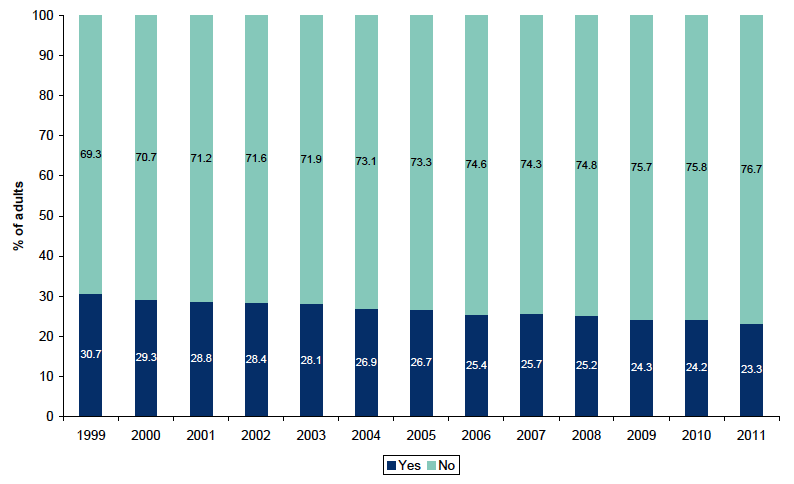 |
| Figure 10.1, Scottish Government SHS report (click to enlarge) |
The latest draft budget for the health division (2013–2014) shows that the allocation for 'tobacco control' (a curious item for a health budget) is £12.3 million, unchanged from last year. Although not a large amount in budgetary terms it looks from this information as if it could be better used elsewhere in the economy – a point brought home particularly in these times of austerity, but use of public money in this way is never excusable.
Saturday, 6 October 2012
Supreme Court hearing for tobacco display ban, Scotland
The latest hearings in the appeal of Imperial Tobacco against the tobacco display ban will be heard next month at the Supreme Court in London. ASH Scotland describes the scene thus:
She clearly expects a court victory, but one is tempted to conclude that she requires a vote against the tobacco companies in principle, rather than on the legal case presented. That would certainly not be a conclusion that reflected the purpose of the courts: victory should be on legal grounds, not on the basis of whether either side represents tobacco interests.
The UK Supreme Court has set a date to hear the legal challenge by Imperial Tobacco against the Scottish Government’s legislation to ban unstaffed tobacco vending machines and tobacco displays at point of sale. In response Sheila Duffy, Chief Executive of ASH Scotland, said:
'These public health measures were passed overwhelmingly by our democratically elected Parliament and have twice been upheld by the Scottish courts.
This is part of a growing international problem. We have heard from partner organisations from Australia to Uruguay that, having lost the battles over scientific evidence and public support, tobacco companies are resorting to delaying valid public health measures in the courts.
Tobacco kills half of its long-term consumers and Imperial Tobacco should accept the public, political and legal judgements that it cannot be treated like an ordinary product.
I am looking for the Supreme Court to rule against Imperial Tobacco and clear the way for Scotland to implement these important public health measures.'She seems to be making a fuss because the courts are being used exactly the way they should be designed to be used: for a company to challenge what it perceives as unfair legislation. But in the eyes of tobacco control a tobacco company that uses the courts in this way is somehow perverse and unreasonable. Her reasoning that tobacco cannot be seen like an 'ordinary product' misses the point that campaigns against other products will gain strength if this one prospers, as we see in the latest embarrassing escapade in the campaign to denormalise alcohol.
She clearly expects a court victory, but one is tempted to conclude that she requires a vote against the tobacco companies in principle, rather than on the legal case presented. That would certainly not be a conclusion that reflected the purpose of the courts: victory should be on legal grounds, not on the basis of whether either side represents tobacco interests.
Wednesday, 3 October 2012
Scottish pub closures blamed on supermarket prices: more expected
Supermarket beer prices are held responsible for pub closures and many more closures are expected.
Nothing if not opportunist I added the following comment to the Express;
This is the answer! Please sign and share.
Nothing if not opportunist I added the following comment to the Express;
I am author of petition 01451 at the Scottish Parliament, 'review the smoking ban' open for signatures until 22 October. The smoking ban was brought in with the promise that non-smokers would fill the pubs if smoke were no longer a problem. Someone didn't do their market research properly, as the pub's traditional customers were used to the differential between supermarket and pub prices but people the pubs were now trying to woo were not used to them. And many smokers no longer cared to pay the differential now that they were shunted outdoors throughout the evening.
Public pressure to bring in minimum pricing will not benefit pubs in the near term, because the European Union will fight them. Far better to take advantage of modern air standards and air cleaning technology and enable the hospitality trade to cater for smokers again.It is nothing short of madness to expect that minimum pricing will bring relief to the bar trade in the near future. Europe will fight it.
This is the answer! Please sign and share.
Subscribe to:
Posts (Atom)