Minutes from the August meeting of the Scottish Tobacco Control Alliance state that the next stage of national tobacco control in Scotland will not go out to public consultation, but only to tobacco control advocate groups.
On the bright side they will be putting on a ceilidh in the spring for fundraising purposes, according to the section on funding. Expect fewer free summits in the future.
H/tip to Jay and Eddie for the link.
Sunday, 30 September 2012


Wednesday, 26 September 2012
Norfolk Council insists on retaining tobacco investments
It is not entirely clear from this who (if anyone) is challenging Norfolk Council. But they have decided that changes to their investment policy would probably only come if the law changed – they are responsible for the health of pensions:
“This [smoking], I must admit, is anti-social but it’s a long way from child labour and so forth.
“Where does it end? We are here to earn, or the pension fund to earn, enough money for people to retire from work.”We are not in an age of plenty. I agree that Norfolk should keep its pensions fund in tobacco, since their responsibility is to get the best return. But if Norfolk Council relies on it and the Welsh government can take advantage of it, why should everyone else be prevented from taking financial benefits from the fact that people smoke. Anti-smokers and tobacco control advocates don't hesitate to complain at the faintest suggestion that their opponents might in some way benefit from tobacco funds, when they take a huge cut in tobacco sales. No one relies on the funds from tobacco more than the authorities that wish to denormalise smoking!
Tuesday, 25 September 2012
Better late than never!
The Scotsman report on PE 014515 appears in the ASH Scotland bulletin today.
The story is complemented with this digest of tobacco control legislation. This includes 'evaluation' of the smoking ban: of course, different from 'post-legislative scrutiny'. 'Evaluation' includes the (Times junk stat of the year 2007) 17 per cent reduction in heart attacks, and a reduction in smoke in bars of 86 per cent.
I am sure most air cleaning systems would achieve better than 86 per cent.
Well, a nod of acknowledgement from ASH Scotland is appreciated. A more detailed attack would also be illuminating.
The story is complemented with this digest of tobacco control legislation. This includes 'evaluation' of the smoking ban: of course, different from 'post-legislative scrutiny'. 'Evaluation' includes the (Times junk stat of the year 2007) 17 per cent reduction in heart attacks, and a reduction in smoke in bars of 86 per cent.
I am sure most air cleaning systems would achieve better than 86 per cent.
Well, a nod of acknowledgement from ASH Scotland is appreciated. A more detailed attack would also be illuminating.
Destroying tobacco livelihoods
The Framework Convention for Tobacco Control this year threatens sweeping measures that will specifically affect production in Malawi so as to jeopardise their tobacco trade. What kind of grasping megalomaniacs would impose this kind of regime on people with no alternative livelihoods, in the name of health?:
Two organisations that might have an impact in this situation: the International Labour Organization, which is a UN organisation and so officially probably shares some of the anti-tobacco agenda, but also probably contains some very experienced people. And the IUF: 'uniting food, farm and hotel workers worldwide', is an international union. Could they at least express an opinion? It seems incredible that such outrageous interference with national farming activities should be allowed by a supranational body with no democratic mandate.
This story has just popped up too.
During its meeting held in Geneva last week, the sub-committee has, among other things proposed that banning of minimum support prices and leaf auctions, restrict production by regulating the seasons in which tobacco can be grown, reduce the area allocated for tobacco farming, as well as ban financial or technical support for tobacco farmers.
WHO also wants all bodies connecting governments with growers to be dismantled.The tobacco growers association ITGA reported on this back in June, referring to articles 17 and 18 of the Framework Convention on Tobacco Control (see sidebar):
Article 17 Provision of support for economically viable alternative activities
Parties shall, in cooperation with each other and with competent international and regional intergovernmental organizations, promote, as appropriate, economically viable alternatives for tobacco workers, growers and, as the case may be, individual sellers.
Article 18 Protection of the environment and the health of persons
In carrying out their obligations under this Convention, the Parties agree to have due regard to the protection of the environment and the health of persons in relation to the environment in respect of tobacco cultivation and manufacture within their respective territories.Article 17 says nothing about strangling the industry without viable alternatives for the growers. The ITGA's position is that there are no viable alternatives, no research has been done, and the growers have been kept away from talks: evident in the proposal outlined above to dismantle cooperation between growers and governments.
Two organisations that might have an impact in this situation: the International Labour Organization, which is a UN organisation and so officially probably shares some of the anti-tobacco agenda, but also probably contains some very experienced people. And the IUF: 'uniting food, farm and hotel workers worldwide', is an international union. Could they at least express an opinion? It seems incredible that such outrageous interference with national farming activities should be allowed by a supranational body with no democratic mandate.
This story has just popped up too.
Monday, 24 September 2012
No comment from ASH Scotland on PE 01451?
After the Scotsman article on Friday detailing our petition I have been waiting all weekend for Sheila Duffy's response. She can usually be relied upon to make a robust rebuttal of anyone who challenges the wisdom of tobacco control in the pages of the Scotsman.
I've had to wait until today for the daily ASH Scotland news bulletin (not posted online yet), only to find that neither Friday's coverage at the Scotsman, nor Sunday's at the Scottish Sunday Express (which was not online, but they cover reports regularly that are not online) even made it to the daily news bulletin!
I wouldn't even mention this had I not found their coverage in the past to be pretty reflective of what's out there in the mainstream press: not all of it favourable to their cause.
Can it be that Sheila and her crew are lost for words?
I've had to wait until today for the daily ASH Scotland news bulletin (not posted online yet), only to find that neither Friday's coverage at the Scotsman, nor Sunday's at the Scottish Sunday Express (which was not online, but they cover reports regularly that are not online) even made it to the daily news bulletin!
I wouldn't even mention this had I not found their coverage in the past to be pretty reflective of what's out there in the mainstream press: not all of it favourable to their cause.
Can it be that Sheila and her crew are lost for words?
Sunday, 23 September 2012
Switzerland votes resoundingly against general smoking ban
The Swiss have voted against a federal smoking ban, according to the a report from the BBC (753 comments as of now, demonstrating that debate on this topic is still strong), Deutsche Welle, AGI.it, and the Bangladesh Daily Star also anticipated widespread rejection of smoking bans by the Swiss this morning.
Smoking is restricted in some areas, but the vote went against a nationwide ban, and attempts to make a ban general across Switzerland have failed in the past.
Smoking is restricted in some areas, but the vote went against a nationwide ban, and attempts to make a ban general across Switzerland have failed in the past.
Petition PE 01451 reported in Scottish Sunday Express
Another good write-up on the petition from Ben Borland in the Scottish Sunday Express:
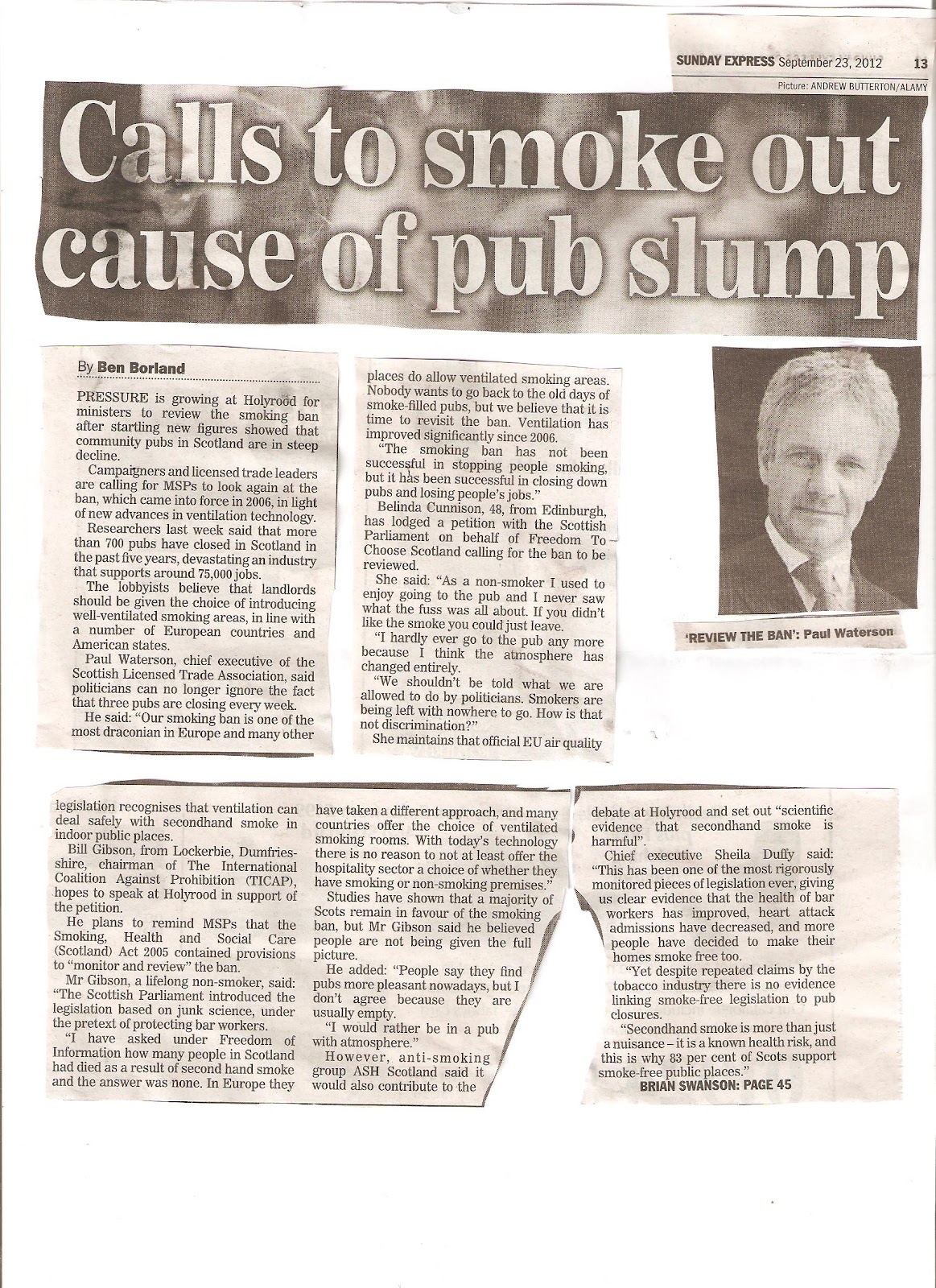 |
| Click to enlarge |
Sheila Duffy expects to provide 'scientific evidence that secondary smoke is harmful', which rather seems to miss the point of the petition. The petition refutes the notion that secondary smoke needs to be isolated and banned, rather than treated as just one of many airborne toxins. If all toxins are dealt with by setting air quality standards and applying technology where it is needed, there is no need for additional evidence about the toxicity of smoke. If it is so dangerous it will exceed the air quality standards, and air cleaning/ventilation will be applied.
She also refers to improvements in heart attack rates (supporting the 'junk science of the year' study by Professor Jill Pell announced to the world in 2007 and published in 2008), and disputes that pubs have suffered since the smoking ban was implemented. I was fully expecting a retaliation from Sheila Duffy to the Scotsman piece on the petition published on Friday: that may yet come.
Saturday, 22 September 2012
What a dilemma for Welsh Assembly Members
Next month AMs will be asked to water down Wales’ ban on smoking in public places by exempting film and TV productions, following commercial pressure from the creative industries.Oh dear, what will they do? ASH Wales is rightly concerned. A vote for jobs is just too dangerous a precedent. The pubs will be wanting one next ...
Scotsman reports on petition
Having submitted two previous petitions (both listed in the side bar) on the smoking ban, press attention was something I did not particularly expect. However the Scotsman has given this account, and it is a fair one:
The article also picks out another important point: removing toxins 'regardless of their source'. Why single out a single source of (relatively mild) pollutants when our whole environment is stuffed with regulation-breaking levels of them? It really doesn't make sense.
It makes no more sense than to say the doctrinaire solution of preventing smoking in public places will always prevail, when we have the collective will and the understanding required to obviate the need for a comprehensive ban.
So a huge thanks to Scott MacNab for the write-up in the Scotsman. It comes shortly after stories in the media about pub closures prompted by a report: 'Local pub, local hub? The future of the Scottish community pub', which you can download from here. The report does not flinch from the impact of the smoking ban on pubs, but its main concern is the duty escalator on beer, which has made it much more expensive for consumers in recent years. It describes Scottish pub closures in stark terms: 703 community closed in Scotland since 2007 (nearly one-fifth of the total). This cannot be doing Scottish social and community life any favours.
More soon.
Petition link here: please keep sharing, the closing date is 22 October!
The EC document that first prompted us to submit Petition 01451 is called EN 13779 – Ventilation for non-residential buildings. As the petition says, its section on 'good practice' does not call for a general smoking ban. but concerns the quality of air brought in from outside and the way exhaust air is released. I would be lying if I claimed to understand it all. But the point is that the rules are the same for tobacco smoke as for everything else. Indeed if you look at Table 3 (p. 17) you will see that, while smoking is treated differently from non-smoking, even smoking is described only as a 'moderate' level of pollution.A group called Freedom to Choose Scotland, which has previously lobbied for an end to the ban, says that new European Air Quality standards on indoor areas, published since the smoking ban, backs up its case.The group says these guidelines do not suggest good practice involves a ban on smoking. It is recognised as a pollutant, along with others, but ventilation requirements are set out to deal with these.The Petition states: “Ventilation, or clean air technology is a developing science and ventilation includes extraction and other methods of air cleaning,It adds: “Any effective air cleaning system removes toxins regardless of their source.”
The article also picks out another important point: removing toxins 'regardless of their source'. Why single out a single source of (relatively mild) pollutants when our whole environment is stuffed with regulation-breaking levels of them? It really doesn't make sense.
It makes no more sense than to say the doctrinaire solution of preventing smoking in public places will always prevail, when we have the collective will and the understanding required to obviate the need for a comprehensive ban.
So a huge thanks to Scott MacNab for the write-up in the Scotsman. It comes shortly after stories in the media about pub closures prompted by a report: 'Local pub, local hub? The future of the Scottish community pub', which you can download from here. The report does not flinch from the impact of the smoking ban on pubs, but its main concern is the duty escalator on beer, which has made it much more expensive for consumers in recent years. It describes Scottish pub closures in stark terms: 703 community closed in Scotland since 2007 (nearly one-fifth of the total). This cannot be doing Scottish social and community life any favours.
More soon.
Petition link here: please keep sharing, the closing date is 22 October!
Wednesday, 19 September 2012
In Switzerland, smoking rooms nearly over the experimental phase

 |
| Source |
On one side are coffee tables and oak chairs covered with leather. On the other side, there are Egg armchairs by Arne Jacobsen, a black Bakelite telephone and an old flea market record player. It hardly comes as a surprise that in this era of ever more restrictive smoking laws, when people often have to brave the elements just to take a drag, the Bon Génie would be an instant hit among smokers. Besides offering a roof, which is something smokers already appreciate, it also provides an environment with real style.
It is not, however, the only such place in Switzerland catering to the needs and tastes of smokers. Several other refined smoking rooms have opened in recent years, including the vast Cigar Lounge at the Schweizerhof Hotel in Bern, which is also inspired by the 1950s post-war style, and the more modern Fish Tank at the Lausanne Palace & Spa, which was refurbished two years ago. These successful examples are leading more and more hotels, such as the Beau Rivage Palace in Lausanne, to also consider smoking lounges.
“Today’s smoking lounges don’t have anything to do with the old smoky rooms for Havana cigar connoisseurs, or worse yet, the smoking areas in airports,” says Antoine Wasserfallen, a professor at the Hotel School in Lausanne. “They are the result of careful research in design and new technologies.”
Wasserfallen foresees that smoking lounges, still in their experimental phase, will evolve in the near future. “People like smoking lounges. But most of them aren’t profitable enough,” he says. “In some cantons, waited table service is banned, so you have to find solutions to make the sales easier, such as installing a serving hatch,” the expert notes.This smoking room is the initiative of someone who wanted an alternative to seeing smokers booted out into the cold, and believed that technology would deal with the smell of smoke, which some people find objectionable. They struggle to cope with food service being banned in some smoking rooms – but throughout the UK, this whole arrangement would be illegal, because smoke is so, so poisonous that even the most up-to-date technology can't deal with it.
Heaven forbid that anyone should be allowed to use their skills to address a problem (whether perceived or real) like secondary smoke. Tobacco control and all its friends in government have decreed that their way is the only way and it's not up for discussion. Non-negotiable. You cannot now, or ever, devise a system that will stop smoke from killing people. They have declared it to be impossible, now and for all time. (Flat earthers!)
Someone from the mainstream media called me today about our new petition 01451 (calling for a review of the smoking ban), which addresses this very issue. We know, and have known for some time, that the European Commission has air quality standards and techniques for ventilation, and tobacco smoke is dealt with here. It is absolutely pointless for the authorities to hide any longer behind the mantras, 'there is no safe level of secondary smoke', and 'ventilation doesn't work'.
It is up to those in office to devise systems that will work. Set standards, and if the standards are met there is no problem. If the standards are not met, that is what technology is for. And the technology will clean all the muck. Not just the muck from tobacco smoke, but all the other airborne pollution.
Is it really too much to ask, when humankind has learned to kill by remote control weaponry, to allow the use of technology to enable people to sit and have a drink together?
Tuesday, 18 September 2012
Novartis support for smoking bans spelled out
Hat tip to Dave Atherton for this link to Novartis's statement on public policy and advocacy.
Claiming an ethical basis for their activities they give the following on their involvement in smoking:
It is a favourite trick of the tobacco control industry to portray tobacco as 'big business' that is ruthlessly exploiting the little guy. But this company, and the entire pharmaceutical sector, is even bigger business. Somehow tobacco is unduly tarnished on the grounds that it is a big business, even though its rivals in the nicotine market are favoured and allowed to contribute to public policy. They have the ear of government, and can also engage in this kind of activity with the intelligentsia.
One result is that a whole lot of well meaning people with benevolent intentions can reduce people's capacity to make their own, usually faulty, choices about food, drink or smoking. The angle that is not acknowledged is the money that is made in the process. Not only does this benefit large corporations financially at the expense of smaller communities, but it also empowers them at the expense of these communities (probably on many issues beyond the lifestyle ones usually addressed here). Thanks to lobbying of this kind, we have the smoking ban and further restrictions, which have damaged pubs and recreational environments and will go on to damage shops. The whole fabric of economic society is at the mercy of those at the top.
I hesitate to call this kind of thing fascism (the collusion of corporations with the state?). But I still don't like it, because it looks to me as if the rightness of it is taken for granted by the whiter-than-white who engage in making decisions on behalf of everyone else, without apparently caring about the economic ramifications for the wider public – and failing to acknowledge their own dependence on the wider public for their survival.
Claiming an ethical basis for their activities they give the following on their involvement in smoking:
It is sometimes claimed that pharmaceutical companies exercise undue influence on governments and pursue commercial objectives without taking into consideration society's interests. We consider it our responsibility to provide decision-makers in government with the objective and fact-based information needed to formulate sound health policies.
Our lobbying and advocacy efforts focus on increasing access to the best medicines and to health information globally, while preserving incentives for research and innovation through competitive pricing. In addition, we believe that it is in the interest of companies striving for a leadership role in corporate citizenship to campaign for policies and regulations which favor ethical business conduct. [emphasis added]
[...]
An example of how Novartis is contributing proactively to the health policy and disease prevention debate in Europe is the question of smoking cessation. Tobacco is the single largest cause of avoidable death in the EU and over half a million people die each year in Europe as a direct or indirect result of smoking. It is estimated that 25% of all cancer deaths and 15% of all deaths in the EU could be attributed to smoking.
Until recently, efforts by European regulators to reduce smoking were concentrated mainly on the introduction of 'smoke free' legislation which prohibits smoking in certain environments. Novartis believes that greater public health benefits could be achieved through a policy of smoking cessation, coupled with increased duty on tobacco.
Novartis is campaigning to encourage policies to complement non-smoking environments with smoking cessation, with nicotine replacement therapy (NRT) as an important component of an EU strategy on tobacco control.
Together with various NGOs, we helped to foster a 'Smoke Free Partnership.' Our aim is to foster a policy and legislative environment which leads to better public health through strong tobacco control measures and increased availability of NRT in line with the WHO Framework Convention on Tobacco Control.It clearly acknowledges lobbying for conditions that favour its commercial objectives, namely NRT sales. Perhaps these well-meaning souls actually believe what they are saying, which is effectively that they are whiter than white, use only the best peer-reviewed evidence, care very much about citizens' health (and, of course only incidentally, can make a comfortable living into the bargain).
It is a favourite trick of the tobacco control industry to portray tobacco as 'big business' that is ruthlessly exploiting the little guy. But this company, and the entire pharmaceutical sector, is even bigger business. Somehow tobacco is unduly tarnished on the grounds that it is a big business, even though its rivals in the nicotine market are favoured and allowed to contribute to public policy. They have the ear of government, and can also engage in this kind of activity with the intelligentsia.
One result is that a whole lot of well meaning people with benevolent intentions can reduce people's capacity to make their own, usually faulty, choices about food, drink or smoking. The angle that is not acknowledged is the money that is made in the process. Not only does this benefit large corporations financially at the expense of smaller communities, but it also empowers them at the expense of these communities (probably on many issues beyond the lifestyle ones usually addressed here). Thanks to lobbying of this kind, we have the smoking ban and further restrictions, which have damaged pubs and recreational environments and will go on to damage shops. The whole fabric of economic society is at the mercy of those at the top.
I hesitate to call this kind of thing fascism (the collusion of corporations with the state?). But I still don't like it, because it looks to me as if the rightness of it is taken for granted by the whiter-than-white who engage in making decisions on behalf of everyone else, without apparently caring about the economic ramifications for the wider public – and failing to acknowledge their own dependence on the wider public for their survival.
Saturday, 15 September 2012
No new evidence? New petition launched
Four years ago the European Commission published an indoor air quality standard entitled:
Somehow in spite of having published this guidance on air quality, the European Commission has adopted an authoritarian stance recommending smoking bans in all indoor workplaces everywhere in Europe, as if there were no other solution available to a mild toxicity problem.
The smoking ban in Scotland is based on this extreme position, and the new petition PE 01451 asks the Scottish Parliament to request the Scottish Government to take seriously the existence of a European standard that should enable smoking rooms to operate.
A FOI request established that the Scottish Government had no record of this standard as of last summer, even though it was published in 2008. It is therefore new evidence, which the Parliament did not have access to when the legislation went through in 2005. All they had (or all they paid attention to) was the mantras 'there is no safe level of secondary smoke' and 'ventilation doesn't work'.
The document refers to smoking several times. One example:
The level of air quality required, and the method of classification applied shall be specified. Whether smoking is allowed or not is an important input. The necessary air flow rates to achieve the specified requirements shall be calculated. If nothing is declared, the rates of outdoor air per person for Indoor Air Quality category IDA 2 can be used as a default.The European Commission, the details of whose forthcoming (and rather savage) revised tobacco directive have been leaked to the press, have published evidence that tobacco smoke can be dealt with in the same way as any other toxin. In essence this is (1) establishing a safe air quality standard; (2) advising how to remove the toxins in cases where the air quality standard is breached.
Somehow in spite of having published this guidance on air quality, the European Commission has adopted an authoritarian stance recommending smoking bans in all indoor workplaces everywhere in Europe, as if there were no other solution available to a mild toxicity problem.
 |
| PE 01451, Review of smoking ban |
The smoking ban in Scotland is based on this extreme position, and the new petition PE 01451 asks the Scottish Parliament to request the Scottish Government to take seriously the existence of a European standard that should enable smoking rooms to operate.
A FOI request established that the Scottish Government had no record of this standard as of last summer, even though it was published in 2008. It is therefore new evidence, which the Parliament did not have access to when the legislation went through in 2005. All they had (or all they paid attention to) was the mantras 'there is no safe level of secondary smoke' and 'ventilation doesn't work'.
Thursday, 13 September 2012
The joke's on the Australian government
A tobacco company comes up with a slogan and marketing package to explain the plain packaging legislation to its customers. Not what I would even call a joke, just a fairly rational response to controversial legislation.
But some people just can't bear not having the last word.
But some people just can't bear not having the last word.
Another dopamine-blocker to stop enjoyment from smoking on the way
LONDON (Reuters) on a new drug from giants GlaxoSmithKlein:
An experimental drug that blocks certain brain receptors can reduce nicotine cravings in addicted rats and baboons - a finding researchers say could lead to new medicines to help people stop smoking for good.
The candidate drug, called GSK598809, belongs to a class of compounds that block a specific type of dopamine receptor in key areas of the brain linked to tobacco addiction.
[...]
Previous studies have shown that nicotine in tobacco smoke increases the release of the brain chemical dopamine in the ventral striatum, midbrain and pallidum - all parts of the brain thought to play a key role in getting smokers hooked.
Didn't they learn anything from Champix (other than that pharmaceutical drugs regardless of their track record are still considered to be a lower risk to health than smoking?)
Tuesday, 11 September 2012
Danes coerced into banning smokeless tobacco?
Reading this article, it certainly seems as if there are fewer arguments in favour than against, and yet the Danes have capitulated to EU demands to take smokeless tobacco off the shelves, after threats of legal action.
'Venstre, Dansk Folkeparti, Liberal Alliance and Enhedslisten all said that they would not support the government’s effort to ban snus.' One spokesman puts this down to tobacco industry lobbying, but all are agreed that removing the snus is counter-productive as a health measure. One of the two people quoted from the cancer charity that supports the measure felt that snus is growing in popularity. He felt that it should be banned even though it is less dangerous from his perspective than smoking – but it still causes mouth and throat cancers.
If this means that people are using smoking less tobacco, one would have thought that would please him – but it seems that quitting should be done only using approved pharmaceutical methods.
He also confesses: "We are afraid it will turn out like smoking hookahs [water pipes] ... No one would have believed 10 or 15 years ago that a habit practised by old Lebanese men would suddenly become a hit in western Europe."
'Venstre, Dansk Folkeparti, Liberal Alliance and Enhedslisten all said that they would not support the government’s effort to ban snus.' One spokesman puts this down to tobacco industry lobbying, but all are agreed that removing the snus is counter-productive as a health measure. One of the two people quoted from the cancer charity that supports the measure felt that snus is growing in popularity. He felt that it should be banned even though it is less dangerous from his perspective than smoking – but it still causes mouth and throat cancers.
If this means that people are using smoking less tobacco, one would have thought that would please him – but it seems that quitting should be done only using approved pharmaceutical methods.
He also confesses: "We are afraid it will turn out like smoking hookahs [water pipes] ... No one would have believed 10 or 15 years ago that a habit practised by old Lebanese men would suddenly become a hit in western Europe."
Monday, 10 September 2012
Lebanon ban, verdict unclear
Lebanon's ban in bars is fairly new, and has had mixed reactions.
Another article is written in a more defiant tone, entitled 'How will one get around the smoking ban?' It describes low-key protests. Tobacco smoking can be conducted outdoors as generally happens in Europe but a line seems to have been crossed with the banning of hookah.
Another article is written in a more defiant tone, entitled 'How will one get around the smoking ban?' It describes low-key protests. Tobacco smoking can be conducted outdoors as generally happens in Europe but a line seems to have been crossed with the banning of hookah.
The cigarette problem can be solved this way in Lebanon too, but what about the hookah (water pipe) which has become part and parcel of Arab culture despite its Persian roots?
Does the government have the right to stop those who enjoy making bubbles in a bottle, listening to the sound they make, and savoring the taste in a glass-fronted cafe, whose titillating mixture of privacy and exposure would have kept Freud busy for years.
How will the creative Lebanese people deal with this new reality? Will we witness a new legal innovation in the same vein as the “Murr extra floor”? [A twist in the law, introduced by ex-minister Michel Murr, which allowed people to add a floor to their buildings against regulations.]
There are several ideas and designs being discussed by hookah smokers on the internet. But they are still in the design stage. So, stay tuned and we will bring you the latest news on this hot topic.Certainly worth seeing how this develops. There is a clear sense that the Lebanese will find ways of doing what they want to do.
The OcTABber Resistance
For this I will direct you straight to blogger Pat Nurse who has launched this campaign: a reply to 'Stoptober', the government's stop smoking campaign for next month. More soon.

Sunday, 9 September 2012
Stoptober and its fallacies
The UK has an abundance of wealth to spend on silly stunts like this one.
Dame Sally Davies (CMO) urges us to realise that apart from the financial cost to the country, the cost to individuals is the real issue that people should be thinking about. She tells us that 1,260 people a day are admitted to hospital with smoking-related diseases, It is tiresome to point out what has been said many times: that smoking-related diseases are not necessarily caused by smoking. Consider this graph from the World Health Organisation (h/tip Fredrik Eich at Alternative Analysis). Given the low rate of lung cancer deaths in Mexico compared with Scotland, it would seem that there many factors at play other than smoking.

(Legend reads: blue, approximate population in hundreds ages 70–74; orange, deaths from lung cancer ages 70–74.)
In explaining any respiratory problems resulting from air pollution, the burning of fossil fuels merits consideration, especially in the light of reports that UK levels of such emissions have broken European guidelines for years. Only Dame Sally Davies knows why smoking is such a focus of attention, rather than extraordinary levels of emissions, and why the medical establishment repeatedly refers to smoking as a 'preventable cause' of cancer, when considered on a population-wide basis it is not preventable (certainly not more than most other causes of cancer), nor is it necessarily an exceptionally significant cause of cancer or other 'smoking-related' diseases. Do the funders of studies on tobacco allow researchers to conclude that fossil fuel emissions are a factor in respiratory and heart health?
Dame Sally Davies (CMO) urges us to realise that apart from the financial cost to the country, the cost to individuals is the real issue that people should be thinking about. She tells us that 1,260 people a day are admitted to hospital with smoking-related diseases, It is tiresome to point out what has been said many times: that smoking-related diseases are not necessarily caused by smoking. Consider this graph from the World Health Organisation (h/tip Fredrik Eich at Alternative Analysis). Given the low rate of lung cancer deaths in Mexico compared with Scotland, it would seem that there many factors at play other than smoking.
(Legend reads: blue, approximate population in hundreds ages 70–74; orange, deaths from lung cancer ages 70–74.)
In explaining any respiratory problems resulting from air pollution, the burning of fossil fuels merits consideration, especially in the light of reports that UK levels of such emissions have broken European guidelines for years. Only Dame Sally Davies knows why smoking is such a focus of attention, rather than extraordinary levels of emissions, and why the medical establishment repeatedly refers to smoking as a 'preventable cause' of cancer, when considered on a population-wide basis it is not preventable (certainly not more than most other causes of cancer), nor is it necessarily an exceptionally significant cause of cancer or other 'smoking-related' diseases. Do the funders of studies on tobacco allow researchers to conclude that fossil fuel emissions are a factor in respiratory and heart health?
Friday, 7 September 2012
On those who find non-communicable diseases a greater priority than infectious ones
The story is here. I find it quite hard to understand how anyone can prioritise non-communicable diseases over most urgent health problems. They don't spread, unlike communicative diseases. Surely this must be an important consideration. Other health related issues at the seminar under discussion were hunger, water and armed conflict.
All of these provide more immediately life-threatening scenarios, not only for individuals but also for families and communities. I can't seem to use that phrase now without reflecting how it has been over-used by people discussing top-down social management policies but these things are real in the wider world. Water and food shortages and infrastructure damaged by warfare all present more dangers to lives, including young lives (those of breadwinners).
Non-communicative diseases do not endanger the lives around sufferers in the same unpredictable way as communicable diseases. I am not trying to diminish their seriousness for those afflicted but when thinking of aid budgets and whole populations it surely makes more sense to treat illnesses that can be passed on to others, and to resolve food and water problems before tackling non-communicative diseases.
An economist, Rachel Nugent, fails to convince laureates at the Copenhagen Consensus that NCDs should swallow up most of the hypothetical aid budget. Richard Smith of the BMJ gives her account of what happened, and has a dim view of the laureates' conclusions about the most important spending priorities:
Another issue with non-communicable diseases is that they are usually blamed on lifestyle factors. As we can see from Morton Satin (comments on the BMJ piece) there is dispute about the information given to the laureates about salt consumption, and Nugent's proposal about tobacco tax certainly also has a dogmatic route. (She claims that there is historic evidence that raising taxes produced health dividends – even if there is truth in this claim, it doesn't mean it is replicable in perpetuity.)
The C3 website, of which Richard Smith is an unpaid trustee, shows its activities in relation to preventative health, for example the workplace page, which tells us that C3 has many corporate partners including Unilever. Unliver has a whole page dedicated to it at Corporate Watch, which mentions its bad environmental record as well as various exploitative practices, before going on to explain its strategy to campaign on healthy eating in order to offset criticism of its unhealthy food output. Mars is another corporate partner of C3 on occupational health, and local readers will remember how it disowned the practice of deep-frying Mars bars.
My acquaintance with C3 is less than 12 hours old. But I am suspicious of the emphasis on non-communicable diseases while other more deadly perils persist.
All of these provide more immediately life-threatening scenarios, not only for individuals but also for families and communities. I can't seem to use that phrase now without reflecting how it has been over-used by people discussing top-down social management policies but these things are real in the wider world. Water and food shortages and infrastructure damaged by warfare all present more dangers to lives, including young lives (those of breadwinners).
Non-communicative diseases do not endanger the lives around sufferers in the same unpredictable way as communicable diseases. I am not trying to diminish their seriousness for those afflicted but when thinking of aid budgets and whole populations it surely makes more sense to treat illnesses that can be passed on to others, and to resolve food and water problems before tackling non-communicative diseases.
An economist, Rachel Nugent, fails to convince laureates at the Copenhagen Consensus that NCDs should swallow up most of the hypothetical aid budget. Richard Smith of the BMJ gives her account of what happened, and has a dim view of the laureates' conclusions about the most important spending priorities:
They ranked “Bundled micronutrient interventions to fight hunger and improve education” top, and the next four priorities were all about countering infectious disease. Vaccination against hepatitis B (9), drugs for patients with heart attacks (10), and salt reduction (11) all, however, came in the top 16 that would be funded. The polypill came in at 19 and tobacco taxation, the top choice of Nugent’s team, at 22.
Why they chose these 16 is not explained, but a sense that they thought of some people, particularly children, as more deserving seemed to be one explanation. It certainly wasn’t only the numbers that decided them, said Nugent. When you listen to them ask questions, she continued, you realise that they aren’t that different from anybody else. They are driven by anecdote, and there is always a bias towards the status quo, which favours action on infectious disease over NCD.The idea that infectious diseases might require resources more urgently than infectious ones is written off as some kind of immature knee-jerk tabloid sensationalist response and a 'bias to the status quo'. And where did the idea of deserts have anything to do with it ... surely the point is to limit damage within communities and this means tackling health problems that are likely to spread quickly.
Another issue with non-communicable diseases is that they are usually blamed on lifestyle factors. As we can see from Morton Satin (comments on the BMJ piece) there is dispute about the information given to the laureates about salt consumption, and Nugent's proposal about tobacco tax certainly also has a dogmatic route. (She claims that there is historic evidence that raising taxes produced health dividends – even if there is truth in this claim, it doesn't mean it is replicable in perpetuity.)
The C3 website, of which Richard Smith is an unpaid trustee, shows its activities in relation to preventative health, for example the workplace page, which tells us that C3 has many corporate partners including Unilever. Unliver has a whole page dedicated to it at Corporate Watch, which mentions its bad environmental record as well as various exploitative practices, before going on to explain its strategy to campaign on healthy eating in order to offset criticism of its unhealthy food output. Mars is another corporate partner of C3 on occupational health, and local readers will remember how it disowned the practice of deep-frying Mars bars.
My acquaintance with C3 is less than 12 hours old. But I am suspicious of the emphasis on non-communicable diseases while other more deadly perils persist.
Thursday, 6 September 2012
Of smoking bans and beds
This morning on BBC Scotland, Kaye Adams put forward the discussion proposed in Tasmania to ban smoking completely to anyone born in the twenty-first century. It's clearly not part of her working life to be having to confirm people's ages by ID on an ongoing basis from 2018 on. The idea of having to ID people of 50 and 60 years old in a few decades hasn't occurred to Kaye, but she has a touching faith that 'out of sight is out of mind', and that people who are under 13 today simply won't grow up in the expectation that people will smoke. This is in spite of the tendency, which anti-smokers accept, that people generally start smoking before the age of legal purchase.
Kaye found herself in a minority as most callers to the programme opposed it.
More stories of interest: one, the recent research on bed-blocking in Scottish hospitals. It is hard to open a Scottish newspaper these days without finding some evidence of funding problems in the health service. Admittedly the near-one million pounds going to ASH Scotland on an annual basis would not go far in funding children's wards, for example. But the general theme is that non-urgent spending on issues that have been created by specific budgets displaces urgent funding needed for practical purposes on the ground.
On the subject of beds, this story popped up today from Tanzania: namely a report of tobacco company donations of hospital beds. In 'enlightened' Western Europe, this would never be allowed. One would hope that tobacco companies would not gain undue influence in Tanzanian society following such donations as the anti-smoking communities have here, even though anti-smoking communities don't donate many hospital beds! (Perhaps they would claim that their efforts are freeing up hospital beds, but such a claim would be hard to prove.)
Finally in the Lebanon a BBC report gives a divided picture of the public reception of smoking bans, which opens by putting the smoking ban issue in some perspective:
This piece even describes the anti-smoker interviewed in the piece as 'griping'. Well done Matt Nash for some balanced reporting.
Kaye found herself in a minority as most callers to the programme opposed it.
More stories of interest: one, the recent research on bed-blocking in Scottish hospitals. It is hard to open a Scottish newspaper these days without finding some evidence of funding problems in the health service. Admittedly the near-one million pounds going to ASH Scotland on an annual basis would not go far in funding children's wards, for example. But the general theme is that non-urgent spending on issues that have been created by specific budgets displaces urgent funding needed for practical purposes on the ground.
On the subject of beds, this story popped up today from Tanzania: namely a report of tobacco company donations of hospital beds. In 'enlightened' Western Europe, this would never be allowed. One would hope that tobacco companies would not gain undue influence in Tanzanian society following such donations as the anti-smoking communities have here, even though anti-smoking communities don't donate many hospital beds! (Perhaps they would claim that their efforts are freeing up hospital beds, but such a claim would be hard to prove.)
Finally in the Lebanon a BBC report gives a divided picture of the public reception of smoking bans, which opens by putting the smoking ban issue in some perspective:
So far this summer, the country has dealt with gunbattles in Beirut, warring Sunni and Alawite neighbourhoods in Tripoli, waves of kidnappings, an increase in bank robberies, untold numbers of tyres burned by angry residents blocking roads, and up to 12-hour rolling blackouts linked to an employee strike at the state-owned electricity company.
Yet on Monday, the authorities turned their attention to banning smoking inside restaurants, cafes, pubs and nightclubs.It finishes by describing a demonstration:
Along with the Syndicate of Owners of Restaurants, Cafes, Nightclubs and Pastries, they were demanding amendments to the law to allow smoking in some establishments.Considering the day-to-day inconveniences experienced in this community, the syndicate might have good cause to fear uneven and unfair implementation of the ban.
This piece even describes the anti-smoker interviewed in the piece as 'griping'. Well done Matt Nash for some balanced reporting.
Wednesday, 5 September 2012
Not equal under the law under smoking restrictions
The latest smoking story to hit the Scottish broadsheets tells how the Scottish Court Service has banned its employees from smoking in front of the court building. Sorry, was that a request or a unilateral change to conditions of employment? not too sure:
Well, quite.
And doesn't this show how anti-smoking restrictions divide those that have freedom from those that don't? Employees in a building are at the mercy of their employers, but those who are self-employed are not in a contract with an employer.
And before anyone points out that this is not about a law – no it isn't. But the law also hits those at the bottom of the income heap harder than those at the top. Who is more likely to be dismissed for transgressing the smoking ban? of course, it is the employee who is cheaper and easier to replace and probably less likely to sue for unfair dismissal. When you employ a successful professional, you won't want the expense of dismissing that person and having to appoint someone else because of what seems like a trivial issue. But for those at the bottom of the pile, isn't the smoking ban just another useful rule to keep them in order?
It's supposed to be about reducing health inequalities, isn't it? but while the children of the stockbroker play outside in the garden, the children of the checkout worker get to go to the play park, if their parents can cope with not being able to smoke when they get there. This is making it harder, not easier, to iron out inequalities.
The (so-called) Labour Party did its members a grave dis-service by supporting the war on smokers and pretending this was in the interests of workers. From destroying many of their social outlets, to treating them as drones who must stop smoking in order to address health inequalities, this and similar laws treat people, not as autonomous beings responsible for their own welfare, but as social statistics.
Sheila Duffy, predictably, applauds the outdoor restrictions of the Scottish Court Service, claiming that they will protect the public from exposure, and praises them for going beyond the letter of the law. 'Nuff said.
The Herald covers this story here.
The Scottish Court Service has told lawyers and their staff to stop smoking outside the Court of Session, Edinburgh, and use a designated shelter.Whatever. Solicitors working in the building are not obliged to follow the same rules as employees. Althouth they have been requested to accept the restriction on smoking in front of the building Donald Findlay, one of the better known local solicitors, gives his views: 'until somebody shows me a law which I am breaking, I will adopt my usual policy on these things and do what I like within the law'.
Well, quite.
And doesn't this show how anti-smoking restrictions divide those that have freedom from those that don't? Employees in a building are at the mercy of their employers, but those who are self-employed are not in a contract with an employer.
And before anyone points out that this is not about a law – no it isn't. But the law also hits those at the bottom of the income heap harder than those at the top. Who is more likely to be dismissed for transgressing the smoking ban? of course, it is the employee who is cheaper and easier to replace and probably less likely to sue for unfair dismissal. When you employ a successful professional, you won't want the expense of dismissing that person and having to appoint someone else because of what seems like a trivial issue. But for those at the bottom of the pile, isn't the smoking ban just another useful rule to keep them in order?
It's supposed to be about reducing health inequalities, isn't it? but while the children of the stockbroker play outside in the garden, the children of the checkout worker get to go to the play park, if their parents can cope with not being able to smoke when they get there. This is making it harder, not easier, to iron out inequalities.
The (so-called) Labour Party did its members a grave dis-service by supporting the war on smokers and pretending this was in the interests of workers. From destroying many of their social outlets, to treating them as drones who must stop smoking in order to address health inequalities, this and similar laws treat people, not as autonomous beings responsible for their own welfare, but as social statistics.
Sheila Duffy, predictably, applauds the outdoor restrictions of the Scottish Court Service, claiming that they will protect the public from exposure, and praises them for going beyond the letter of the law. 'Nuff said.
The Herald covers this story here.
Sunday, 2 September 2012
2032 could see end of UK smoking
One wonders what convoluted calculations might have produced this prediction. But all it is, is a prediction stated by Professor John Britton, a career tobacco control advocate, that the anti-smoking community can eradicate smoking 'within 20 years'.
Adding, 'Andrew Lansley could make himself a legacy greater than almost any other Health Secretary in history', Britton opines that in spite of growing austerity and increasing strains on the NHS, the British public will laud Lansley for a prediction to eradicate smoking, even though he will not be Health Secretary
for nearly long enough to see this prediction out.
Adding, 'Andrew Lansley could make himself a legacy greater than almost any other Health Secretary in history', Britton opines that in spite of growing austerity and increasing strains on the NHS, the British public will laud Lansley for a prediction to eradicate smoking, even though he will not be Health Secretary
for nearly long enough to see this prediction out.
Saturday, 1 September 2012
Research on the effects of smoking
A headline today states Tobacco smoke tied to flu complications in kids – another story written to suggest that correlation and causation are the same thing. I have the feeling that the proportion of children admitted to hospital with flu symptoms must be quite small and I am quite sure that we are not being given other correlations, such as links with deprivation.
News like this comes out regularly and plentifully. It is hard to escape the conclusion that good money is being spent on studies on every single aspect of smoking, and it is hard to see what purpose it serves other than bolstering a view that tobacco is a dangerous legal substance and attempts to restrict its use are justified. ASH Scotland publishes a daily bulletin, with a rundown of the latest tobacco research added every Friday: this week there were over 50 studies under 29 headings. This means not far off three thousand studies on an annual basis.
This seems a lot of research into smoking and one can only wonder how much has clinical rather than political value – once again I link to this page from Cancer Research UK, where they say clearly enough that research conclusions should encourage further restrictions on smoking in order to qualify for a grant. It also states that most research grants come in at between £20,000 and £40,000. Of course they don't fund all the studies on tobacco, but one gets a sense of the huge amount of money going into this kind of research.
My range of experience does not allow me to make sense of an article entitled 'Interaction between Smoking and HLA-DRB1*04 Gene Is Associated with a High Cardiovascular Risk in Brazilian Amazon Patients with Rheumatoid Arthritis'. Is it designed to encourage anti-tobacco policies in the Brazilian Amazon? Or does it have any clinical relevance?
News like this comes out regularly and plentifully. It is hard to escape the conclusion that good money is being spent on studies on every single aspect of smoking, and it is hard to see what purpose it serves other than bolstering a view that tobacco is a dangerous legal substance and attempts to restrict its use are justified. ASH Scotland publishes a daily bulletin, with a rundown of the latest tobacco research added every Friday: this week there were over 50 studies under 29 headings. This means not far off three thousand studies on an annual basis.
This seems a lot of research into smoking and one can only wonder how much has clinical rather than political value – once again I link to this page from Cancer Research UK, where they say clearly enough that research conclusions should encourage further restrictions on smoking in order to qualify for a grant. It also states that most research grants come in at between £20,000 and £40,000. Of course they don't fund all the studies on tobacco, but one gets a sense of the huge amount of money going into this kind of research.
My range of experience does not allow me to make sense of an article entitled 'Interaction between Smoking and HLA-DRB1*04 Gene Is Associated with a High Cardiovascular Risk in Brazilian Amazon Patients with Rheumatoid Arthritis'. Is it designed to encourage anti-tobacco policies in the Brazilian Amazon? Or does it have any clinical relevance?
Subscribe to:
Posts (Atom)